

1.5 Binding Energy of Nucleus
5
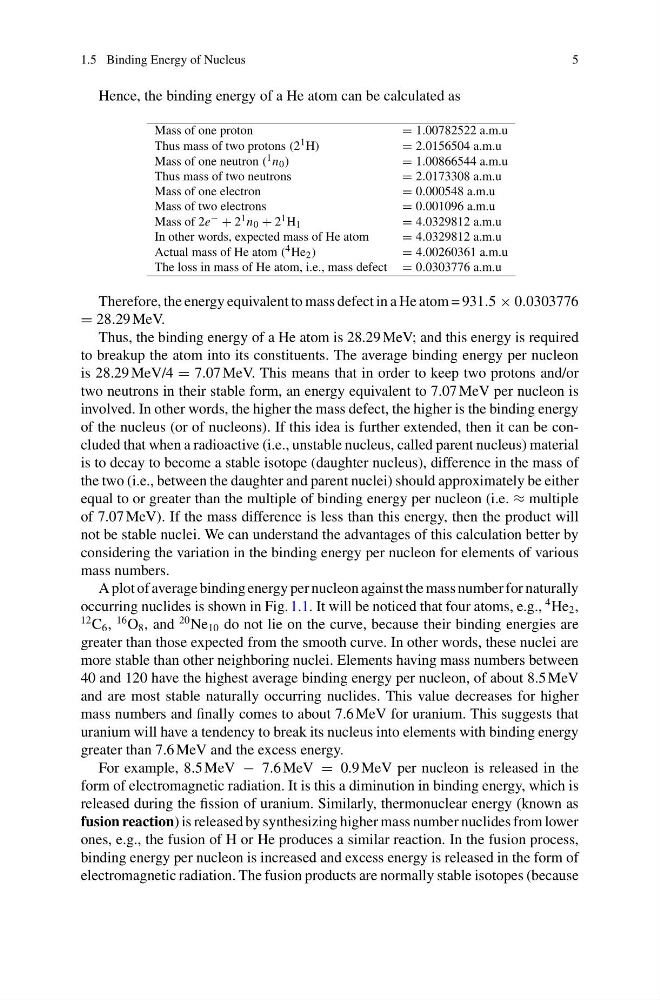
Hence, the binding energy of a He atom can be calculated as
Mass of one proton
= 1.00782522 a.m.u
Thus mass of two protons (2 1 H)
= 2.0156504 a.m.u
Mass of one neutron ( 1 n 0 )
= 1.00866544 a.m.u
Thus mass of two neutrons
= 2.0173308 a.m.u
Mass of one electron
= 0.000548 a.m.u
Mass of two electrons
= 0.001096 a.m.u
Mass of 2e − + 2 1 n 0 + 2 1 H 1
= 4.0329812 a.m.u
In other words, expected mass of He atom
= 4.0329812 a.m.u
Actual mass of He atom ( 4 He 2 )
= 4.00260361 a.m.u
The loss in mass of He atom, i.e., mass defect = 0.0303776 a.m.u
Therefore, the energy equivalent to mass defect in a He atom = 931.5 × 0.0303776
= 28.29 MeV.
Thus, the binding energy of a He atom is 28.29 MeV; and this energy is required
to breakup the atom into its constituents. The average binding energy per nucleon
is 28.29 MeV/4 = 7.07 MeV. This means that in order to keep two protons and/or
two neutrons in their stable form, an energy equivalent to 7.07 MeV per nucleon is
involved. In other words, the higher the mass defect, the higher is the binding energy
of the nucleus (or of nucleons). If this idea is further extended, then it can be concluded that when a radioactive (i.e., unstable nucleus, called parent nucleus) material
is to decay to become a stable isotope (daughter nucleus), difference in the mass of
the two (i.e., between the daughter and parent nuclei) should approximately be either
equal to or greater than the multiple of binding energy per nucleon (i.e. ≈ multiple
of 7.07 MeV). If the mass difference is less than this energy, then the product will
not be stable nuclei. We can understand the advantages of this calculation better by
considering the variation in the binding energy per nucleon for elements of various
mass numbers.
A plot of average binding energy per nucleon against the mass number for naturally
occurring nuclides is shown in Fig. 1.1. It will be noticed that four atoms, e.g.,
4 He 2 ,
12 C 6 ,
16 O 8 , and
20 Ne 10 do not lie on the curve, because their binding energies are
greater than those expected from the smooth curve. In other words, these nuclei are
more stable than other neighboring nuclei. Elements having mass numbers between
40 and 120 have the highest average binding energy per nucleon, of about 8.5 MeV
and are most stable naturally occurring nuclides. This value decreases for higher
mass numbers and finally comes to about 7.6 MeV for uranium. This suggests that
uranium will have a tendency to break its nucleus into elements with binding energy
greater than 7.6 MeV and the excess energy.
For example, 8.5 MeV − 7.6 MeV = 0.9 MeV per nucleon is released in the
form of electromagnetic radiation. It is this a diminution in binding energy, which is
released during the fission of uranium. Similarly, thermonuclear energy (known as
fusion reaction) is released by synthesizing higher mass number nuclides from lower
ones, e.g., the fusion of H or He produces a similar reaction. In the fusion process,
binding energy per nucleon is increased and excess energy is released in the form of
electromagnetic radiation. The fusion products are normally stable isotopes (because
5
Hence, the binding energy of a He atom can be calculated as
Mass of one proton
= 1.00782522 a.m.u
Thus mass of two protons (2 1 H)
= 2.0156504 a.m.u
Mass of one neutron ( 1 n 0 )
= 1.00866544 a.m.u
Thus mass of two neutrons
= 2.0173308 a.m.u
Mass of one electron
= 0.000548 a.m.u
Mass of two electrons
= 0.001096 a.m.u
Mass of 2e − + 2 1 n 0 + 2 1 H 1
= 4.0329812 a.m.u
In other words, expected mass of He atom
= 4.0329812 a.m.u
Actual mass of He atom ( 4 He 2 )
= 4.00260361 a.m.u
The loss in mass of He atom, i.e., mass defect = 0.0303776 a.m.u
Therefore, the energy equivalent to mass defect in a He atom = 931.5 × 0.0303776
= 28.29 MeV.
Thus, the binding energy of a He atom is 28.29 MeV; and this energy is required
to breakup the atom into its constituents. The average binding energy per nucleon
is 28.29 MeV/4 = 7.07 MeV. This means that in order to keep two protons and/or
two neutrons in their stable form, an energy equivalent to 7.07 MeV per nucleon is
involved. In other words, the higher the mass defect, the higher is the binding energy
of the nucleus (or of nucleons). If this idea is further extended, then it can be concluded that when a radioactive (i.e., unstable nucleus, called parent nucleus) material
is to decay to become a stable isotope (daughter nucleus), difference in the mass of
the two (i.e., between the daughter and parent nuclei) should approximately be either
equal to or greater than the multiple of binding energy per nucleon (i.e. ≈ multiple
of 7.07 MeV). If the mass difference is less than this energy, then the product will
not be stable nuclei. We can understand the advantages of this calculation better by
considering the variation in the binding energy per nucleon for elements of various
mass numbers.
A plot of average binding energy per nucleon against the mass number for naturally
occurring nuclides is shown in Fig. 1.1. It will be noticed that four atoms, e.g.,
4 He 2 ,
12 C 6 ,
16 O 8 , and
20 Ne 10 do not lie on the curve, because their binding energies are
greater than those expected from the smooth curve. In other words, these nuclei are
more stable than other neighboring nuclei. Elements having mass numbers between
40 and 120 have the highest average binding energy per nucleon, of about 8.5 MeV
and are most stable naturally occurring nuclides. This value decreases for higher
mass numbers and finally comes to about 7.6 MeV for uranium. This suggests that
uranium will have a tendency to break its nucleus into elements with binding energy
greater than 7.6 MeV and the excess energy.
For example, 8.5 MeV − 7.6 MeV = 0.9 MeV per nucleon is released in the
form of electromagnetic radiation. It is this a diminution in binding energy, which is
released during the fission of uranium. Similarly, thermonuclear energy (known as
fusion reaction) is released by synthesizing higher mass number nuclides from lower
ones, e.g., the fusion of H or He produces a similar reaction. In the fusion process,
binding energy per nucleon is increased and excess energy is released in the form of
electromagnetic radiation. The fusion products are normally stable isotopes (because