

13.7 Chromatography
207
developing it (Fig. 7.6A and B) or by cutting the papergram into small strips, finding
the count rate of each strip and drawing a histogram. The separated constituents (Fig.
12.1C) are then removed from the papergram by extracting with the help of a suitable
solvent. In order to confirm the identity of the isotope, it is customary to calculate the
R f factor for each separated nuclide. R f is defined as the ratio of distance traveled
by the radioactive isotope spot and the distance traveled by the solvent front.
The R f factor of an ion has a characteristic value under the given conditions,
and may give a preliminary indication of the ion’s identity. For example, Fig. 7.6A
and B were obtained by scanning the paper chromatogram with a G.M. counter
and auto-radiograph (positive of an X -ray exposed film) respectively, of a chromatogram of a reactor irradiated mixture of sodium bromide and potassium fluoride;
hydrochloric acid methanol was used as solvent. Figure 7.6B was obtained from the
auto-radiograph produced after the radiation had penetrated 11 layers of X -ray film
(Ilford industrial G), and indicates the relative penetrating power of radiations. R f
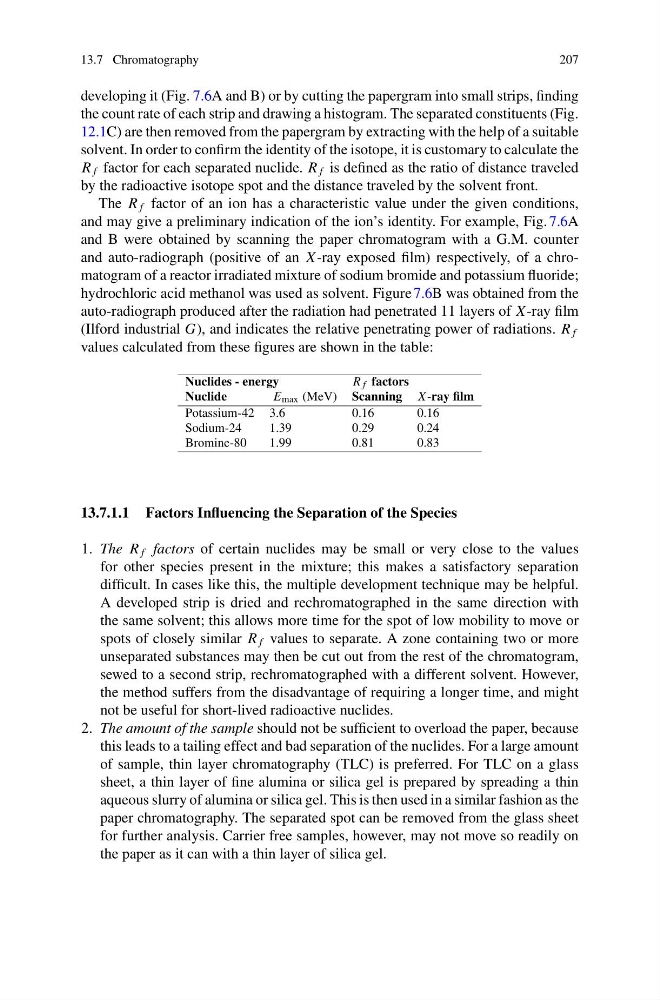
values calculated from these figures are shown in the table:
Nuclides - energy
R f factors
Nuclide
E max (MeV) Scanning X -ray film
Potassium-42 3.6
0.16
0.16
Sodium-24
1.39
0.29
0.24
Bromine-80
1.99
0.81
0.83
13.7.1.1 Factors Influencing the Separation of the Species
1. The R f factors of certain nuclides may be small or very close to the values
for other species present in the mixture; this makes a satisfactory separation
difficult. In cases like this, the multiple development technique may be helpful.
A developed strip is dried and rechromatographed in the same direction with
the same solvent; this allows more time for the spot of low mobility to move or
spots of closely similar R f values to separate. A zone containing two or more
unseparated substances may then be cut out from the rest of the chromatogram,
sewed to a second strip, rechromatographed with a different solvent. However,
the method suffers from the disadvantage of requiring a longer time, and might
not be useful for short-lived radioactive nuclides.
2. The amount of the sample should not be sufficient to overload the paper, because
this leads to a tailing effect and bad separation of the nuclides. For a large amount
of sample, thin layer chromatography (TLC) is preferred. For TLC on a glass
sheet, a thin layer of fine alumina or silica gel is prepared by spreading a thin
aqueous slurry of alumina or silica gel. This is then used in a similar fashion as the
paper chromatography. The separated spot can be removed from the glass sheet
for further analysis. Carrier free samples, however, may not move so readily on
the paper as it can with a thin layer of silica gel.
207
developing it (Fig. 7.6A and B) or by cutting the papergram into small strips, finding
the count rate of each strip and drawing a histogram. The separated constituents (Fig.
12.1C) are then removed from the papergram by extracting with the help of a suitable
solvent. In order to confirm the identity of the isotope, it is customary to calculate the
R f factor for each separated nuclide. R f is defined as the ratio of distance traveled
by the radioactive isotope spot and the distance traveled by the solvent front.
The R f factor of an ion has a characteristic value under the given conditions,
and may give a preliminary indication of the ion’s identity. For example, Fig. 7.6A
and B were obtained by scanning the paper chromatogram with a G.M. counter
and auto-radiograph (positive of an X -ray exposed film) respectively, of a chromatogram of a reactor irradiated mixture of sodium bromide and potassium fluoride;
hydrochloric acid methanol was used as solvent. Figure 7.6B was obtained from the
auto-radiograph produced after the radiation had penetrated 11 layers of X -ray film
(Ilford industrial G), and indicates the relative penetrating power of radiations. R f
values calculated from these figures are shown in the table:
Nuclides - energy
R f factors
Nuclide
E max (MeV) Scanning X -ray film
Potassium-42 3.6
0.16
0.16
Sodium-24
1.39
0.29
0.24
Bromine-80
1.99
0.81
0.83
13.7.1.1 Factors Influencing the Separation of the Species
1. The R f factors of certain nuclides may be small or very close to the values
for other species present in the mixture; this makes a satisfactory separation
difficult. In cases like this, the multiple development technique may be helpful.
A developed strip is dried and rechromatographed in the same direction with
the same solvent; this allows more time for the spot of low mobility to move or
spots of closely similar R f values to separate. A zone containing two or more
unseparated substances may then be cut out from the rest of the chromatogram,
sewed to a second strip, rechromatographed with a different solvent. However,
the method suffers from the disadvantage of requiring a longer time, and might
not be useful for short-lived radioactive nuclides.
2. The amount of the sample should not be sufficient to overload the paper, because
this leads to a tailing effect and bad separation of the nuclides. For a large amount
of sample, thin layer chromatography (TLC) is preferred. For TLC on a glass
sheet, a thin layer of fine alumina or silica gel is prepared by spreading a thin
aqueous slurry of alumina or silica gel. This is then used in a similar fashion as the
paper chromatography. The separated spot can be removed from the glass sheet
for further analysis. Carrier free samples, however, may not move so readily on
the paper as it can with a thin layer of silica gel.