

206
13 Radiochemical Separation Techniques
13.7 Chromatography
The term chromatography is commonly applied to the separation of substances by
selective distribution between a flowing fluid and an insoluble solid known as the
support. Chromatographic technique may be used for processing micro amounts of
material for preparative purposes or micro amounts for assay purposes. Chromatographic techniques for the purpose of radiochemical separations can be classified
as:
1. Partition chromatography—Paper chromatography
2. Ion-exchange chromatography
3. Adsorption chromatography—Column chromatography.
13.7.1 Paper Chromatography
Paper chromatography is broadly applicable for the qualitative and quantitative analysis of mixtures. This is based on the partition of the substance to be separated between
a fixed and mobile phase, and the separation depends on the different distribution
coefficients.
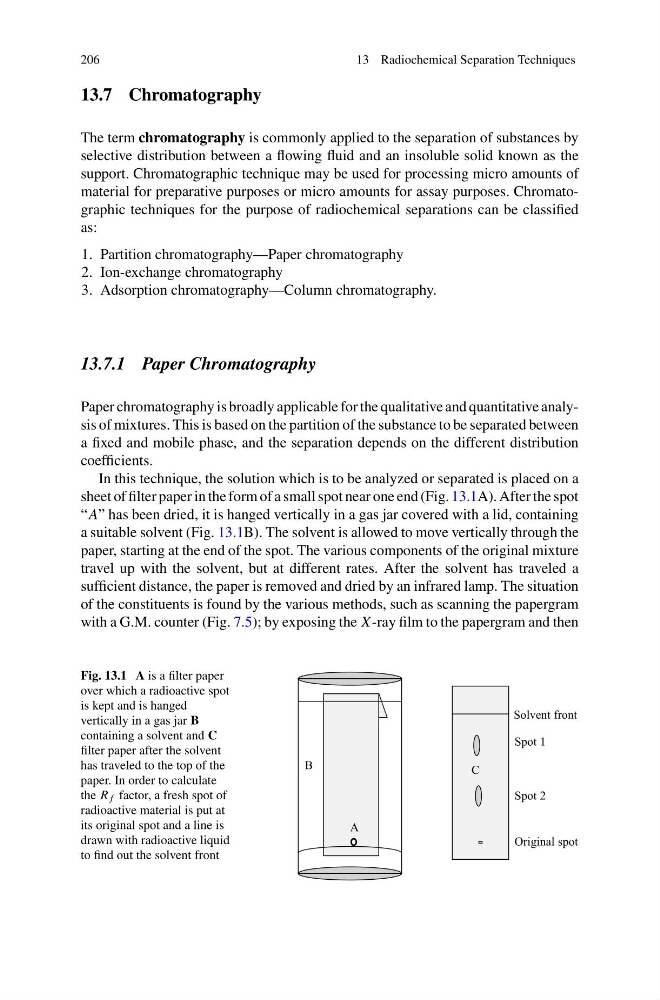
In this technique, the solution which is to be analyzed or separated is placed on a
sheet of filter paper in the form of a small spot near one end (Fig. 13.1A). After the spot
“A” has been dried, it is hanged vertically in a gas jar covered with a lid, containing
a suitable solvent (Fig. 13.1B). The solvent is allowed to move vertically through the
paper, starting at the end of the spot. The various components of the original mixture
travel up with the solvent, but at different rates. After the solvent has traveled a
sufficient distance, the paper is removed and dried by an infrared lamp. The situation
of the constituents is found by the various methods, such as scanning the papergram
with a G.M. counter (Fig. 7.5); by exposing the X -ray film to the papergram and then
Fig. 13.1 A is a filter paper
over which a radioactive spot
is kept and is hanged
vertically in a gas jar B
containing a solvent and C
filter paper after the solvent
has traveled to the top of the
paper. In order to calculate
the R f factor, a fresh spot of
radioactive material is put at
its original spot and a line is
drawn with radioactive liquid
to find out the solvent front
A
B
C
Solvent front
Spot 1
Spot 2
Original spot
13 Radiochemical Separation Techniques
13.7 Chromatography
The term chromatography is commonly applied to the separation of substances by
selective distribution between a flowing fluid and an insoluble solid known as the
support. Chromatographic technique may be used for processing micro amounts of
material for preparative purposes or micro amounts for assay purposes. Chromatographic techniques for the purpose of radiochemical separations can be classified
as:
1. Partition chromatography—Paper chromatography
2. Ion-exchange chromatography
3. Adsorption chromatography—Column chromatography.
13.7.1 Paper Chromatography
Paper chromatography is broadly applicable for the qualitative and quantitative analysis of mixtures. This is based on the partition of the substance to be separated between
a fixed and mobile phase, and the separation depends on the different distribution
coefficients.
In this technique, the solution which is to be analyzed or separated is placed on a
sheet of filter paper in the form of a small spot near one end (Fig. 13.1A). After the spot
“A” has been dried, it is hanged vertically in a gas jar covered with a lid, containing
a suitable solvent (Fig. 13.1B). The solvent is allowed to move vertically through the
paper, starting at the end of the spot. The various components of the original mixture
travel up with the solvent, but at different rates. After the solvent has traveled a
sufficient distance, the paper is removed and dried by an infrared lamp. The situation
of the constituents is found by the various methods, such as scanning the papergram
with a G.M. counter (Fig. 7.5); by exposing the X -ray film to the papergram and then
Fig. 13.1 A is a filter paper
over which a radioactive spot
is kept and is hanged
vertically in a gas jar B
containing a solvent and C
filter paper after the solvent
has traveled to the top of the
paper. In order to calculate
the R f factor, a fresh spot of
radioactive material is put at
its original spot and a line is
drawn with radioactive liquid
to find out the solvent front
A
B
C
Solvent front
Spot 1
Spot 2
Original spot