

12.5 Units of Radiation Dose
191
through the wound or cut in the hands, skin etc., while handling the radioactive
materials. These levels apply, not only to people occupationally exposed to radiation,
but also to the general population.
12.5.7 Dose Rate Calculation
The dose-rate can be calculated by using a simplified mathematical equation, but
these calculations give approximate results. In calculating the dose-rate, the decay
scheme of the radioactive isotope must be known. This helps in finding out the
different types of radiations emitted, their energy, and their % abundance. With
isotopes giving several radiations with different % abundances, the total energy is
calculated which is the sum of products of energy and the % abundance for each
type of radiation separately and this value should be considered in the calculation of
dose rate. If more than one radiation is emitted per disintegration, the dose-rate is
multiplied by the number of radiations emitted.
12.5.7.1 γ -Rays or X-Rays
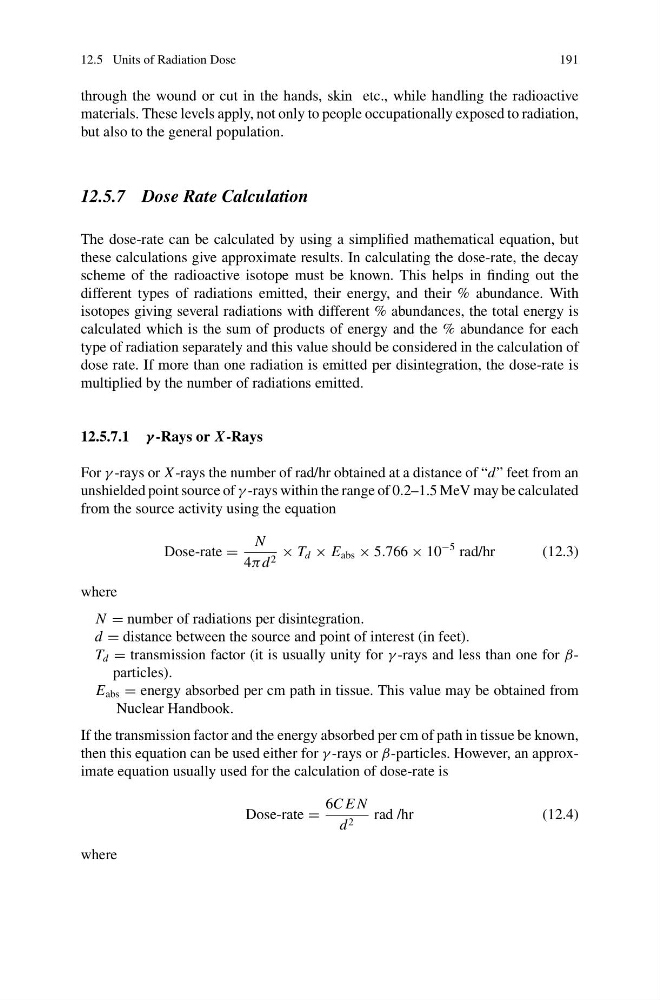
For γ -rays or X -rays the number of rad/hr obtained at a distance of “d” feet from an
unshielded point source of γ -rays within the range of 0.2–1.5 MeV may be calculated
from the source activity using the equation
Dose-rate =
N
4π d 2 × T d × E abs × 5.766 × 10
−5 rad/hr
(12.3)
where
N = number of radiations per disintegration.
d = distance between the source and point of interest (in feet).
T d = transmission factor (it is usually unity for γ -rays and less than one for βparticles).
E abs = energy absorbed per cm path in tissue. This value may be obtained from
Nuclear Handbook.
If the transmission factor and the energy absorbed per cm of path in tissue be known,
then this equation can be used either for γ -rays or β-particles. However, an approximate equation usually used for the calculation of dose-rate is
Dose-rate =
6C E N
d 2 rad /hr
(12.4)
where
191
through the wound or cut in the hands, skin etc., while handling the radioactive
materials. These levels apply, not only to people occupationally exposed to radiation,
but also to the general population.
12.5.7 Dose Rate Calculation
The dose-rate can be calculated by using a simplified mathematical equation, but
these calculations give approximate results. In calculating the dose-rate, the decay
scheme of the radioactive isotope must be known. This helps in finding out the
different types of radiations emitted, their energy, and their % abundance. With
isotopes giving several radiations with different % abundances, the total energy is
calculated which is the sum of products of energy and the % abundance for each
type of radiation separately and this value should be considered in the calculation of
dose rate. If more than one radiation is emitted per disintegration, the dose-rate is
multiplied by the number of radiations emitted.
12.5.7.1 γ -Rays or X-Rays
For γ -rays or X -rays the number of rad/hr obtained at a distance of “d” feet from an
unshielded point source of γ -rays within the range of 0.2–1.5 MeV may be calculated
from the source activity using the equation
Dose-rate =
N
4π d 2 × T d × E abs × 5.766 × 10
−5 rad/hr
(12.3)
where
N = number of radiations per disintegration.
d = distance between the source and point of interest (in feet).
T d = transmission factor (it is usually unity for γ -rays and less than one for βparticles).
E abs = energy absorbed per cm path in tissue. This value may be obtained from
Nuclear Handbook.
If the transmission factor and the energy absorbed per cm of path in tissue be known,
then this equation can be used either for γ -rays or β-particles. However, an approximate equation usually used for the calculation of dose-rate is
Dose-rate =
6C E N
d 2 rad /hr
(12.4)
where