

190
12 Health Hazards and Protection
changed, by the International Commission for Radiological Protection (I.C.R.P.),
should any evidence become available which indicates such alteration.
12.5.5 Maximum Permissible Level of External Radiation
According to I.C.R.P., the total exposure dose accumulated over several years of any
age over 18 shall not exceed that given by the relation
D = 5(Age − 18) rem
(12.2)
where D is the tissue dose in unit of rem. This relationship implies that on an average,
a dose rate of 5 rem per year or 0.1 rem per week is a permissible dose. Over a shorter
period, this latter dose-rate may be exceeded, provided that it is not greater than 3
rem during any period of 13 consecutive weeks. The long term average dose in
hands, forearms, feet, and ankles should not exceed more than 1.5 rem/week, and in
addition, the maximum accumulated doses of 20 rem in 13 consecutive weeks. In
the tracer laboratory, the working dose should not exceed 2.5 rem/hr.
12.5.6 Maximum Permissible Body Burden
The maximum permissible level for internal ingested radioactive isotopes can also be
set on the experimental evidence obtained so far. This level is called the maximum
permissible body burden and it is customary to define this with reference to the
organs of the body. This level depends upon the radioactive isotopes concerned i.e.,
on its toxicity and the effective half-life of the radioactive isotope.
The maximum permissible body burden is defined as that level or amount of
the isotope, which if ingested into the body, will produce no appreciable health
hazard. This level, unlike the maximum permissible level of external radiation, is
liable to change. The unit of maximum permissible body burden is the curie, because
here one is interested in the amount of radioactive isotopes taken in by the body.
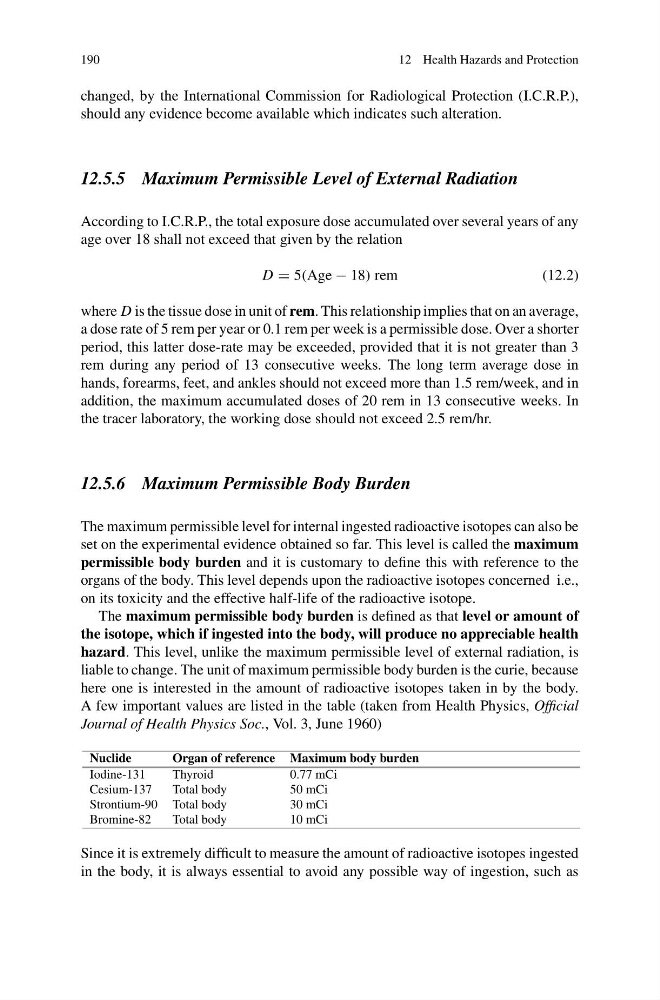
A few important values are listed in the table (taken from Health Physics, Official
Journal of Health Physics Soc., Vol. 3, June 1960)
Nuclide
Organ of reference Maximum body burden
Iodine-131
Thyroid
0.77 mCi
Cesium-137
Total body
50 mCi
Strontium-90 Total body
30 mCi
Bromine-82
Total body
10 mCi
Since it is extremely difficult to measure the amount of radioactive isotopes ingested
in the body, it is always essential to avoid any possible way of ingestion, such as
12 Health Hazards and Protection
changed, by the International Commission for Radiological Protection (I.C.R.P.),
should any evidence become available which indicates such alteration.
12.5.5 Maximum Permissible Level of External Radiation
According to I.C.R.P., the total exposure dose accumulated over several years of any
age over 18 shall not exceed that given by the relation
D = 5(Age − 18) rem
(12.2)
where D is the tissue dose in unit of rem. This relationship implies that on an average,
a dose rate of 5 rem per year or 0.1 rem per week is a permissible dose. Over a shorter
period, this latter dose-rate may be exceeded, provided that it is not greater than 3
rem during any period of 13 consecutive weeks. The long term average dose in
hands, forearms, feet, and ankles should not exceed more than 1.5 rem/week, and in
addition, the maximum accumulated doses of 20 rem in 13 consecutive weeks. In
the tracer laboratory, the working dose should not exceed 2.5 rem/hr.
12.5.6 Maximum Permissible Body Burden
The maximum permissible level for internal ingested radioactive isotopes can also be
set on the experimental evidence obtained so far. This level is called the maximum
permissible body burden and it is customary to define this with reference to the
organs of the body. This level depends upon the radioactive isotopes concerned i.e.,
on its toxicity and the effective half-life of the radioactive isotope.
The maximum permissible body burden is defined as that level or amount of
the isotope, which if ingested into the body, will produce no appreciable health
hazard. This level, unlike the maximum permissible level of external radiation, is
liable to change. The unit of maximum permissible body burden is the curie, because
here one is interested in the amount of radioactive isotopes taken in by the body.
A few important values are listed in the table (taken from Health Physics, Official
Journal of Health Physics Soc., Vol. 3, June 1960)
Nuclide
Organ of reference Maximum body burden
Iodine-131
Thyroid
0.77 mCi
Cesium-137
Total body
50 mCi
Strontium-90 Total body
30 mCi
Bromine-82
Total body
10 mCi
Since it is extremely difficult to measure the amount of radioactive isotopes ingested
in the body, it is always essential to avoid any possible way of ingestion, such as