

11.5 Multiplication or Division to Recorded Count
179
σ u =
σ x
A
(11.4)
In both the Eqs. (11.3) and (11.4), it is assumed that the multiplication or division
is done by a constant factor which does not alter the relative error. We can take one
example to illustrate this calculation.
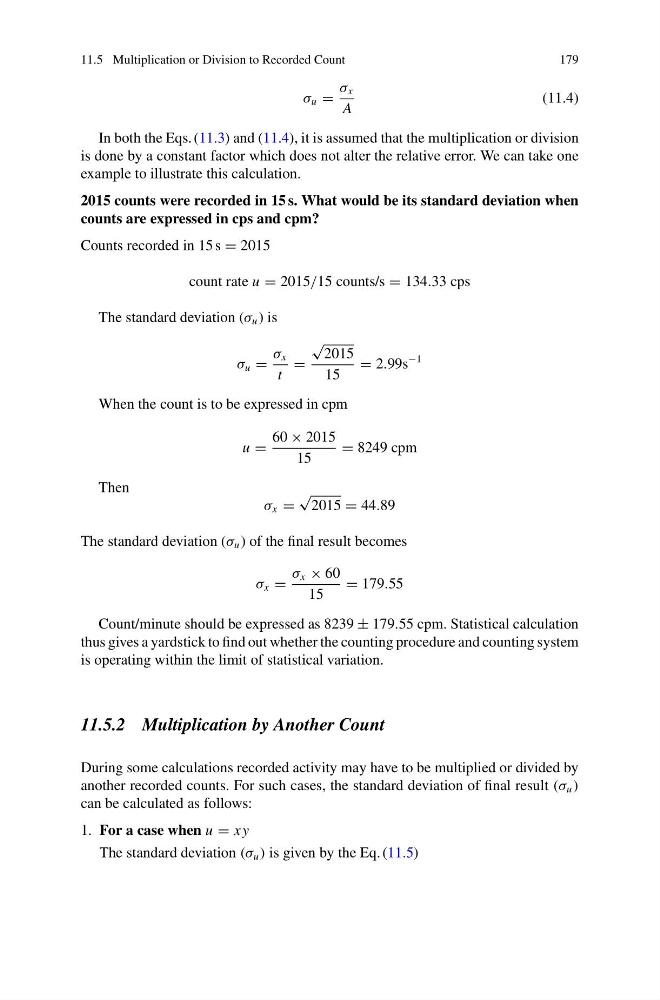
2015 counts were recorded in 15 s. What would be its standard deviation when
counts are expressed in cps and cpm?
Counts recorded in 15 s = 2015
count rate u = 2015/15 counts/s = 134.33 cps
The standard deviation (σ u ) is
σ u =
σ x
t
=
√
2015
15
= 2.99s
−1
When the count is to be expressed in cpm
u =
60 × 2015
15
= 8249 cpm
Then
σ x =
√
2015 = 44.89
The standard deviation (σ u ) of the final result becomes
σ x =
σ x × 60
15
= 179.55
Count/minute should be expressed as 8239 ± 179.55 cpm. Statistical calculation
thus gives a yardstick to find out whether the counting procedure and counting system
is operating within the limit of statistical variation.
11.5.2 Multiplication by Another Count
During some calculations recorded activity may have to be multiplied or divided by
another recorded counts. For such cases, the standard deviation of final result (σ u )
can be calculated as follows:
1. For a case when u = x y
The standard deviation (σ u ) is given by the Eq. (11.5)
179
σ u =
σ x
A
(11.4)
In both the Eqs. (11.3) and (11.4), it is assumed that the multiplication or division
is done by a constant factor which does not alter the relative error. We can take one
example to illustrate this calculation.
2015 counts were recorded in 15 s. What would be its standard deviation when
counts are expressed in cps and cpm?
Counts recorded in 15 s = 2015
count rate u = 2015/15 counts/s = 134.33 cps
The standard deviation (σ u ) is
σ u =
σ x
t
=
√
2015
15
= 2.99s
−1
When the count is to be expressed in cpm
u =
60 × 2015
15
= 8249 cpm
Then
σ x =
√
2015 = 44.89
The standard deviation (σ u ) of the final result becomes
σ x =
σ x × 60
15
= 179.55
Count/minute should be expressed as 8239 ± 179.55 cpm. Statistical calculation
thus gives a yardstick to find out whether the counting procedure and counting system
is operating within the limit of statistical variation.
11.5.2 Multiplication by Another Count
During some calculations recorded activity may have to be multiplied or divided by
another recorded counts. For such cases, the standard deviation of final result (σ u )
can be calculated as follows:
1. For a case when u = x y
The standard deviation (σ u ) is given by the Eq. (11.5)