

10.8 Half-Life Determination
169
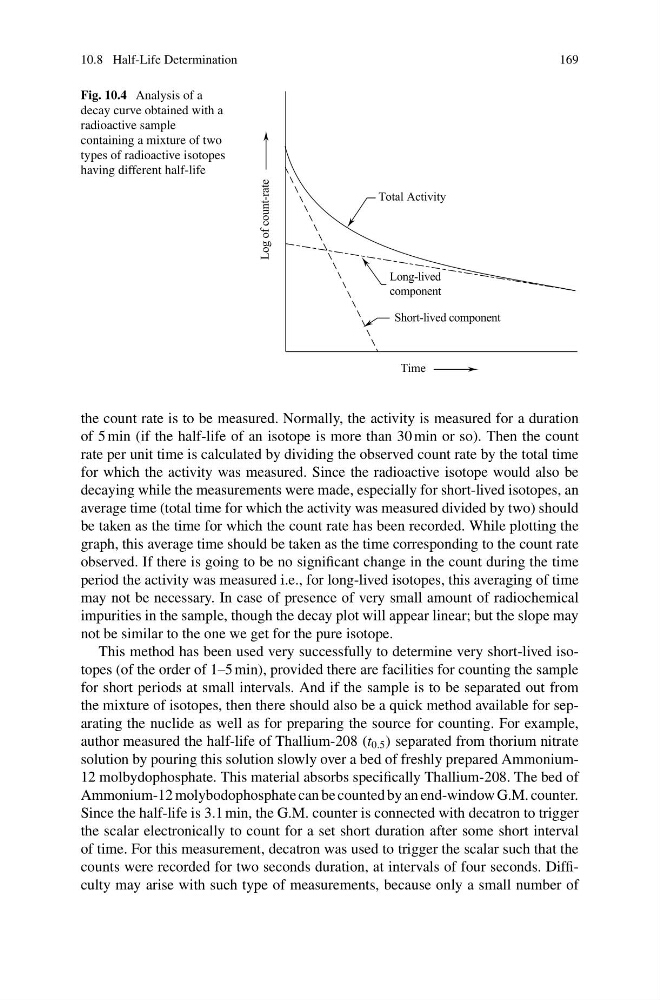
Fig. 10.4 Analysis of a
decay curve obtained with a
radioactive sample
containing a mixture of two
types of radioactive isotopes
having different half-life
the count rate is to be measured. Normally, the activity is measured for a duration
of 5 min (if the half-life of an isotope is more than 30 min or so). Then the count
rate per unit time is calculated by dividing the observed count rate by the total time
for which the activity was measured. Since the radioactive isotope would also be
decaying while the measurements were made, especially for short-lived isotopes, an
average time (total time for which the activity was measured divided by two) should
be taken as the time for which the count rate has been recorded. While plotting the
graph, this average time should be taken as the time corresponding to the count rate
observed. If there is going to be no significant change in the count during the time
period the activity was measured i.e., for long-lived isotopes, this averaging of time
may not be necessary. In case of presence of very small amount of radiochemical
impurities in the sample, though the decay plot will appear linear; but the slope may
not be similar to the one we get for the pure isotope.
This method has been used very successfully to determine very short-lived isotopes (of the order of 1–5 min), provided there are facilities for counting the sample
for short periods at small intervals. And if the sample is to be separated out from
the mixture of isotopes, then there should also be a quick method available for separating the nuclide as well as for preparing the source for counting. For example,
author measured the half-life of Thallium-208 (t 0.5 ) separated from thorium nitrate
solution by pouring this solution slowly over a bed of freshly prepared Ammonium12 molbydophosphate. This material absorbs specifically Thallium-208. The bed of
Ammonium-12 molybodophosphate can be counted by an end-window G.M. counter.
Since the half-life is 3.1 min, the G.M. counter is connected with decatron to trigger
the scalar electronically to count for a set short duration after some short interval
of time. For this measurement, decatron was used to trigger the scalar such that the
counts were recorded for two seconds duration, at intervals of four seconds. Difficulty may arise with such type of measurements, because only a small number of
169
Fig. 10.4 Analysis of a
decay curve obtained with a
radioactive sample
containing a mixture of two
types of radioactive isotopes
having different half-life
the count rate is to be measured. Normally, the activity is measured for a duration
of 5 min (if the half-life of an isotope is more than 30 min or so). Then the count
rate per unit time is calculated by dividing the observed count rate by the total time
for which the activity was measured. Since the radioactive isotope would also be
decaying while the measurements were made, especially for short-lived isotopes, an
average time (total time for which the activity was measured divided by two) should
be taken as the time for which the count rate has been recorded. While plotting the
graph, this average time should be taken as the time corresponding to the count rate
observed. If there is going to be no significant change in the count during the time
period the activity was measured i.e., for long-lived isotopes, this averaging of time
may not be necessary. In case of presence of very small amount of radiochemical
impurities in the sample, though the decay plot will appear linear; but the slope may
not be similar to the one we get for the pure isotope.
This method has been used very successfully to determine very short-lived isotopes (of the order of 1–5 min), provided there are facilities for counting the sample
for short periods at small intervals. And if the sample is to be separated out from
the mixture of isotopes, then there should also be a quick method available for separating the nuclide as well as for preparing the source for counting. For example,
author measured the half-life of Thallium-208 (t 0.5 ) separated from thorium nitrate
solution by pouring this solution slowly over a bed of freshly prepared Ammonium12 molbydophosphate. This material absorbs specifically Thallium-208. The bed of
Ammonium-12 molybodophosphate can be counted by an end-window G.M. counter.
Since the half-life is 3.1 min, the G.M. counter is connected with decatron to trigger
the scalar electronically to count for a set short duration after some short interval
of time. For this measurement, decatron was used to trigger the scalar such that the
counts were recorded for two seconds duration, at intervals of four seconds. Difficulty may arise with such type of measurements, because only a small number of