

10.4 β-Spectrometry
165
10.4.4 Determination of E max
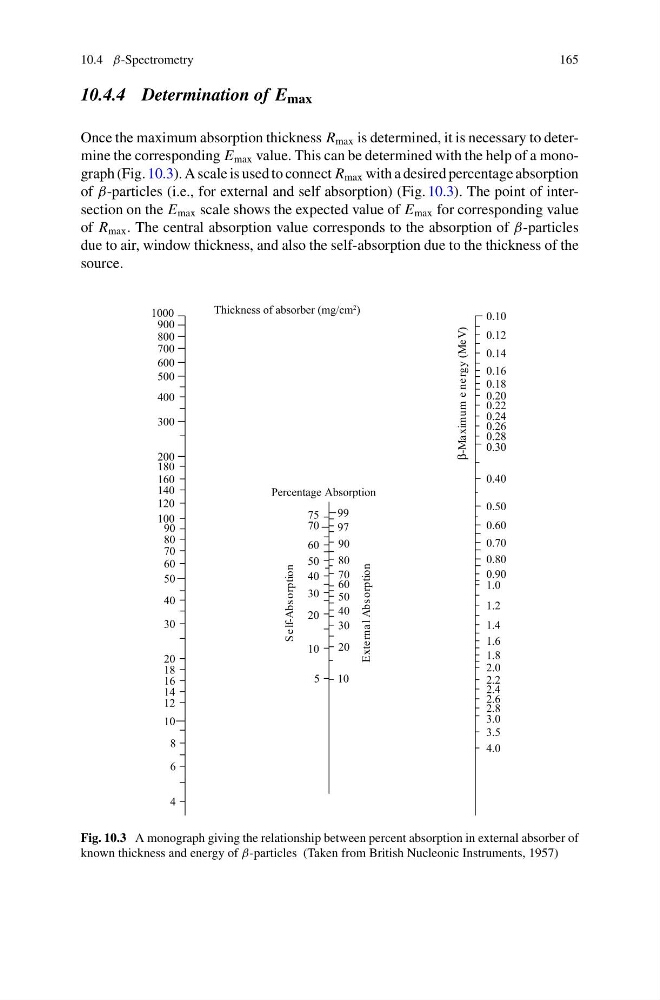
Once the maximum absorption thickness R max is determined, it is necessary to determine the corresponding E max value. This can be determined with the help of a monograph (Fig. 10.3). A scale is used to connect R max with a desired percentage absorption
of β-particles (i.e., for external and self absorption) (Fig. 10.3). The point of intersection on the E max scale shows the expected value of E max for corresponding value
of R max . The central absorption value corresponds to the absorption of β-particles
due to air, window thickness, and also the self-absorption due to the thickness of the
source.
Fig. 10.3 A monograph giving the relationship between percent absorption in external absorber of
known thickness and energy of β-particles (Taken from British Nucleonic Instruments, 1957)
165
10.4.4 Determination of E max
Once the maximum absorption thickness R max is determined, it is necessary to determine the corresponding E max value. This can be determined with the help of a monograph (Fig. 10.3). A scale is used to connect R max with a desired percentage absorption
of β-particles (i.e., for external and self absorption) (Fig. 10.3). The point of intersection on the E max scale shows the expected value of E max for corresponding value
of R max . The central absorption value corresponds to the absorption of β-particles
due to air, window thickness, and also the self-absorption due to the thickness of the
source.
Fig. 10.3 A monograph giving the relationship between percent absorption in external absorber of
known thickness and energy of β-particles (Taken from British Nucleonic Instruments, 1957)