

162
10 Identification of Radioactive Isotopes
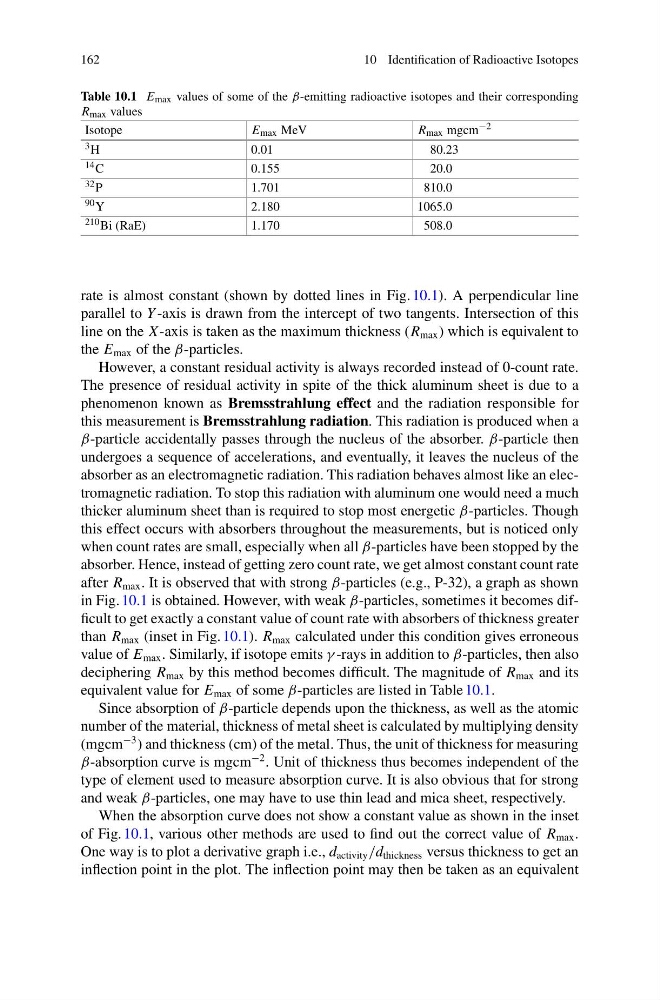
Table 10.1 E max values of some of the β-emitting radioactive isotopes and their corresponding
R max values
Isotope
E max MeV
R max mgcm −2
3 H
0.01
80.23
14 C
0.155
20.0
32 P
1.701
810.0
90 Y
2.180
1065.0
210 Bi (RaE)
1.170
508.0
rate is almost constant (shown by dotted lines in Fig. 10.1). A perpendicular line
parallel to Y -axis is drawn from the intercept of two tangents. Intersection of this
line on the X -axis is taken as the maximum thickness (R max ) which is equivalent to
the E max of the β-particles.
However, a constant residual activity is always recorded instead of 0-count rate.
The presence of residual activity in spite of the thick aluminum sheet is due to a
phenomenon known as Bremsstrahlung effect and the radiation responsible for
this measurement is Bremsstrahlung radiation. This radiation is produced when a
β-particle accidentally passes through the nucleus of the absorber. β-particle then
undergoes a sequence of accelerations, and eventually, it leaves the nucleus of the
absorber as an electromagnetic radiation. This radiation behaves almost like an electromagnetic radiation. To stop this radiation with aluminum one would need a much
thicker aluminum sheet than is required to stop most energetic β-particles. Though
this effect occurs with absorbers throughout the measurements, but is noticed only
when count rates are small, especially when all β-particles have been stopped by the
absorber. Hence, instead of getting zero count rate, we get almost constant count rate
after R max . It is observed that with strong β-particles (e.g., P-32), a graph as shown
in Fig. 10.1 is obtained. However, with weak β-particles, sometimes it becomes difficult to get exactly a constant value of count rate with absorbers of thickness greater
than R max (inset in Fig. 10.1). R max calculated under this condition gives erroneous
value of E max . Similarly, if isotope emits γ -rays in addition to β-particles, then also
deciphering R max by this method becomes difficult. The magnitude of R max and its
equivalent value for E max of some β-particles are listed in Table 10.1.
Since absorption of β-particle depends upon the thickness, as well as the atomic
number of the material, thickness of metal sheet is calculated by multiplying density
(mgcm
−3 ) and thickness (cm) of the metal. Thus, the unit of thickness for measuring
β-absorption curve is mgcm
−2 . Unit of thickness thus becomes independent of the
type of element used to measure absorption curve. It is also obvious that for strong
and weak β-particles, one may have to use thin lead and mica sheet, respectively.
When the absorption curve does not show a constant value as shown in the inset
of Fig. 10.1, various other methods are used to find out the correct value of R max .
One way is to plot a derivative graph i.e., d activity /d thickness versus thickness to get an
inflection point in the plot. The inflection point may then be taken as an equivalent
10 Identification of Radioactive Isotopes
Table 10.1 E max values of some of the β-emitting radioactive isotopes and their corresponding
R max values
Isotope
E max MeV
R max mgcm −2
3 H
0.01
80.23
14 C
0.155
20.0
32 P
1.701
810.0
90 Y
2.180
1065.0
210 Bi (RaE)
1.170
508.0
rate is almost constant (shown by dotted lines in Fig. 10.1). A perpendicular line
parallel to Y -axis is drawn from the intercept of two tangents. Intersection of this
line on the X -axis is taken as the maximum thickness (R max ) which is equivalent to
the E max of the β-particles.
However, a constant residual activity is always recorded instead of 0-count rate.
The presence of residual activity in spite of the thick aluminum sheet is due to a
phenomenon known as Bremsstrahlung effect and the radiation responsible for
this measurement is Bremsstrahlung radiation. This radiation is produced when a
β-particle accidentally passes through the nucleus of the absorber. β-particle then
undergoes a sequence of accelerations, and eventually, it leaves the nucleus of the
absorber as an electromagnetic radiation. This radiation behaves almost like an electromagnetic radiation. To stop this radiation with aluminum one would need a much
thicker aluminum sheet than is required to stop most energetic β-particles. Though
this effect occurs with absorbers throughout the measurements, but is noticed only
when count rates are small, especially when all β-particles have been stopped by the
absorber. Hence, instead of getting zero count rate, we get almost constant count rate
after R max . It is observed that with strong β-particles (e.g., P-32), a graph as shown
in Fig. 10.1 is obtained. However, with weak β-particles, sometimes it becomes difficult to get exactly a constant value of count rate with absorbers of thickness greater
than R max (inset in Fig. 10.1). R max calculated under this condition gives erroneous
value of E max . Similarly, if isotope emits γ -rays in addition to β-particles, then also
deciphering R max by this method becomes difficult. The magnitude of R max and its
equivalent value for E max of some β-particles are listed in Table 10.1.
Since absorption of β-particle depends upon the thickness, as well as the atomic
number of the material, thickness of metal sheet is calculated by multiplying density
(mgcm
−3 ) and thickness (cm) of the metal. Thus, the unit of thickness for measuring
β-absorption curve is mgcm
−2 . Unit of thickness thus becomes independent of the
type of element used to measure absorption curve. It is also obvious that for strong
and weak β-particles, one may have to use thin lead and mica sheet, respectively.
When the absorption curve does not show a constant value as shown in the inset
of Fig. 10.1, various other methods are used to find out the correct value of R max .
One way is to plot a derivative graph i.e., d activity /d thickness versus thickness to get an
inflection point in the plot. The inflection point may then be taken as an equivalent