

108
6 Scintillation Counter
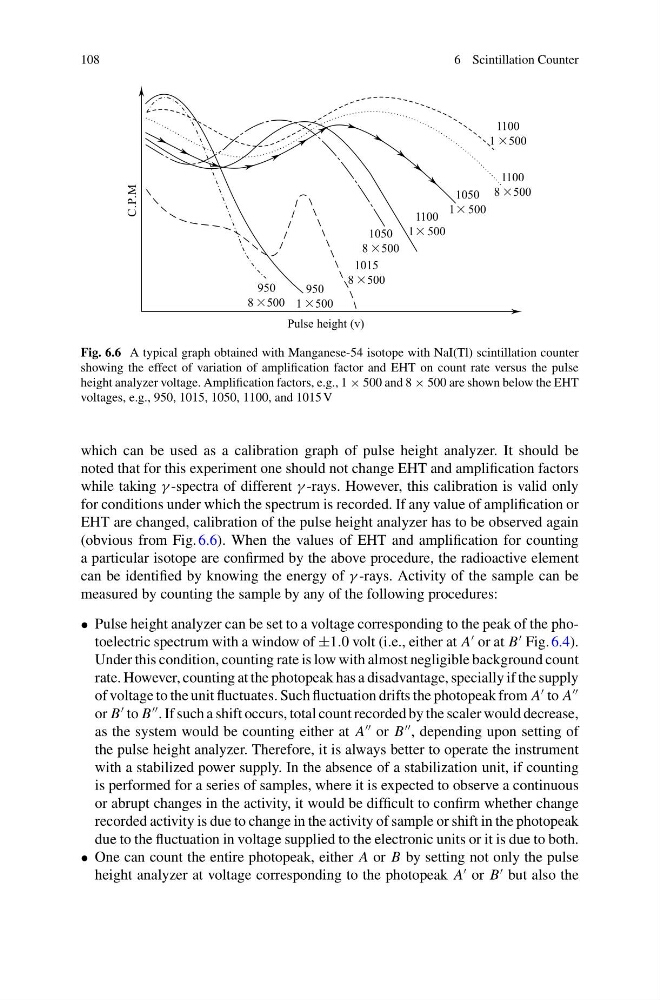
Fig. 6.6 A typical graph obtained with Manganese-54 isotope with NaI(Tl) scintillation counter
showing the effect of variation of amplification factor and EHT on count rate versus the pulse
height analyzer voltage. Amplification factors, e.g., 1 × 500 and 8 × 500 are shown below the EHT
voltages, e.g., 950, 1015, 1050, 1100, and 1015 V
which can be used as a calibration graph of pulse height analyzer. It should be
noted that for this experiment one should not change EHT and amplification factors
while taking γ -spectra of different γ -rays. However, this calibration is valid only
for conditions under which the spectrum is recorded. If any value of amplification or
EHT are changed, calibration of the pulse height analyzer has to be observed again
(obvious from Fig. 6.6). When the values of EHT and amplification for counting
a particular isotope are confirmed by the above procedure, the radioactive element
can be identified by knowing the energy of γ -rays. Activity of the sample can be
measured by counting the sample by any of the following procedures:
• Pulse height analyzer can be set to a voltage corresponding to the peak of the photoelectric spectrum with a window of ±1.0 volt (i.e., either at A
or at B
Fig. 6.4).
Under this condition, counting rate is low with almost negligible background count
rate. However, counting at the photopeak has a disadvantage, specially if the supply
of voltage to the unit fluctuates. Such fluctuation drifts the photopeak from A
to A
or B
to B
. If such a shift occurs, total count recorded by the scaler would decrease,
as the system would be counting either at A
or B
, depending upon setting of
the pulse height analyzer. Therefore, it is always better to operate the instrument
with a stabilized power supply. In the absence of a stabilization unit, if counting
is performed for a series of samples, where it is expected to observe a continuous
or abrupt changes in the activity, it would be difficult to confirm whether change
recorded activity is due to change in the activity of sample or shift in the photopeak
due to the fluctuation in voltage supplied to the electronic units or it is due to both.
• One can count the entire photopeak, either A or B by setting not only the pulse
height analyzer at voltage corresponding to the photopeak A
or B
but also the
6 Scintillation Counter
Fig. 6.6 A typical graph obtained with Manganese-54 isotope with NaI(Tl) scintillation counter
showing the effect of variation of amplification factor and EHT on count rate versus the pulse
height analyzer voltage. Amplification factors, e.g., 1 × 500 and 8 × 500 are shown below the EHT
voltages, e.g., 950, 1015, 1050, 1100, and 1015 V
which can be used as a calibration graph of pulse height analyzer. It should be
noted that for this experiment one should not change EHT and amplification factors
while taking γ -spectra of different γ -rays. However, this calibration is valid only
for conditions under which the spectrum is recorded. If any value of amplification or
EHT are changed, calibration of the pulse height analyzer has to be observed again
(obvious from Fig. 6.6). When the values of EHT and amplification for counting
a particular isotope are confirmed by the above procedure, the radioactive element
can be identified by knowing the energy of γ -rays. Activity of the sample can be
measured by counting the sample by any of the following procedures:
• Pulse height analyzer can be set to a voltage corresponding to the peak of the photoelectric spectrum with a window of ±1.0 volt (i.e., either at A
or at B
Fig. 6.4).
Under this condition, counting rate is low with almost negligible background count
rate. However, counting at the photopeak has a disadvantage, specially if the supply
of voltage to the unit fluctuates. Such fluctuation drifts the photopeak from A
to A
or B
to B
. If such a shift occurs, total count recorded by the scaler would decrease,
as the system would be counting either at A
or B
, depending upon setting of
the pulse height analyzer. Therefore, it is always better to operate the instrument
with a stabilized power supply. In the absence of a stabilization unit, if counting
is performed for a series of samples, where it is expected to observe a continuous
or abrupt changes in the activity, it would be difficult to confirm whether change
recorded activity is due to change in the activity of sample or shift in the photopeak
due to the fluctuation in voltage supplied to the electronic units or it is due to both.
• One can count the entire photopeak, either A or B by setting not only the pulse
height analyzer at voltage corresponding to the photopeak A
or B
but also the