

6.5 Design of Photomultiplier Tube
99
3. Visible light photons are converted into electrons by an electronic eye, a photocathode (M), of a photomultiplier tube (A). Absorption of a light photon by the
photocathode produces photoelectron of corresponding energy and intensity.
4. The electron-multiplication process by a venetian blind type dynode (L) within
the photomultiplier tube amplifies the photocurrent to a measurable quantity.
Normally, each photon produces 2.5 electron when it interacts with one dynode.
5. Analysis of negative voltage pulse gives the full energy spectrum of the radiation.
A schematic representation of pulses at the probe unit (F), an amplifier (H ), and
a scaler (J ) are shown in Fig. 6.1.
6.6 Scintillator
Type of Scintillator (Phosphor Materials) Needed for Measuring the Activities
of Radioactive Isotope
γ -rays emitted by an isotope, when interacting with a phosphor, they excite atoms
to a higher energy. When these are de-excited, photons are emitted. Therefore, phosphor material should easily get excited and quickly de-excited. Moreover, excitation
process should occur with radiation of the lowest possible energy, so that even low
energetic radiation can be detected. In addition, wavelength of the photons emitted during de-excitation process should be in the visible region, i.e., in the range
of 400–600 nm so that they could be registered by the photomultiplier. Considering
these requirements, we are left with only a few types of phosphor materials. The
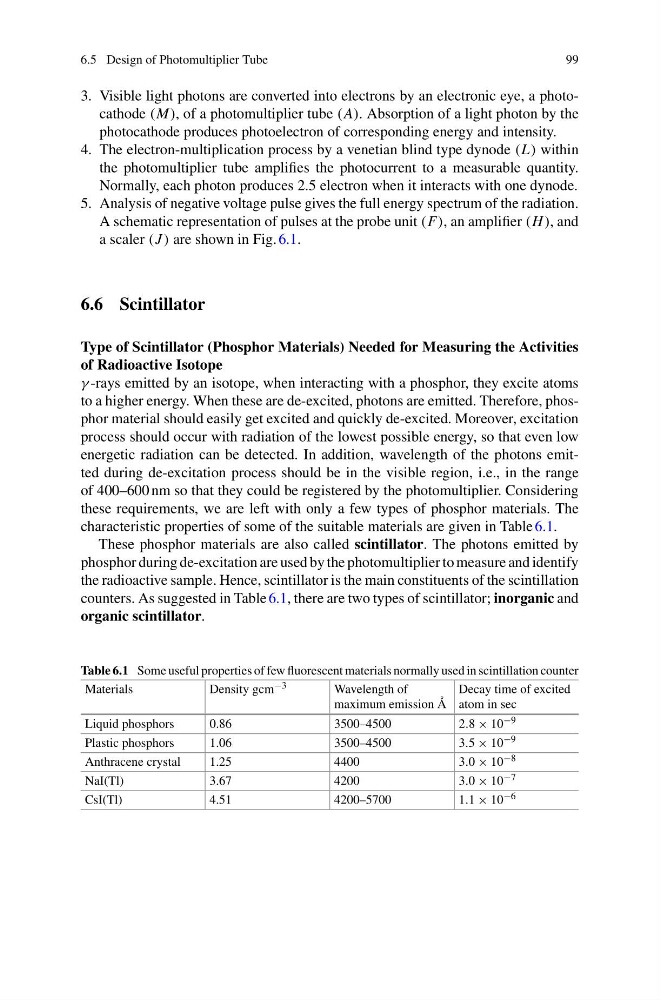
characteristic properties of some of the suitable materials are given in Table 6.1.
These phosphor materials are also called scintillator. The photons emitted by
phosphor during de-excitation are used by the photomultiplier to measure and identify
the radioactive sample. Hence, scintillator is the main constituents of the scintillation
counters. As suggested in Table 6.1, there are two types of scintillator; inorganic and
organic scintillator.
Table 6.1 Some useful properties of few fluorescent materials normally used in scintillation counter
Materials
Density gcm −3
Wavelength of
maximum emission ˚
A
Decay time of excited
atom in sec
Liquid phosphors
0.86
3500–4500
2.8 × 10 −9
Plastic phosphors
1.06
3500–4500
3.5 × 10 −9
Anthracene crystal
1.25
4400
3.0 × 10 −8
NaI(Tl)
3.67
4200
3.0 × 10 −7
CsI(Tl)
4.51
4200–5700
1.1 × 10 −6
99
3. Visible light photons are converted into electrons by an electronic eye, a photocathode (M), of a photomultiplier tube (A). Absorption of a light photon by the
photocathode produces photoelectron of corresponding energy and intensity.
4. The electron-multiplication process by a venetian blind type dynode (L) within
the photomultiplier tube amplifies the photocurrent to a measurable quantity.
Normally, each photon produces 2.5 electron when it interacts with one dynode.
5. Analysis of negative voltage pulse gives the full energy spectrum of the radiation.
A schematic representation of pulses at the probe unit (F), an amplifier (H ), and
a scaler (J ) are shown in Fig. 6.1.
6.6 Scintillator
Type of Scintillator (Phosphor Materials) Needed for Measuring the Activities
of Radioactive Isotope
γ -rays emitted by an isotope, when interacting with a phosphor, they excite atoms
to a higher energy. When these are de-excited, photons are emitted. Therefore, phosphor material should easily get excited and quickly de-excited. Moreover, excitation
process should occur with radiation of the lowest possible energy, so that even low
energetic radiation can be detected. In addition, wavelength of the photons emitted during de-excitation process should be in the visible region, i.e., in the range
of 400–600 nm so that they could be registered by the photomultiplier. Considering
these requirements, we are left with only a few types of phosphor materials. The
characteristic properties of some of the suitable materials are given in Table 6.1.
These phosphor materials are also called scintillator. The photons emitted by
phosphor during de-excitation are used by the photomultiplier to measure and identify
the radioactive sample. Hence, scintillator is the main constituents of the scintillation
counters. As suggested in Table 6.1, there are two types of scintillator; inorganic and
organic scintillator.
Table 6.1 Some useful properties of few fluorescent materials normally used in scintillation counter
Materials
Density gcm −3
Wavelength of
maximum emission ˚
A
Decay time of excited
atom in sec
Liquid phosphors
0.86
3500–4500
2.8 × 10 −9
Plastic phosphors
1.06
3500–4500
3.5 × 10 −9
Anthracene crystal
1.25
4400
3.0 × 10 −8
NaI(Tl)
3.67
4200
3.0 × 10 −7
CsI(Tl)
4.51
4200–5700
1.1 × 10 −6