

2.3 Characterisation Techniques
47
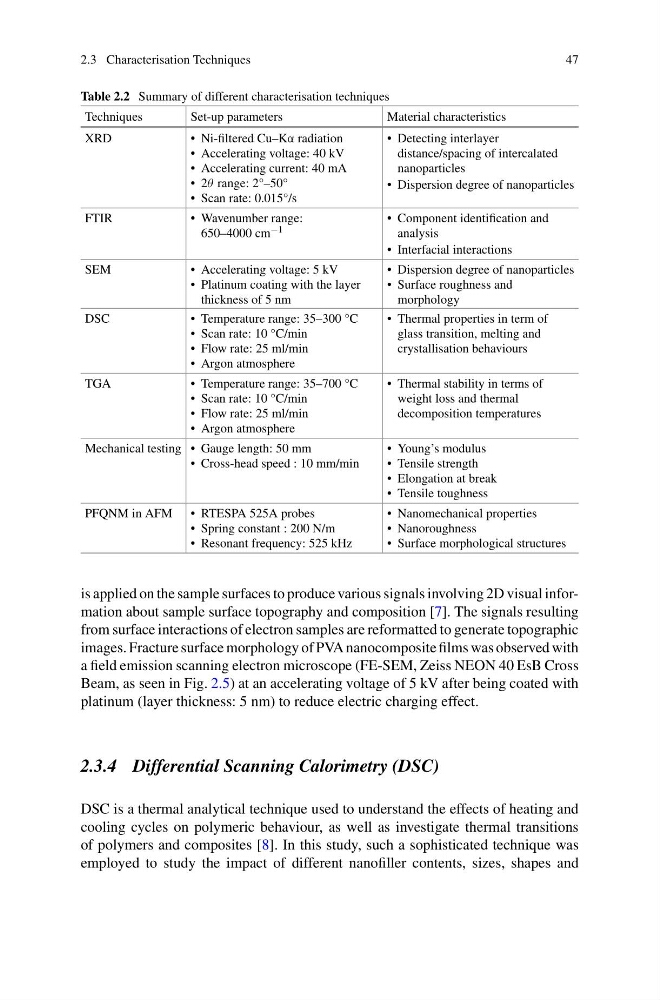
Table 2.2 Summary of different characterisation techniques
Techniques
Set-up parameters
Material characteristics
XRD
• Ni-filtered Cu–Kα radiation
• Accelerating voltage: 40 kV
• Accelerating current: 40 mA
• 2θ range: 2°–50°
• Scan rate: 0.015°/s
• Detecting interlayer
distance/spacing of intercalated
nanoparticles
• Dispersion degree of nanoparticles
FTIR
• Wavenumber range:
650–4000 cm −1
• Component identification and
analysis
• Interfacial interactions
SEM
• Accelerating voltage: 5 kV
• Platinum coating with the layer
thickness of 5 nm
• Dispersion degree of nanoparticles
• Surface roughness and
morphology
DSC
• Temperature range: 35–300 °C
• Scan rate: 10 °C/min
• Flow rate: 25 ml/min
• Argon atmosphere
• Thermal properties in term of
glass transition, melting and
crystallisation behaviours
TGA
• Temperature range: 35–700 °C
• Scan rate: 10 °C/min
• Flow rate: 25 ml/min
• Argon atmosphere
• Thermal stability in terms of
weight loss and thermal
decomposition temperatures
Mechanical testing • Gauge length: 50 mm
• Cross-head speed : 10 mm/min
• Young’s modulus
• Tensile strength
• Elongation at break
• Tensile toughness
PFQNM in AFM • RTESPA 525A probes
• Spring constant : 200 N/m
• Resonant frequency: 525 kHz
• Nanomechanical properties
• Nanoroughness
• Surface morphological structures
is applied on the sample surfaces to produce various signals involving 2D visual information about sample surface topography and composition [7]. The signals resulting
from surface interactions of electron samples are reformatted to generate topographic
images. Fracture surface morphology of PVA nanocomposite films was observed with
a field emission scanning electron microscope (FE-SEM, Zeiss NEON 40 EsB Cross
Beam, as seen in Fig. 2.5) at an accelerating voltage of 5 kV after being coated with
platinum (layer thickness: 5 nm) to reduce electric charging effect.
2.3.4 Differential Scanning Calorimetry (DSC)
DSC is a thermal analytical technique used to understand the effects of heating and
cooling cycles on polymeric behaviour, as well as investigate thermal transitions
of polymers and composites [8]. In this study, such a sophisticated technique was
employed to study the impact of different nanofiller contents, sizes, shapes and
47
Table 2.2 Summary of different characterisation techniques
Techniques
Set-up parameters
Material characteristics
XRD
• Ni-filtered Cu–Kα radiation
• Accelerating voltage: 40 kV
• Accelerating current: 40 mA
• 2θ range: 2°–50°
• Scan rate: 0.015°/s
• Detecting interlayer
distance/spacing of intercalated
nanoparticles
• Dispersion degree of nanoparticles
FTIR
• Wavenumber range:
650–4000 cm −1
• Component identification and
analysis
• Interfacial interactions
SEM
• Accelerating voltage: 5 kV
• Platinum coating with the layer
thickness of 5 nm
• Dispersion degree of nanoparticles
• Surface roughness and
morphology
DSC
• Temperature range: 35–300 °C
• Scan rate: 10 °C/min
• Flow rate: 25 ml/min
• Argon atmosphere
• Thermal properties in term of
glass transition, melting and
crystallisation behaviours
TGA
• Temperature range: 35–700 °C
• Scan rate: 10 °C/min
• Flow rate: 25 ml/min
• Argon atmosphere
• Thermal stability in terms of
weight loss and thermal
decomposition temperatures
Mechanical testing • Gauge length: 50 mm
• Cross-head speed : 10 mm/min
• Young’s modulus
• Tensile strength
• Elongation at break
• Tensile toughness
PFQNM in AFM • RTESPA 525A probes
• Spring constant : 200 N/m
• Resonant frequency: 525 kHz
• Nanomechanical properties
• Nanoroughness
• Surface morphological structures
is applied on the sample surfaces to produce various signals involving 2D visual information about sample surface topography and composition [7]. The signals resulting
from surface interactions of electron samples are reformatted to generate topographic
images. Fracture surface morphology of PVA nanocomposite films was observed with
a field emission scanning electron microscope (FE-SEM, Zeiss NEON 40 EsB Cross
Beam, as seen in Fig. 2.5) at an accelerating voltage of 5 kV after being coated with
platinum (layer thickness: 5 nm) to reduce electric charging effect.
2.3.4 Differential Scanning Calorimetry (DSC)
DSC is a thermal analytical technique used to understand the effects of heating and
cooling cycles on polymeric behaviour, as well as investigate thermal transitions
of polymers and composites [8]. In this study, such a sophisticated technique was
employed to study the impact of different nanofiller contents, sizes, shapes and