

6.3 Prediction of Elastic Moduli of PVA-Based Bionanocomposites
151
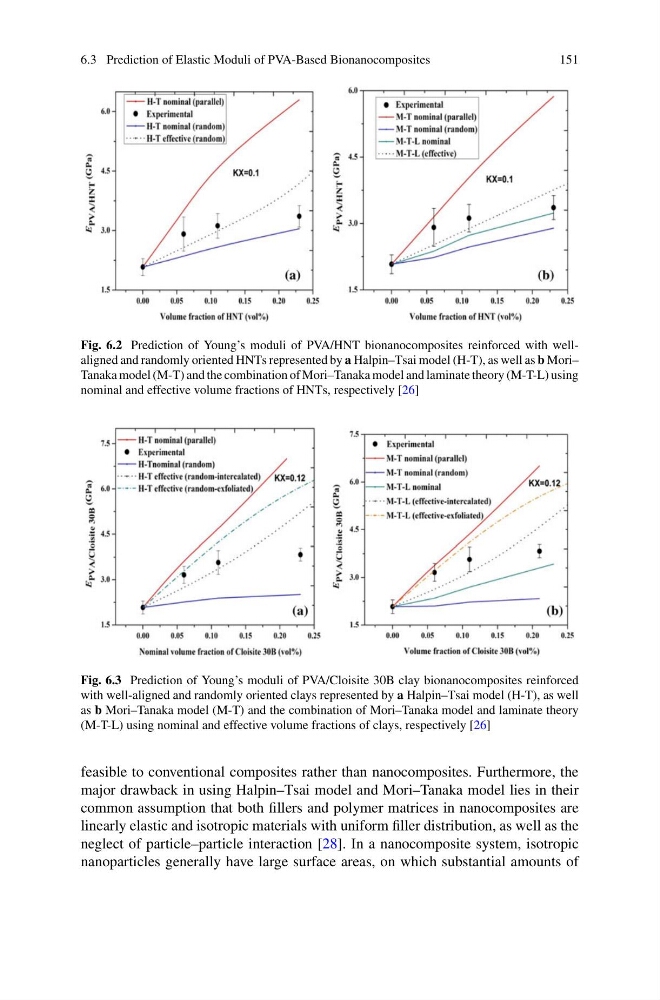
Fig. 6.2 Prediction of Young’s moduli of PVA/HNT bionanocomposites reinforced with wellaligned and randomly oriented HNTs represented by a Halpin–Tsai model (H-T), as well as b Mori–
Tanaka model (M-T) and the combination of Mori–Tanaka model and laminate theory (M-T-L) using
nominal and effective volume fractions of HNTs, respectively [26]
Fig. 6.3 Prediction of Young’s moduli of PVA/Cloisite 30B clay bionanocomposites reinforced
with well-aligned and randomly oriented clays represented by a Halpin–Tsai model (H-T), as well
as b Mori–Tanaka model (M-T) and the combination of Mori–Tanaka model and laminate theory
(M-T-L) using nominal and effective volume fractions of clays, respectively [26]
feasible to conventional composites rather than nanocomposites. Furthermore, the
major drawback in using Halpin–Tsai model and Mori–Tanaka model lies in their
common assumption that both fillers and polymer matrices in nanocomposites are
linearly elastic and isotropic materials with uniform filler distribution, as well as the
neglect of particle–particle interaction [28]. In a nanocomposite system, isotropic
nanoparticles generally have large surface areas, on which substantial amounts of
151
Fig. 6.2 Prediction of Young’s moduli of PVA/HNT bionanocomposites reinforced with wellaligned and randomly oriented HNTs represented by a Halpin–Tsai model (H-T), as well as b Mori–
Tanaka model (M-T) and the combination of Mori–Tanaka model and laminate theory (M-T-L) using
nominal and effective volume fractions of HNTs, respectively [26]
Fig. 6.3 Prediction of Young’s moduli of PVA/Cloisite 30B clay bionanocomposites reinforced
with well-aligned and randomly oriented clays represented by a Halpin–Tsai model (H-T), as well
as b Mori–Tanaka model (M-T) and the combination of Mori–Tanaka model and laminate theory
(M-T-L) using nominal and effective volume fractions of clays, respectively [26]
feasible to conventional composites rather than nanocomposites. Furthermore, the
major drawback in using Halpin–Tsai model and Mori–Tanaka model lies in their
common assumption that both fillers and polymer matrices in nanocomposites are
linearly elastic and isotropic materials with uniform filler distribution, as well as the
neglect of particle–particle interaction [28]. In a nanocomposite system, isotropic
nanoparticles generally have large surface areas, on which substantial amounts of