

6.3 Prediction of Elastic Moduli of PVA-Based Bionanocomposites
149
6.3 Prediction of Elastic Moduli of PVA-Based
Bionanocomposites
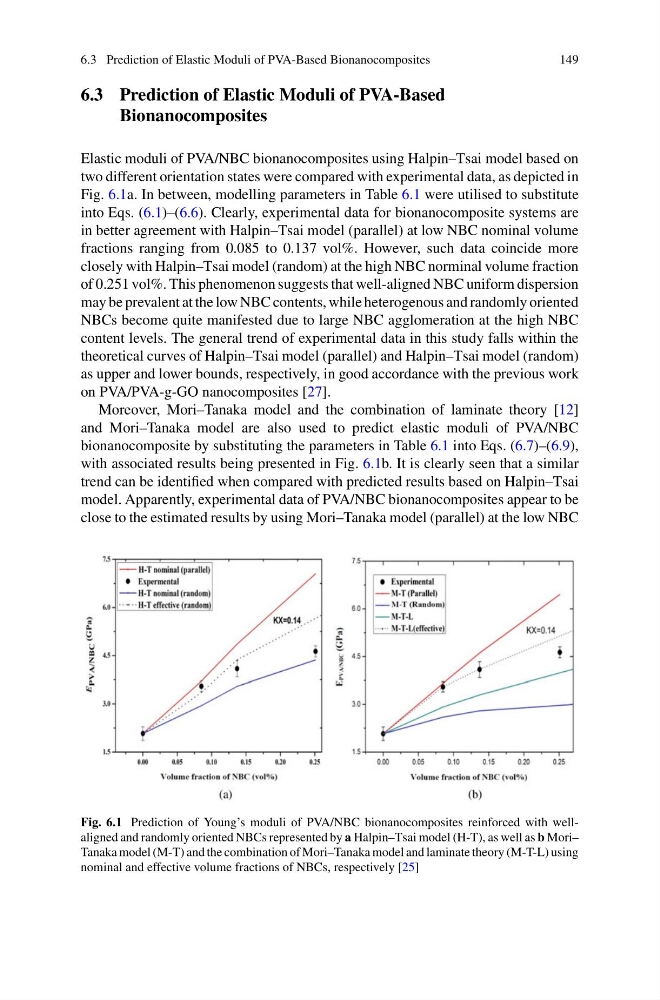
Elastic moduli of PVA/NBC bionanocomposites using Halpin–Tsai model based on
two different orientation states were compared with experimental data, as depicted in
Fig. 6.1a. In between, modelling parameters in Table 6.1 were utilised to substitute
into Eqs. (6.1)–(6.6). Clearly, experimental data for bionanocomposite systems are
in better agreement with Halpin–Tsai model (parallel) at low NBC nominal volume
fractions ranging from 0.085 to 0.137 vol%. However, such data coincide more
closely with Halpin–Tsai model (random) at the high NBC norminal volume fraction
of 0.251 vol%. This phenomenon suggests that well-aligned NBC uniform dispersion
may be prevalent at the low NBC contents, while heterogenous and randomly oriented
NBCs become quite manifested due to large NBC agglomeration at the high NBC
content levels. The general trend of experimental data in this study falls within the
theoretical curves of Halpin–Tsai model (parallel) and Halpin–Tsai model (random)
as upper and lower bounds, respectively, in good accordance with the previous work
on PVA/PVA-g-GO nanocomposites [27].
Moreover, Mori–Tanaka model and the combination of laminate theory [12]
and Mori–Tanaka model are also used to predict elastic moduli of PVA/NBC
bionanocomposite by substituting the parameters in Table 6.1 into Eqs. (6.7)–(6.9),
with associated results being presented in Fig. 6.1b. It is clearly seen that a similar
trend can be identified when compared with predicted results based on Halpin–Tsai
model. Apparently, experimental data of PVA/NBC bionanocomposites appear to be
close to the estimated results by using Mori–Tanaka model (parallel) at the low NBC
Fig. 6.1 Prediction of Young’s moduli of PVA/NBC bionanocomposites reinforced with wellaligned and randomly oriented NBCs represented by a Halpin–Tsai model (H-T), as well as b Mori–
Tanaka model (M-T) and the combination of Mori–Tanaka model and laminate theory (M-T-L) using
nominal and effective volume fractions of NBCs, respectively [25]
149
6.3 Prediction of Elastic Moduli of PVA-Based
Bionanocomposites
Elastic moduli of PVA/NBC bionanocomposites using Halpin–Tsai model based on
two different orientation states were compared with experimental data, as depicted in
Fig. 6.1a. In between, modelling parameters in Table 6.1 were utilised to substitute
into Eqs. (6.1)–(6.6). Clearly, experimental data for bionanocomposite systems are
in better agreement with Halpin–Tsai model (parallel) at low NBC nominal volume
fractions ranging from 0.085 to 0.137 vol%. However, such data coincide more
closely with Halpin–Tsai model (random) at the high NBC norminal volume fraction
of 0.251 vol%. This phenomenon suggests that well-aligned NBC uniform dispersion
may be prevalent at the low NBC contents, while heterogenous and randomly oriented
NBCs become quite manifested due to large NBC agglomeration at the high NBC
content levels. The general trend of experimental data in this study falls within the
theoretical curves of Halpin–Tsai model (parallel) and Halpin–Tsai model (random)
as upper and lower bounds, respectively, in good accordance with the previous work
on PVA/PVA-g-GO nanocomposites [27].
Moreover, Mori–Tanaka model and the combination of laminate theory [12]
and Mori–Tanaka model are also used to predict elastic moduli of PVA/NBC
bionanocomposite by substituting the parameters in Table 6.1 into Eqs. (6.7)–(6.9),
with associated results being presented in Fig. 6.1b. It is clearly seen that a similar
trend can be identified when compared with predicted results based on Halpin–Tsai
model. Apparently, experimental data of PVA/NBC bionanocomposites appear to be
close to the estimated results by using Mori–Tanaka model (parallel) at the low NBC
Fig. 6.1 Prediction of Young’s moduli of PVA/NBC bionanocomposites reinforced with wellaligned and randomly oriented NBCs represented by a Halpin–Tsai model (H-T), as well as b Mori–
Tanaka model (M-T) and the combination of Mori–Tanaka model and laminate theory (M-T-L) using
nominal and effective volume fractions of NBCs, respectively [25]