

5.2 Interphase Characterisation of PVA-Based Bionanocomposites
133
B
(c) A23
B23
A23
B23
(d)
(b)
(a)
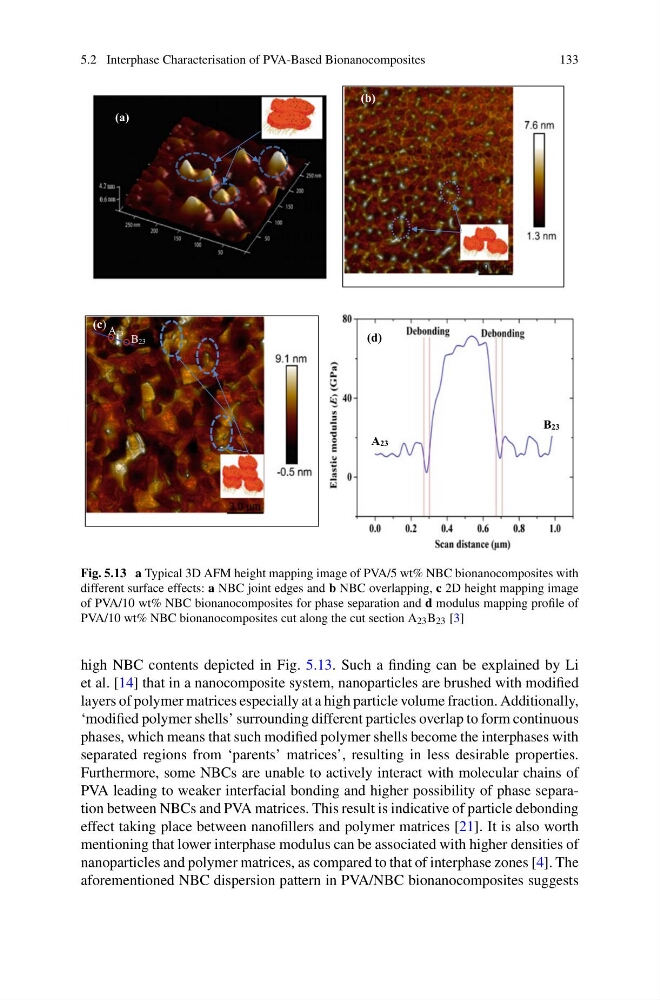
Fig. 5.13 a Typical 3D AFM height mapping image of PVA/5 wt% NBC bionanocomposites with
different surface effects: a NBC joint edges and b NBC overlapping, c 2D height mapping image
of PVA/10 wt% NBC bionanocomposites for phase separation and d modulus mapping profile of
PVA/10 wt% NBC bionanocomposites cut along the cut section A 23 B 23 [3]
high NBC contents depicted in Fig. 5.13. Such a finding can be explained by Li
et al. [14] that in a nanocomposite system, nanoparticles are brushed with modified
layers of polymer matrices especially at a high particle volume fraction. Additionally,
‘modified polymer shells’ surrounding different particles overlap to form continuous
phases, which means that such modified polymer shells become the interphases with
separated regions from ‘parents’ matrices’, resulting in less desirable properties.
Furthermore, some NBCs are unable to actively interact with molecular chains of
PVA leading to weaker interfacial bonding and higher possibility of phase separation between NBCs and PVA matrices. This result is indicative of particle debonding
effect taking place between nanofillers and polymer matrices [21]. It is also worth
mentioning that lower interphase modulus can be associated with higher densities of
nanoparticles and polymer matrices, as compared to that of interphase zones [4]. The
aforementioned NBC dispersion pattern in PVA/NBC bionanocomposites suggests
133
B
(c) A23
B23
A23
B23
(d)
(b)
(a)
Fig. 5.13 a Typical 3D AFM height mapping image of PVA/5 wt% NBC bionanocomposites with
different surface effects: a NBC joint edges and b NBC overlapping, c 2D height mapping image
of PVA/10 wt% NBC bionanocomposites for phase separation and d modulus mapping profile of
PVA/10 wt% NBC bionanocomposites cut along the cut section A 23 B 23 [3]
high NBC contents depicted in Fig. 5.13. Such a finding can be explained by Li
et al. [14] that in a nanocomposite system, nanoparticles are brushed with modified
layers of polymer matrices especially at a high particle volume fraction. Additionally,
‘modified polymer shells’ surrounding different particles overlap to form continuous
phases, which means that such modified polymer shells become the interphases with
separated regions from ‘parents’ matrices’, resulting in less desirable properties.
Furthermore, some NBCs are unable to actively interact with molecular chains of
PVA leading to weaker interfacial bonding and higher possibility of phase separation between NBCs and PVA matrices. This result is indicative of particle debonding
effect taking place between nanofillers and polymer matrices [21]. It is also worth
mentioning that lower interphase modulus can be associated with higher densities of
nanoparticles and polymer matrices, as compared to that of interphase zones [4]. The
aforementioned NBC dispersion pattern in PVA/NBC bionanocomposites suggests