

5.2 Interphase Characterisation of PVA-Based Bionanocomposites
121
(d)
(e)
(c)
B18
A18
Partially embedded
Cloisite30B
Fully embedded
Cloisite 30B
Fully embedded
Cloisite 30B
Partially embedded
Cloisite 30B
(a)
(b)
A18
B18
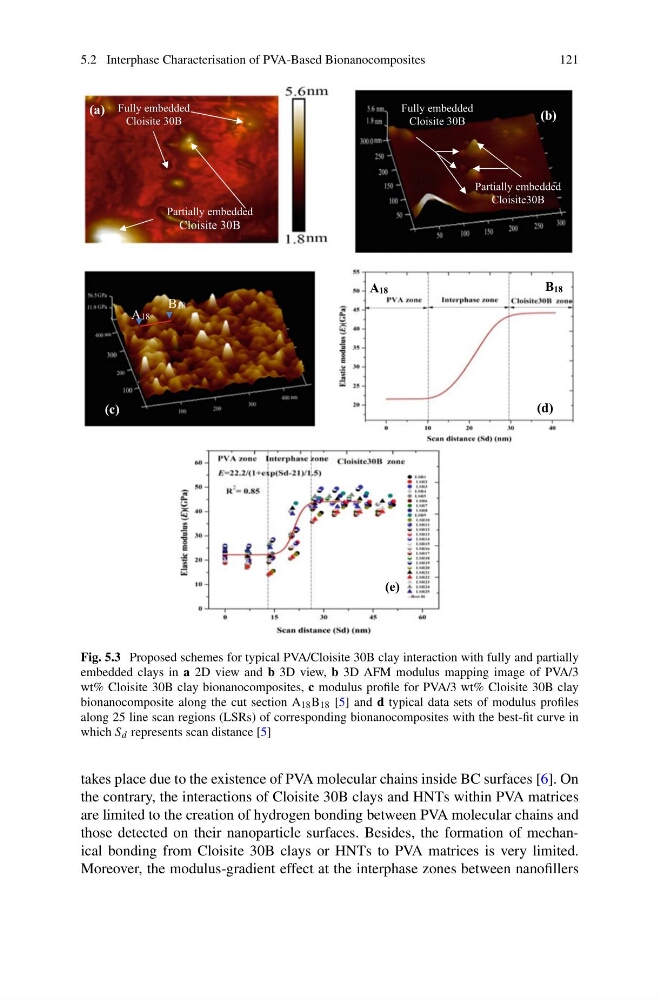
Fig. 5.3 Proposed schemes for typical PVA/Cloisite 30B clay interaction with fully and partially
embedded clays in a 2D view and b 3D view, b 3D AFM modulus mapping image of PVA/3
wt% Cloisite 30B clay bionanocomposites, c modulus profile for PVA/3 wt% Cloisite 30B clay
bionanocomposite along the cut section A 18 B 18 [5] and d typical data sets of modulus profiles
along 25 line scan regions (LSRs) of corresponding bionanocomposites with the best-fit curve in
which S d represents scan distance [5]
takes place due to the existence of PVA molecular chains inside BC surfaces [6]. On
the contrary, the interactions of Cloisite 30B clays and HNTs within PVA matrices
are limited to the creation of hydrogen bonding between PVA molecular chains and
those detected on their nanoparticle surfaces. Besides, the formation of mechanical bonding from Cloisite 30B clays or HNTs to PVA matrices is very limited.
Moreover, the modulus-gradient effect at the interphase zones between nanofillers
121
(d)
(e)
(c)
B18
A18
Partially embedded
Cloisite30B
Fully embedded
Cloisite 30B
Fully embedded
Cloisite 30B
Partially embedded
Cloisite 30B
(a)
(b)
A18
B18
Fig. 5.3 Proposed schemes for typical PVA/Cloisite 30B clay interaction with fully and partially
embedded clays in a 2D view and b 3D view, b 3D AFM modulus mapping image of PVA/3
wt% Cloisite 30B clay bionanocomposites, c modulus profile for PVA/3 wt% Cloisite 30B clay
bionanocomposite along the cut section A 18 B 18 [5] and d typical data sets of modulus profiles
along 25 line scan regions (LSRs) of corresponding bionanocomposites with the best-fit curve in
which S d represents scan distance [5]
takes place due to the existence of PVA molecular chains inside BC surfaces [6]. On
the contrary, the interactions of Cloisite 30B clays and HNTs within PVA matrices
are limited to the creation of hydrogen bonding between PVA molecular chains and
those detected on their nanoparticle surfaces. Besides, the formation of mechanical bonding from Cloisite 30B clays or HNTs to PVA matrices is very limited.
Moreover, the modulus-gradient effect at the interphase zones between nanofillers