

108
4 PVA Bionanocomposite Films with Different Particle …
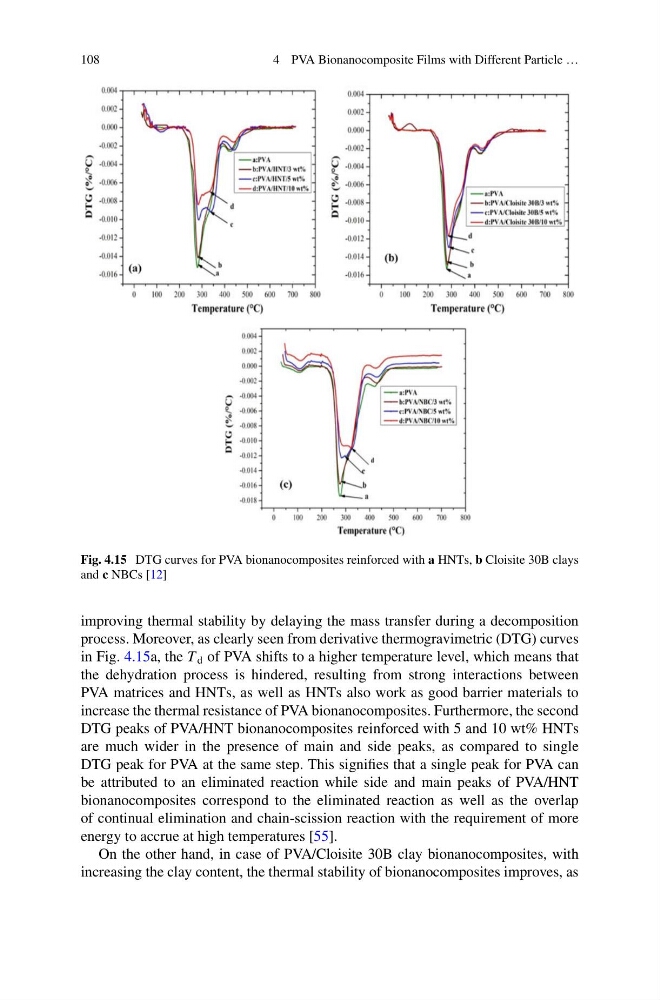
Fig. 4.15 DTG curves for PVA bionanocomposites reinforced with a HNTs, b Cloisite 30B clays
and c NBCs [12]
improving thermal stability by delaying the mass transfer during a decomposition
process. Moreover, as clearly seen from derivative thermogravimetric (DTG) curves
in Fig. 4.15a, the T d of PVA shifts to a higher temperature level, which means that
the dehydration process is hindered, resulting from strong interactions between
PVA matrices and HNTs, as well as HNTs also work as good barrier materials to
increase the thermal resistance of PVA bionanocomposites. Furthermore, the second
DTG peaks of PVA/HNT bionanocomposites reinforced with 5 and 10 wt% HNTs
are much wider in the presence of main and side peaks, as compared to single
DTG peak for PVA at the same step. This signifies that a single peak for PVA can
be attributed to an eliminated reaction while side and main peaks of PVA/HNT
bionanocomposites correspond to the eliminated reaction as well as the overlap
of continual elimination and chain-scission reaction with the requirement of more
energy to accrue at high temperatures [55].
On the other hand, in case of PVA/Cloisite 30B clay bionanocomposites, with
increasing the clay content, the thermal stability of bionanocomposites improves, as
4 PVA Bionanocomposite Films with Different Particle …
Fig. 4.15 DTG curves for PVA bionanocomposites reinforced with a HNTs, b Cloisite 30B clays
and c NBCs [12]
improving thermal stability by delaying the mass transfer during a decomposition
process. Moreover, as clearly seen from derivative thermogravimetric (DTG) curves
in Fig. 4.15a, the T d of PVA shifts to a higher temperature level, which means that
the dehydration process is hindered, resulting from strong interactions between
PVA matrices and HNTs, as well as HNTs also work as good barrier materials to
increase the thermal resistance of PVA bionanocomposites. Furthermore, the second
DTG peaks of PVA/HNT bionanocomposites reinforced with 5 and 10 wt% HNTs
are much wider in the presence of main and side peaks, as compared to single
DTG peak for PVA at the same step. This signifies that a single peak for PVA can
be attributed to an eliminated reaction while side and main peaks of PVA/HNT
bionanocomposites correspond to the eliminated reaction as well as the overlap
of continual elimination and chain-scission reaction with the requirement of more
energy to accrue at high temperatures [55].
On the other hand, in case of PVA/Cloisite 30B clay bionanocomposites, with
increasing the clay content, the thermal stability of bionanocomposites improves, as