

4.9 Thermal Properties
107
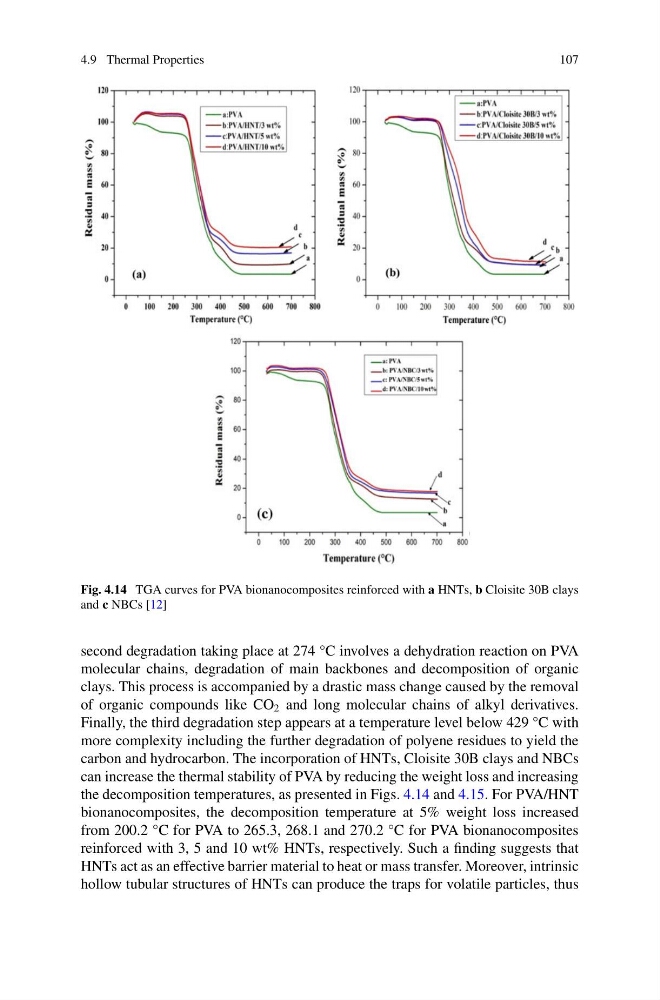
Fig. 4.14 TGA curves for PVA bionanocomposites reinforced with a HNTs, b Cloisite 30B clays
and c NBCs [12]
second degradation taking place at 274 °C involves a dehydration reaction on PVA
molecular chains, degradation of main backbones and decomposition of organic
clays. This process is accompanied by a drastic mass change caused by the removal
of organic compounds like CO 2 and long molecular chains of alkyl derivatives.
Finally, the third degradation step appears at a temperature level below 429 °C with
more complexity including the further degradation of polyene residues to yield the
carbon and hydrocarbon. The incorporation of HNTs, Cloisite 30B clays and NBCs
can increase the thermal stability of PVA by reducing the weight loss and increasing
the decomposition temperatures, as presented in Figs. 4.14 and 4.15. For PVA/HNT
bionanocomposites, the decomposition temperature at 5% weight loss increased
from 200.2 °C for PVA to 265.3, 268.1 and 270.2 °C for PVA bionanocomposites
reinforced with 3, 5 and 10 wt% HNTs, respectively. Such a finding suggests that
HNTs act as an effective barrier material to heat or mass transfer. Moreover, intrinsic
hollow tubular structures of HNTs can produce the traps for volatile particles, thus
107
Fig. 4.14 TGA curves for PVA bionanocomposites reinforced with a HNTs, b Cloisite 30B clays
and c NBCs [12]
second degradation taking place at 274 °C involves a dehydration reaction on PVA
molecular chains, degradation of main backbones and decomposition of organic
clays. This process is accompanied by a drastic mass change caused by the removal
of organic compounds like CO 2 and long molecular chains of alkyl derivatives.
Finally, the third degradation step appears at a temperature level below 429 °C with
more complexity including the further degradation of polyene residues to yield the
carbon and hydrocarbon. The incorporation of HNTs, Cloisite 30B clays and NBCs
can increase the thermal stability of PVA by reducing the weight loss and increasing
the decomposition temperatures, as presented in Figs. 4.14 and 4.15. For PVA/HNT
bionanocomposites, the decomposition temperature at 5% weight loss increased
from 200.2 °C for PVA to 265.3, 268.1 and 270.2 °C for PVA bionanocomposites
reinforced with 3, 5 and 10 wt% HNTs, respectively. Such a finding suggests that
HNTs act as an effective barrier material to heat or mass transfer. Moreover, intrinsic
hollow tubular structures of HNTs can produce the traps for volatile particles, thus