

For analysis of the internalization of bacteria into the cytoplasm, invaded cell populations are typically subjected to the gentamicin protection assay [5, 6]. While this method is widely adapted
for the analysis of cellular internalization, it may be flawed considering the potential for leakage of gentamicin into eukaryotic cells. It
is also possible that the eradication of bacterial vectors external to
the cell membrane by gentamicin may not be thorough. Minor
variations to these bacterial internalization and transgene expression assays have been successfully utilized [1, 7]; however, there is
no consensus regarding the accuracy in which invasion outcomes
are reported, especially including successful membrane attachment
and internalization into the cytoplasm.
High-resolution imaging can be applied as an alternative to
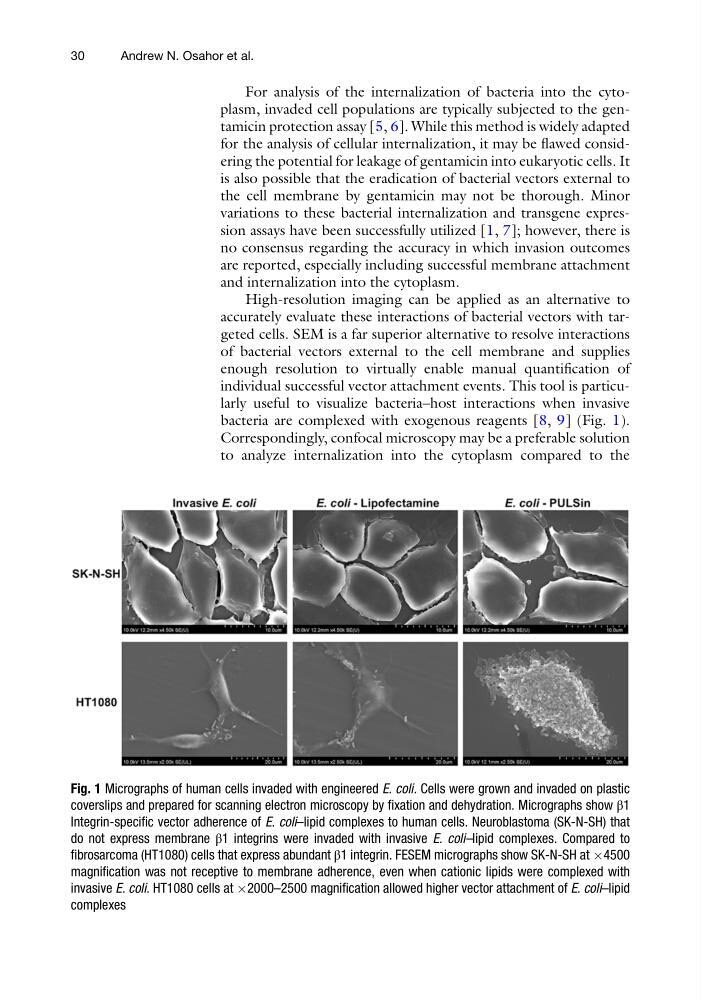
accurately evaluate these interactions of bacterial vectors with targeted cells. SEM is a far superior alternative to resolve interactions
of bacterial vectors external to the cell membrane and supplies
enough resolution to virtually enable manual quantification of
individual successful vector attachment events. This tool is particularly useful to visualize bacteria–host interactions when invasive
bacteria are complexed with exogenous reagents [8, 9] (Fig. 1).
Correspondingly, confocal microscopy may be a preferable solution
to analyze internalization into the cytoplasm compared to the
Fig. 1 Micrographs of human cells invaded with engineered E. coli. Cells were grown and invaded on plastic
coverslips and prepared for scanning electron microscopy by fixation and dehydration. Micrographs show β1
Integrin-specific vector adherence of E. coli–lipid complexes to human cells. Neuroblastoma (SK-N-SH) that
do not express membrane β1 integrins were invaded with invasive E. coli–lipid complexes. Compared to
fibrosarcoma (HT1080) cells that express abundant β1 integrin. FESEM micrographs show SK-N-SH at Â4500
magnification was not receptive to membrane adherence, even when cationic lipids were complexed with
invasive E. coli. HT1080 cells at Â2000–2500 magnification allowed higher vector attachment of E. coli–lipid
complexes
30
Andrew N. Osahor et al.
for the analysis of cellular internalization, it may be flawed considering the potential for leakage of gentamicin into eukaryotic cells. It
is also possible that the eradication of bacterial vectors external to
the cell membrane by gentamicin may not be thorough. Minor
variations to these bacterial internalization and transgene expression assays have been successfully utilized [1, 7]; however, there is
no consensus regarding the accuracy in which invasion outcomes
are reported, especially including successful membrane attachment
and internalization into the cytoplasm.
High-resolution imaging can be applied as an alternative to
accurately evaluate these interactions of bacterial vectors with targeted cells. SEM is a far superior alternative to resolve interactions
of bacterial vectors external to the cell membrane and supplies
enough resolution to virtually enable manual quantification of
individual successful vector attachment events. This tool is particularly useful to visualize bacteria–host interactions when invasive
bacteria are complexed with exogenous reagents [8, 9] (Fig. 1).
Correspondingly, confocal microscopy may be a preferable solution
to analyze internalization into the cytoplasm compared to the
Fig. 1 Micrographs of human cells invaded with engineered E. coli. Cells were grown and invaded on plastic
coverslips and prepared for scanning electron microscopy by fixation and dehydration. Micrographs show β1
Integrin-specific vector adherence of E. coli–lipid complexes to human cells. Neuroblastoma (SK-N-SH) that
do not express membrane β1 integrins were invaded with invasive E. coli–lipid complexes. Compared to
fibrosarcoma (HT1080) cells that express abundant β1 integrin. FESEM micrographs show SK-N-SH at Â4500
magnification was not receptive to membrane adherence, even when cationic lipids were complexed with
invasive E. coli. HT1080 cells at Â2000–2500 magnification allowed higher vector attachment of E. coli–lipid
complexes
30
Andrew N. Osahor et al.