

5. Place the reaction tube in a thermocycler by using the following
parameters: 37
C for 30 min; 95
C for 5 min; ramp down to
25
C at 5
C/min.
6. Dilute the phosphorylated and annealed oligonucleotide 1:200
by adding 1 μL of the oligonucleotide (step 5) to 199 μL of
ddH 2 O.
3.3 Cloning
of the Annealed sgRNA
Oligo into PX459
(sgRNA/PX459)
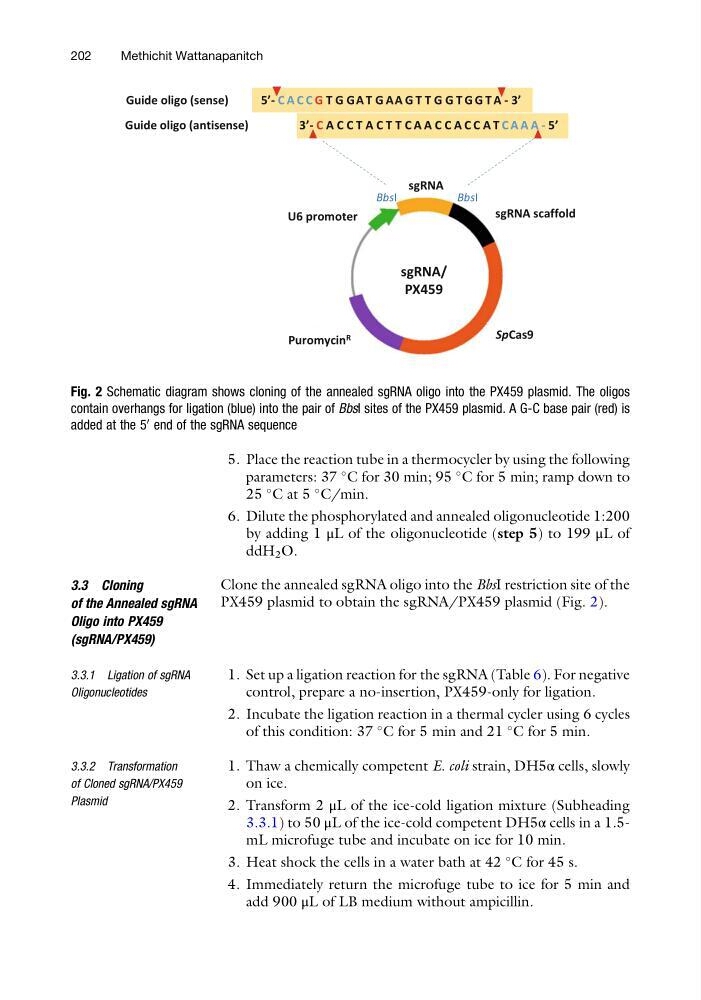
Clone the annealed sgRNA oligo into the BbsI restriction site of the
PX459 plasmid to obtain the sgRNA/PX459 plasmid (Fig. 2).
3.3.1 Ligation of sgRNA
Oligonucleotides
1. Set up a ligation reaction for the sgRNA (Table 6). For negative
control, prepare a no-insertion, PX459-only for ligation.
2. Incubate the ligation reaction in a thermal cycler using 6 cycles
of this condition: 37
C for 5 min and 21
C for 5 min.
3.3.2 Transformation
of Cloned sgRNA/PX459
Plasmid
1. Thaw a chemically competent E. coli strain, DH5α cells, slowly
on ice.
2. Transform 2 μL of the ice-cold ligation mixture (Subheading
3.3.1) to 50 μL of the ice-cold competent DH5α cells in a 1.5mL microfuge tube and incubate on ice for 10 min.
3. Heat shock the cells in a water bath at 42
C for 45 s.
4. Immediately return the microfuge tube to ice for 5 min and
add 900 μL of LB medium without ampicillin.
BbsI
sgRNA
SpCas9
BbsI
Guide oligo (sense)
Guide oligo (antisense)
sgRNA scaffold
5’- C A C C G T G GA T G AA G T T G G T G G T A - 3’
3’- C A C C T A C T T C A A C C A C C A T C A A A - 5’
U6 promoter
Puromycin R
sgRNA/
PX459
Fig. 2 Schematic diagram shows cloning of the annealed sgRNA oligo into the PX459 plasmid. The oligos
contain overhangs for ligation (blue) into the pair of BbsI sites of the PX459 plasmid. A G-C base pair (red) is
added at the 5
0
end of the sgRNA sequence
202
Methichit Wattanapanitch
parameters: 37
C for 30 min; 95
C for 5 min; ramp down to
25
C at 5
C/min.
6. Dilute the phosphorylated and annealed oligonucleotide 1:200
by adding 1 μL of the oligonucleotide (step 5) to 199 μL of
ddH 2 O.
3.3 Cloning
of the Annealed sgRNA
Oligo into PX459
(sgRNA/PX459)
Clone the annealed sgRNA oligo into the BbsI restriction site of the
PX459 plasmid to obtain the sgRNA/PX459 plasmid (Fig. 2).
3.3.1 Ligation of sgRNA
Oligonucleotides
1. Set up a ligation reaction for the sgRNA (Table 6). For negative
control, prepare a no-insertion, PX459-only for ligation.
2. Incubate the ligation reaction in a thermal cycler using 6 cycles
of this condition: 37
C for 5 min and 21
C for 5 min.
3.3.2 Transformation
of Cloned sgRNA/PX459
Plasmid
1. Thaw a chemically competent E. coli strain, DH5α cells, slowly
on ice.
2. Transform 2 μL of the ice-cold ligation mixture (Subheading
3.3.1) to 50 μL of the ice-cold competent DH5α cells in a 1.5mL microfuge tube and incubate on ice for 10 min.
3. Heat shock the cells in a water bath at 42
C for 45 s.
4. Immediately return the microfuge tube to ice for 5 min and
add 900 μL of LB medium without ampicillin.
BbsI
sgRNA
SpCas9
BbsI
Guide oligo (sense)
Guide oligo (antisense)
sgRNA scaffold
5’- C A C C G T G GA T G AA G T T G G T G G T A - 3’
3’- C A C C T A C T T C A A C C A C C A T C A A A - 5’
U6 promoter
Puromycin R
sgRNA/
PX459
Fig. 2 Schematic diagram shows cloning of the annealed sgRNA oligo into the PX459 plasmid. The oligos
contain overhangs for ligation (blue) into the pair of BbsI sites of the PX459 plasmid. A G-C base pair (red) is
added at the 5
0
end of the sgRNA sequence
202
Methichit Wattanapanitch