

3.1.3 Cryopreserving
iPSCs
This protocol is suitable for a confluent well of a 6-well plate.
1. Prepare 5 mL of a freezing solution (10% DMSO in mTeSR™1
medium) and chill at 4
C.
2. Harvest iPSCs according to the passaging protocol described in
Subheading 3.1.2, steps 2–6. Minimize the break-up of cell
aggregates.
3. Centrifuge the cell suspension at 500 Â g for 5 min at room
temperature.
4. Aspirate the medium.
5. Add 4 mL of chilled freezing solution dropwise to the cells
while gently rocking the tube back and forth.
6. Quickly dispense 1 mL aliquots of the suspension into four
cryogenic vials.
7. Transfer the cryovials into the cryopreservation box and store
at À80
C freezer for overnight.
8. Next day, transfer the vials to a liquid nitrogen tank for storage.
3.2 Design
and Construction
of sgRNA
The protocol for the construction of sgRNA is adapted from Ran,
et al. [11].
1. Design sgRNAs targeting the HbE mutation using the
CRISPR Design Tool (http://crispr.mit.edu/). Input the
region of around 200 bp spanning the HbE point mutation.
Select the gRNAs with the highest specificity and the lowest
off-targets, and the cleavage site as close to the HbE mutation
as possible (see Note 5).
2. Order the 20-bp oligonucleotide sequences as shown in
Table 1 (see Note 6).
3. Dilute the sgRNA oligonucleotides by resuspending the sense and
antisense strands in ddH 2 O to a final concentration of 100 μM.
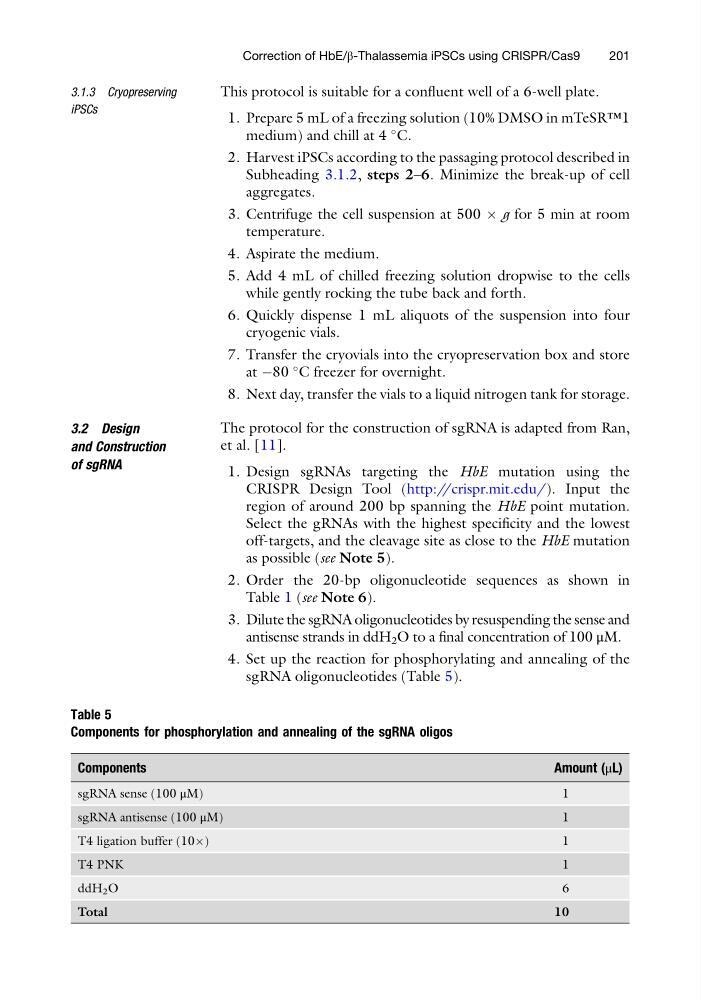
4. Set up the reaction for phosphorylating and annealing of the
sgRNA oligonucleotides (Table 5).
Table 5
Components for phosphorylation and annealing of the sgRNA oligos
Components
Amount (μL)
sgRNA sense (100 μM)
1
sgRNA antisense (100 μM)
1
T4 ligation buffer (10Â)
1
T4 PNK
1
ddH 2 O
6
Total
10
Correction of HbE/β-Thalassemia iPSCs using CRISPR/Cas9
201
iPSCs
This protocol is suitable for a confluent well of a 6-well plate.
1. Prepare 5 mL of a freezing solution (10% DMSO in mTeSR™1
medium) and chill at 4
C.
2. Harvest iPSCs according to the passaging protocol described in
Subheading 3.1.2, steps 2–6. Minimize the break-up of cell
aggregates.
3. Centrifuge the cell suspension at 500 Â g for 5 min at room
temperature.
4. Aspirate the medium.
5. Add 4 mL of chilled freezing solution dropwise to the cells
while gently rocking the tube back and forth.
6. Quickly dispense 1 mL aliquots of the suspension into four
cryogenic vials.
7. Transfer the cryovials into the cryopreservation box and store
at À80
C freezer for overnight.
8. Next day, transfer the vials to a liquid nitrogen tank for storage.
3.2 Design
and Construction
of sgRNA
The protocol for the construction of sgRNA is adapted from Ran,
et al. [11].
1. Design sgRNAs targeting the HbE mutation using the
CRISPR Design Tool (http://crispr.mit.edu/). Input the
region of around 200 bp spanning the HbE point mutation.
Select the gRNAs with the highest specificity and the lowest
off-targets, and the cleavage site as close to the HbE mutation
as possible (see Note 5).
2. Order the 20-bp oligonucleotide sequences as shown in
Table 1 (see Note 6).
3. Dilute the sgRNA oligonucleotides by resuspending the sense and
antisense strands in ddH 2 O to a final concentration of 100 μM.
4. Set up the reaction for phosphorylating and annealing of the
sgRNA oligonucleotides (Table 5).
Table 5
Components for phosphorylation and annealing of the sgRNA oligos
Components
Amount (μL)
sgRNA sense (100 μM)
1
sgRNA antisense (100 μM)
1
T4 ligation buffer (10Â)
1
T4 PNK
1
ddH 2 O
6
Total
10
Correction of HbE/β-Thalassemia iPSCs using CRISPR/Cas9
201