

In the fabrication process and formulation of the polymer
beads, the polysaccharide mixture, the cross-linking approaches of
the drug-carrying beads, and the resulting cross-linking densities
inaugurate altering drug release profiles [5]. An increased beads
matrix density by increasing the cross-linking density will lead to a
slower release of the drug out of the bead.
The chemical cross-linking approaches provides a stronger and
less flexible polymer matrix but is not necessarily reproducible.
However, radiation cross-linking using gamma, UV radiation, or
electron beams gives a replicable breakage and reformation of
chemical bonds between the polymer molecules [5]. The crosslinking approach of complex coacervation depends on electrostatic
attraction when two oppositely charged polymers are mixed, and it
is a low-cost technique that ensures mechanical and thermal protection of the bead encapsulated drug [5]. However, aggregation
and clumping are common limitations in the polymer beads
recovery.
Lastly, ionotropic gelation is another method that cross-links
and induces gelation of polyelectrolyte polymers in the presence of
counterions. It can be done in a conventional approach where the
polyelectrolyte polymer solution is manually dropped into the
cross-linking solution [7]. In order to prepare a homogenous
sized beads, a Buchi encapsulator is used for a more consistent
ionotropic gelation [8, 9]. Natural polysaccharide beads have
been produced via ionotropic gelation using chemical cross-linkers,
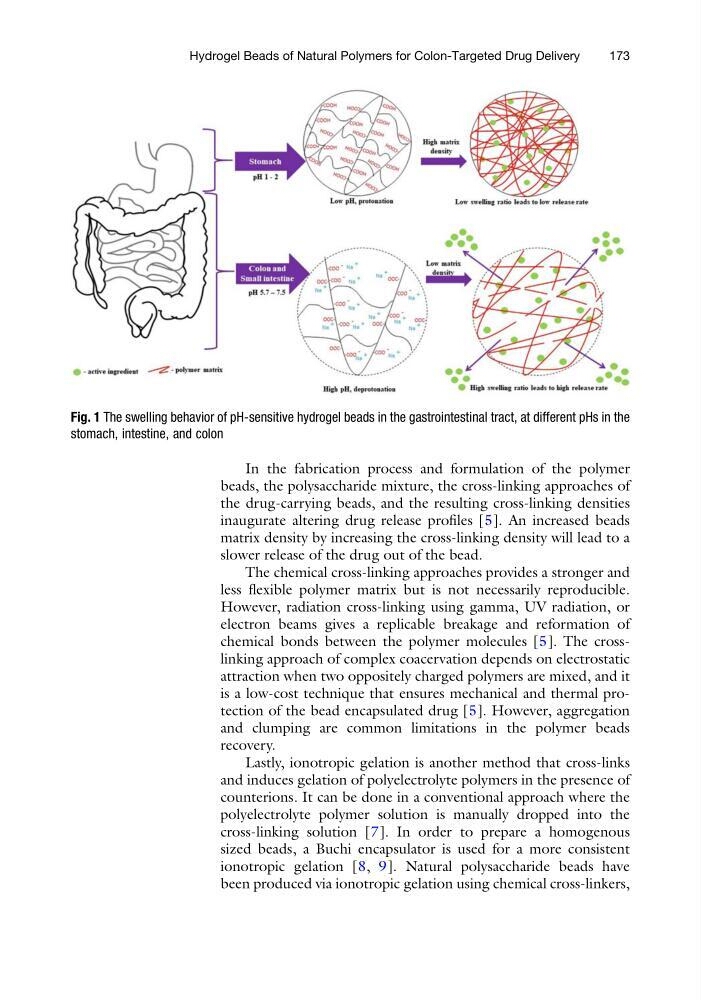
Fig. 1 The swelling behavior of pH-sensitive hydrogel beads in the gastrointestinal tract, at different pHs in the
stomach, intestine, and colon
Hydrogel Beads of Natural Polymers for Colon-Targeted Drug Delivery
173
beads, the polysaccharide mixture, the cross-linking approaches of
the drug-carrying beads, and the resulting cross-linking densities
inaugurate altering drug release profiles [5]. An increased beads
matrix density by increasing the cross-linking density will lead to a
slower release of the drug out of the bead.
The chemical cross-linking approaches provides a stronger and
less flexible polymer matrix but is not necessarily reproducible.
However, radiation cross-linking using gamma, UV radiation, or
electron beams gives a replicable breakage and reformation of
chemical bonds between the polymer molecules [5]. The crosslinking approach of complex coacervation depends on electrostatic
attraction when two oppositely charged polymers are mixed, and it
is a low-cost technique that ensures mechanical and thermal protection of the bead encapsulated drug [5]. However, aggregation
and clumping are common limitations in the polymer beads
recovery.
Lastly, ionotropic gelation is another method that cross-links
and induces gelation of polyelectrolyte polymers in the presence of
counterions. It can be done in a conventional approach where the
polyelectrolyte polymer solution is manually dropped into the
cross-linking solution [7]. In order to prepare a homogenous
sized beads, a Buchi encapsulator is used for a more consistent
ionotropic gelation [8, 9]. Natural polysaccharide beads have
been produced via ionotropic gelation using chemical cross-linkers,
Fig. 1 The swelling behavior of pH-sensitive hydrogel beads in the gastrointestinal tract, at different pHs in the
stomach, intestine, and colon
Hydrogel Beads of Natural Polymers for Colon-Targeted Drug Delivery
173