

exosomes isolation and lead to a false high protein amount in
the downstream analysis [50].
Similarly, in the case of CDNs production, several washing
steps are needed during cell harvesting to remove any residual
FBS on the cells prior to the centrifugation. This is to avoid the
interference
of
the
cow-derived
exosomes
when
quantifying CDNs.
8. Cells contain a large number of proteases. During the shearing
process (centrifugation), as the homeostasis and the controlled
environment become unbalanced, the endogenous proteases
could potentially degrade the surface membrane proteins on
CDNs [51]. The proteases used in this protocol include a
cocktail, containing protease inhibitors for serine proteases,
aminopeptidase B, leucine aminopeptidase, cysteine proteases,
and aspartic proteases. The detailed concentration can be
found at https://www.abcam.com/protease-inhibitor-cock
tail-edta-free-ab201111.html
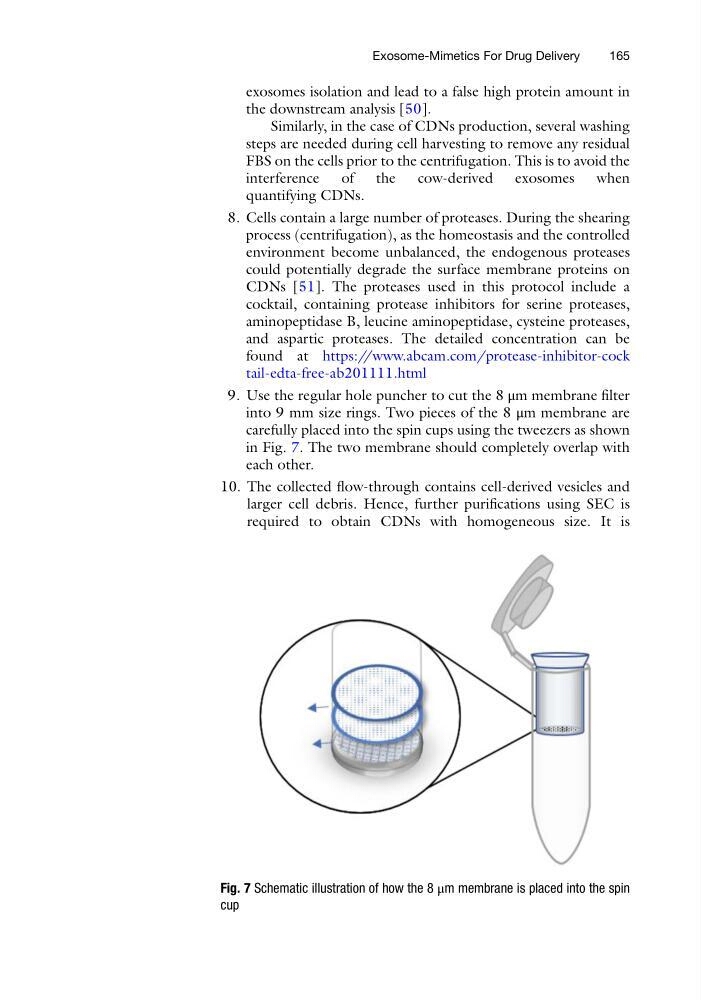
9. Use the regular hole puncher to cut the 8 μm membrane filter
into 9 mm size rings. Two pieces of the 8 μm membrane are
carefully placed into the spin cups using the tweezers as shown
in Fig. 7. The two membrane should completely overlap with
each other.
10. The collected flow-through contains cell-derived vesicles and
larger cell debris. Hence, further purifications using SEC is
required to obtain CDNs with homogeneous size. It is
Fig. 7 Schematic illustration of how the 8 μm membrane is placed into the spin
cup
Exosome-Mimetics For Drug Delivery
165
the downstream analysis [50].
Similarly, in the case of CDNs production, several washing
steps are needed during cell harvesting to remove any residual
FBS on the cells prior to the centrifugation. This is to avoid the
interference
of
the
cow-derived
exosomes
when
quantifying CDNs.
8. Cells contain a large number of proteases. During the shearing
process (centrifugation), as the homeostasis and the controlled
environment become unbalanced, the endogenous proteases
could potentially degrade the surface membrane proteins on
CDNs [51]. The proteases used in this protocol include a
cocktail, containing protease inhibitors for serine proteases,
aminopeptidase B, leucine aminopeptidase, cysteine proteases,
and aspartic proteases. The detailed concentration can be
found at https://www.abcam.com/protease-inhibitor-cock
tail-edta-free-ab201111.html
9. Use the regular hole puncher to cut the 8 μm membrane filter
into 9 mm size rings. Two pieces of the 8 μm membrane are
carefully placed into the spin cups using the tweezers as shown
in Fig. 7. The two membrane should completely overlap with
each other.
10. The collected flow-through contains cell-derived vesicles and
larger cell debris. Hence, further purifications using SEC is
required to obtain CDNs with homogeneous size. It is
Fig. 7 Schematic illustration of how the 8 μm membrane is placed into the spin
cup
Exosome-Mimetics For Drug Delivery
165