

clumping or inducing cell death. If adherent cells are used for
CDNs production, the cells should be rinsed with PBS before
trypsinization and collected into a fresh sterile tube, followed
by the same production protocol.
5. Trypan blue staining allows the discrimination between the
viable cell and dead cells: as the dead cells are unable to exclude
the dye, they become stained in blue. The trypan blue solution
should be filtered to remove any particles or precipitates in the
solution, which may interfere with the counting. A pipette is
used to fill the hemocytometer chamber slowly and continuously to prevent any bubble formation in the chamber. The
total number of cells and blue staining cells are counted under
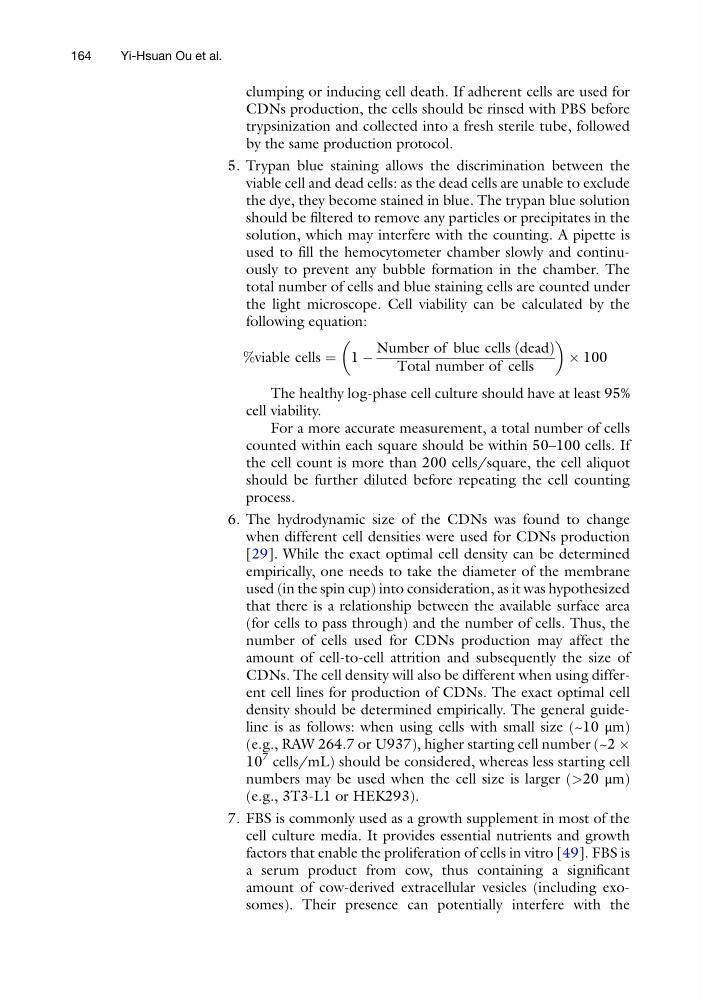
the light microscope. Cell viability can be calculated by the
following equation:
%viable cells ¼ 1 À
Number of blue cells dead
ð
Þ
Total number of cells
 100
The healthy log-phase cell culture should have at least 95%
cell viability.
For a more accurate measurement, a total number of cells
counted within each square should be within 50–100 cells. If
the cell count is more than 200 cells/square, the cell aliquot
should be further diluted before repeating the cell counting
process.
6. The hydrodynamic size of the CDNs was found to change
when different cell densities were used for CDNs production
[29]. While the exact optimal cell density can be determined
empirically, one needs to take the diameter of the membrane
used (in the spin cup) into consideration, as it was hypothesized
that there is a relationship between the available surface area
(for cells to pass through) and the number of cells. Thus, the
number of cells used for CDNs production may affect the
amount of cell-to-cell attrition and subsequently the size of
CDNs. The cell density will also be different when using different cell lines for production of CDNs. The exact optimal cell
density should be determined empirically. The general guideline is as follows: when using cells with small size (~10 μm)
(e.g., RAW 264.7 or U937), higher starting cell number (~2 Â
10
7 cells/mL) should be considered, whereas less starting cell
numbers may be used when the cell size is larger (>20 μm)
(e.g., 3T3-L1 or HEK293).
7. FBS is commonly used as a growth supplement in most of the
cell culture media. It provides essential nutrients and growth
factors that enable the proliferation of cells in vitro [49]. FBS is
a serum product from cow, thus containing a significant
amount of cow-derived extracellular vesicles (including exosomes). Their presence can potentially interfere with the
164
Yi-Hsuan Ou et al.
CDNs production, the cells should be rinsed with PBS before
trypsinization and collected into a fresh sterile tube, followed
by the same production protocol.
5. Trypan blue staining allows the discrimination between the
viable cell and dead cells: as the dead cells are unable to exclude
the dye, they become stained in blue. The trypan blue solution
should be filtered to remove any particles or precipitates in the
solution, which may interfere with the counting. A pipette is
used to fill the hemocytometer chamber slowly and continuously to prevent any bubble formation in the chamber. The
total number of cells and blue staining cells are counted under
the light microscope. Cell viability can be calculated by the
following equation:
%viable cells ¼ 1 À
Number of blue cells dead
ð
Þ
Total number of cells
 100
The healthy log-phase cell culture should have at least 95%
cell viability.
For a more accurate measurement, a total number of cells
counted within each square should be within 50–100 cells. If
the cell count is more than 200 cells/square, the cell aliquot
should be further diluted before repeating the cell counting
process.
6. The hydrodynamic size of the CDNs was found to change
when different cell densities were used for CDNs production
[29]. While the exact optimal cell density can be determined
empirically, one needs to take the diameter of the membrane
used (in the spin cup) into consideration, as it was hypothesized
that there is a relationship between the available surface area
(for cells to pass through) and the number of cells. Thus, the
number of cells used for CDNs production may affect the
amount of cell-to-cell attrition and subsequently the size of
CDNs. The cell density will also be different when using different cell lines for production of CDNs. The exact optimal cell
density should be determined empirically. The general guideline is as follows: when using cells with small size (~10 μm)
(e.g., RAW 264.7 or U937), higher starting cell number (~2 Â
10
7 cells/mL) should be considered, whereas less starting cell
numbers may be used when the cell size is larger (>20 μm)
(e.g., 3T3-L1 or HEK293).
7. FBS is commonly used as a growth supplement in most of the
cell culture media. It provides essential nutrients and growth
factors that enable the proliferation of cells in vitro [49]. FBS is
a serum product from cow, thus containing a significant
amount of cow-derived extracellular vesicles (including exosomes). Their presence can potentially interfere with the
164
Yi-Hsuan Ou et al.