

there is a need to engineer their surface (e.g., through PEGylation)
for improvement of their circulation time and enhancement of their
accumulation at the in vivo targets.
Third, another potential drawback is with regard to the immunogenicity. Though it has been claimed that endogenous exosomes
are likely to exhibit less immunogenic potential compared to other
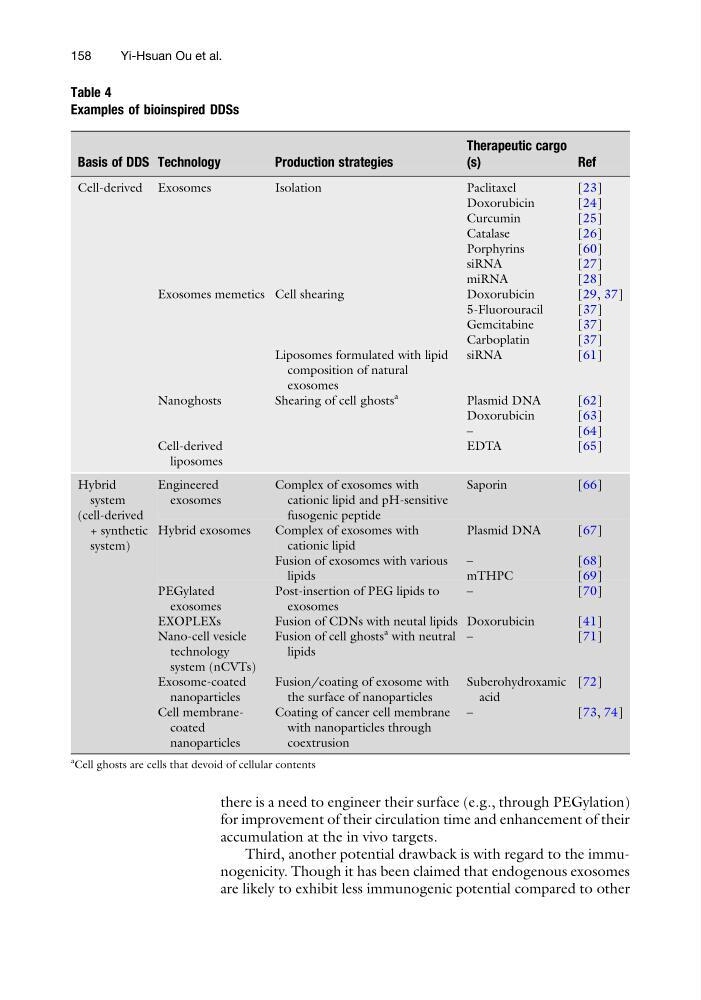
Table 4
Examples of bioinspired DDSs
Basis of DDS Technology
Production strategies
Therapeutic cargo
(s)
Ref
Cell-derived Exosomes
Isolation
Paclitaxel
Doxorubicin
Curcumin
Catalase
Porphyrins
siRNA
miRNA
[23]
[24]
[25]
[26]
[60]
[27]
[28]
Exosomes memetics Cell shearing
Doxorubicin
5-Fluorouracil
Gemcitabine
Carboplatin
[29, 37]
[37]
[37]
[37]
Liposomes formulated with lipid
composition of natural
exosomes
siRNA
[61]
Nanoghosts
Shearing of cell ghosts
a
Plasmid DNA
Doxorubicin
–
[62]
[63]
[64]
Cell-derived
liposomes
EDTA
[65]
Hybrid
system
(cell-derived
+ synthetic
system)
Engineered
exosomes
Complex of exosomes with
cationic lipid and pH-sensitive
fusogenic peptide
Saporin
[66]
Hybrid exosomes
Complex of exosomes with
cationic lipid
Plasmid DNA
[67]
Fusion of exosomes with various
lipids
–
mTHPC
[68]
[69]
PEGylated
exosomes
Post-insertion of PEG lipids to
exosomes
–
[ 70]
EXOPLEXs
Fusion of CDNs with neutal lipids Doxorubicin
[41]
Nano-cell vesicle
technology
system (nCVTs)
Fusion of cell ghosts
a with neutral
lipids
–
[ 71]
Exosome-coated
nanoparticles
Fusion/coating of exosome with
the surface of nanoparticles
Suberohydroxamic
acid
[72]
Cell membranecoated
nanoparticles
Coating of cancer cell membrane
with nanoparticles through
coextrusion
–
[ 73, 74]
a
Cell ghosts are cells that devoid of cellular contents
158
Yi-Hsuan Ou et al.
for improvement of their circulation time and enhancement of their
accumulation at the in vivo targets.
Third, another potential drawback is with regard to the immunogenicity. Though it has been claimed that endogenous exosomes
are likely to exhibit less immunogenic potential compared to other
Table 4
Examples of bioinspired DDSs
Basis of DDS Technology
Production strategies
Therapeutic cargo
(s)
Ref
Cell-derived Exosomes
Isolation
Paclitaxel
Doxorubicin
Curcumin
Catalase
Porphyrins
siRNA
miRNA
[23]
[24]
[25]
[26]
[60]
[27]
[28]
Exosomes memetics Cell shearing
Doxorubicin
5-Fluorouracil
Gemcitabine
Carboplatin
[29, 37]
[37]
[37]
[37]
Liposomes formulated with lipid
composition of natural
exosomes
siRNA
[61]
Nanoghosts
Shearing of cell ghosts
a
Plasmid DNA
Doxorubicin
–
[62]
[63]
[64]
Cell-derived
liposomes
EDTA
[65]
Hybrid
system
(cell-derived
+ synthetic
system)
Engineered
exosomes
Complex of exosomes with
cationic lipid and pH-sensitive
fusogenic peptide
Saporin
[66]
Hybrid exosomes
Complex of exosomes with
cationic lipid
Plasmid DNA
[67]
Fusion of exosomes with various
lipids
–
mTHPC
[68]
[69]
PEGylated
exosomes
Post-insertion of PEG lipids to
exosomes
–
[ 70]
EXOPLEXs
Fusion of CDNs with neutal lipids Doxorubicin
[41]
Nano-cell vesicle
technology
system (nCVTs)
Fusion of cell ghosts
a with neutral
lipids
–
[ 71]
Exosome-coated
nanoparticles
Fusion/coating of exosome with
the surface of nanoparticles
Suberohydroxamic
acid
[72]
Cell membranecoated
nanoparticles
Coating of cancer cell membrane
with nanoparticles through
coextrusion
–
[ 73, 74]
a
Cell ghosts are cells that devoid of cellular contents
158
Yi-Hsuan Ou et al.