

population) [46]; this R8-PNA conjugation is easily realized
during PNA solid-phase synthesis using the same reagents and
solvents.
16. When U251 cells are cultured in the presence of PNA-a221
and R8-PNA-a221 (see Note 1 for the design of miRNAinterfering PNAs), a clear-cut result should be obtained as
depicted in Fig. 4. First of all, culturing of U251 cells with
the PNA-a221 (lacking the R8 peptide) is not associated with
uptake by the cells (blue line). On the contrary, high level
uptake by R8-PNA-a221 should be reproducibly obtained
(orange line). Interestingly, incubation of U251 cells with the
argininocalix[4]arene 1/PNA-a221 formulation will lead to
uptake of the Fl-label PNA-a221 (green line). (See Note 17
for further considerations on the efficiency of PNA uptake by
target cells.)
17. In the case, FACS analyses are programmed to demonstrate
efficient uptake of the anti-miRNA PNAs, fluoresceinconjugated PNAs might be very useful to be complexed to
the argininocalix[4]arene (1) compound. In any case, the
FACS results should be confirmed by microscope-assisted
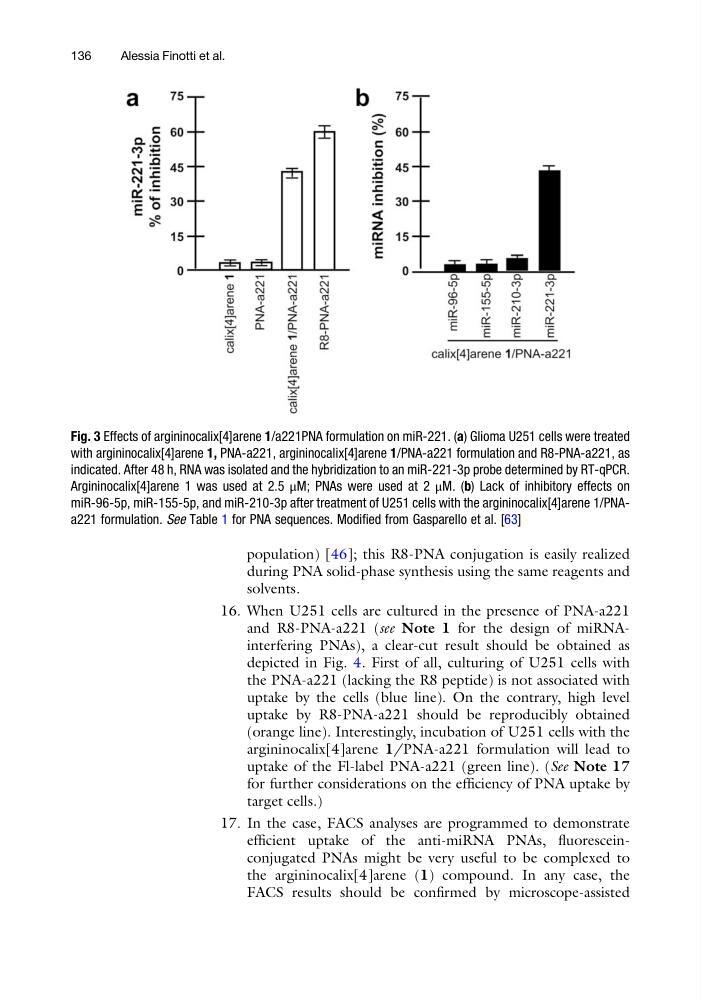
Fig. 3 Effects of argininocalix[4]arene 1/a221PNA formulation on miR-221. (a) Glioma U251 cells were treated
with argininocalix[4]arene 1, PNA-a221, argininocalix[4]arene 1/PNA-a221 formulation and R8-PNA-a221, as
indicated. After 48 h, RNA was isolated and the hybridization to an miR-221-3p probe determined by RT-qPCR.
Argininocalix[4]arene 1 was used at 2.5 μM; PNAs were used at 2 μM. (b) Lack of inhibitory effects on
miR-96-5p, miR-155-5p, and miR-210-3p after treatment of U251 cells with the argininocalix[4]arene 1/PNAa221 formulation. See Table 1 for PNA sequences. Modified from Gasparello et al. [63]
136
Alessia Finotti et al.
during PNA solid-phase synthesis using the same reagents and
solvents.
16. When U251 cells are cultured in the presence of PNA-a221
and R8-PNA-a221 (see Note 1 for the design of miRNAinterfering PNAs), a clear-cut result should be obtained as
depicted in Fig. 4. First of all, culturing of U251 cells with
the PNA-a221 (lacking the R8 peptide) is not associated with
uptake by the cells (blue line). On the contrary, high level
uptake by R8-PNA-a221 should be reproducibly obtained
(orange line). Interestingly, incubation of U251 cells with the
argininocalix[4]arene 1/PNA-a221 formulation will lead to
uptake of the Fl-label PNA-a221 (green line). (See Note 17
for further considerations on the efficiency of PNA uptake by
target cells.)
17. In the case, FACS analyses are programmed to demonstrate
efficient uptake of the anti-miRNA PNAs, fluoresceinconjugated PNAs might be very useful to be complexed to
the argininocalix[4]arene (1) compound. In any case, the
FACS results should be confirmed by microscope-assisted
Fig. 3 Effects of argininocalix[4]arene 1/a221PNA formulation on miR-221. (a) Glioma U251 cells were treated
with argininocalix[4]arene 1, PNA-a221, argininocalix[4]arene 1/PNA-a221 formulation and R8-PNA-a221, as
indicated. After 48 h, RNA was isolated and the hybridization to an miR-221-3p probe determined by RT-qPCR.
Argininocalix[4]arene 1 was used at 2.5 μM; PNAs were used at 2 μM. (b) Lack of inhibitory effects on
miR-96-5p, miR-155-5p, and miR-210-3p after treatment of U251 cells with the argininocalix[4]arene 1/PNAa221 formulation. See Table 1 for PNA sequences. Modified from Gasparello et al. [63]
136
Alessia Finotti et al.