

78
M. Burgay et al.
Looking for these different trends (typically appearing over different time scales
in our timing residual plot), one can fit different data-spans for the relevant
parameters, recursively improving the timing model and, consequently, the residuals
themselves. At the end of a successful timing procedure, we will have flat residuals
that are randomly distributed around the zero with a small rms, and a set of precise
timing parameters that correctly describe our pulsar. This allows us, for instance, to
perform studies of the binary in which the neutron star is included, of its companion
star and its gravitational effects, of the multiwavelength counterpart of our radio
pulsar (by means of the precise—sub-milliarcsecond—localisation allowed by the
timing), of the characteristics of the medium through which its signal has travelled
etc. Pulsar timing is, in summary, a very powerful tool.
As a closing remark to this section on timing, we want to point out that, although
the very high spin angular momentum of the compact object provides the basis
for using the rotation of all the pulsars-like emitters as a clock, not all the radio
emitting neutron stars are equally good time keepers. On one hand, there are neutron
stars (as described in Sect. 2.2) shining in the radio band only intermittently or
sporadically, intrinsically limiting the accuracy in the determination of their timing
parameters. On the other hand, also among the class of the steadily emitting pulsars,
there are sources exhibiting intrinsic rotational instabilities such as glitches (i.e.
sudden increases in spin frequency) and timing noise. Observations show that these
irregularities are mostly found in young and ordinary pulsars [71]. Recycled pulsars,
on the other hand, very rarely show these effects and, at most, only at a very low
level (e.g. [72]). Accuracy in the determination of the times of arrival, moreover,
besides depending on the flux density of the pulsar, scales with the duration of the
pulse itself, hence, roughly, with the star spin period; this, again, favours the rapidlyrotating recycled pulsars.
2.5 Probing Relativistic Gravity with Pulsars
The theory of general relativity is one of the most significant achievements of
modern science. Since the time of its formulation (1915), many experiments have
been performed to test the revolutionary scientific paradigm proposed by Albert
Einstein, starting with Eddington’s experiments in 1919, and most recently with the
breakthrough detections of gravitational waves from black hole and neutron star
binaries by the advanced LIGO and VIRGO detectors. To first approximation, the
effects of general relativity can be parametrized as deviations from Newtonian gravity. The amplitude of these deviations is related to the strength of the gravitational
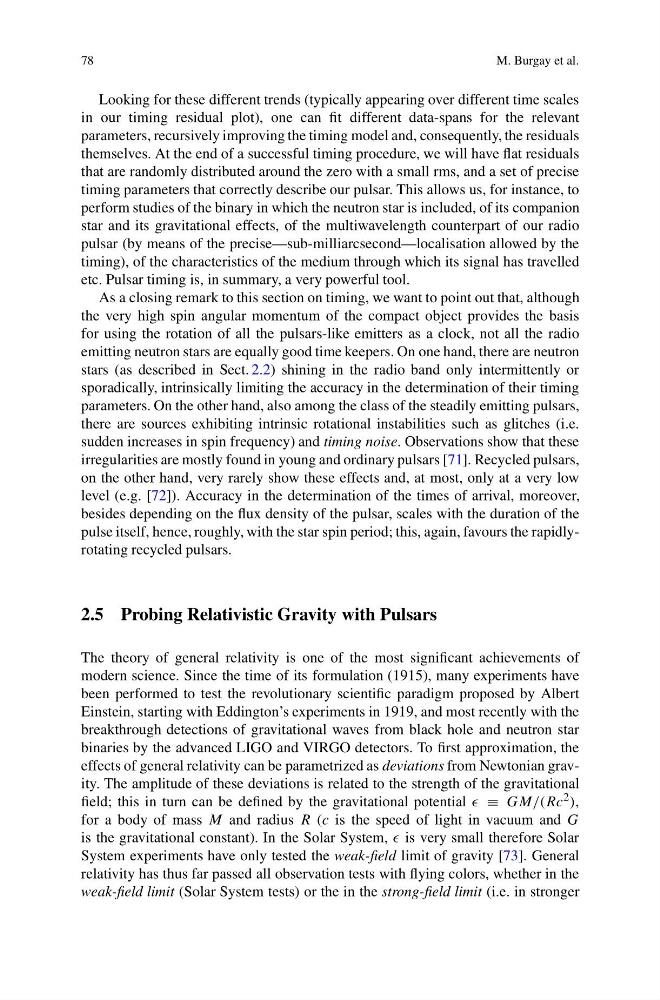
field; this in turn can be defined by the gravitational potential ≡ GM/(Rc 2 ),
for a body of mass M and radius R (c is the speed of light in vacuum and G
is the gravitational constant). In the Solar System, is very small therefore Solar
System experiments have only tested the weak-field limit of gravity [73]. General
relativity has thus far passed all observation tests with flying colors, whether in the
weak-field limit (Solar System tests) or the in the strong-field limit (i.e. in stronger
M. Burgay et al.
Looking for these different trends (typically appearing over different time scales
in our timing residual plot), one can fit different data-spans for the relevant
parameters, recursively improving the timing model and, consequently, the residuals
themselves. At the end of a successful timing procedure, we will have flat residuals
that are randomly distributed around the zero with a small rms, and a set of precise
timing parameters that correctly describe our pulsar. This allows us, for instance, to
perform studies of the binary in which the neutron star is included, of its companion
star and its gravitational effects, of the multiwavelength counterpart of our radio
pulsar (by means of the precise—sub-milliarcsecond—localisation allowed by the
timing), of the characteristics of the medium through which its signal has travelled
etc. Pulsar timing is, in summary, a very powerful tool.
As a closing remark to this section on timing, we want to point out that, although
the very high spin angular momentum of the compact object provides the basis
for using the rotation of all the pulsars-like emitters as a clock, not all the radio
emitting neutron stars are equally good time keepers. On one hand, there are neutron
stars (as described in Sect. 2.2) shining in the radio band only intermittently or
sporadically, intrinsically limiting the accuracy in the determination of their timing
parameters. On the other hand, also among the class of the steadily emitting pulsars,
there are sources exhibiting intrinsic rotational instabilities such as glitches (i.e.
sudden increases in spin frequency) and timing noise. Observations show that these
irregularities are mostly found in young and ordinary pulsars [71]. Recycled pulsars,
on the other hand, very rarely show these effects and, at most, only at a very low
level (e.g. [72]). Accuracy in the determination of the times of arrival, moreover,
besides depending on the flux density of the pulsar, scales with the duration of the
pulse itself, hence, roughly, with the star spin period; this, again, favours the rapidlyrotating recycled pulsars.
2.5 Probing Relativistic Gravity with Pulsars
The theory of general relativity is one of the most significant achievements of
modern science. Since the time of its formulation (1915), many experiments have
been performed to test the revolutionary scientific paradigm proposed by Albert
Einstein, starting with Eddington’s experiments in 1919, and most recently with the
breakthrough detections of gravitational waves from black hole and neutron star
binaries by the advanced LIGO and VIRGO detectors. To first approximation, the
effects of general relativity can be parametrized as deviations from Newtonian gravity. The amplitude of these deviations is related to the strength of the gravitational
field; this in turn can be defined by the gravitational potential ≡ GM/(Rc 2 ),
for a body of mass M and radius R (c is the speed of light in vacuum and G
is the gravitational constant). In the Solar System, is very small therefore Solar
System experiments have only tested the weak-field limit of gravity [73]. General
relativity has thus far passed all observation tests with flying colors, whether in the
weak-field limit (Solar System tests) or the in the strong-field limit (i.e. in stronger