

1 Astrophysical Constraints on Dense Matter in Neutron Stars
35
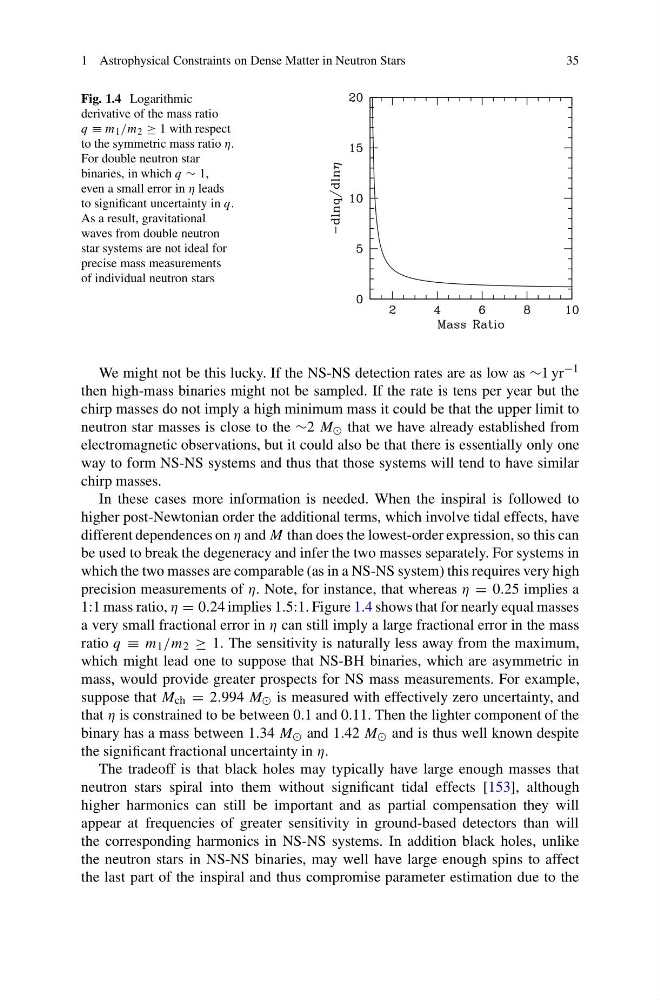
Fig. 1.4 Logarithmic
derivative of the mass ratio
q ≡ m 1 /m 2 ≥ 1 with respect
to the symmetric mass ratio η.
For double neutron star
binaries, in which q ∼ 1,
even a small error in η leads
to significant uncertainty in q.
As a result, gravitational
waves from double neutron
star systems are not ideal for
precise mass measurements
of individual neutron stars
We might not be this lucky. If the NS-NS detection rates are as low as ∼1 yr −1
then high-mass binaries might not be sampled. If the rate is tens per year but the
chirp masses do not imply a high minimum mass it could be that the upper limit to
neutron star masses is close to the ∼2 M that we have already established from
electromagnetic observations, but it could also be that there is essentially only one
way to form NS-NS systems and thus that those systems will tend to have similar
chirp masses.
In these cases more information is needed. When the inspiral is followed to
higher post-Newtonian order the additional terms, which involve tidal effects, have
different dependences on η and M than does the lowest-order expression, so this can
be used to break the degeneracy and infer the two masses separately. For systems in
which the two masses are comparable (as in a NS-NS system) this requires very high
precision measurements of η. Note, for instance, that whereas η = 0.25 implies a
1:1 mass ratio, η = 0.24 implies 1.5:1. Figure 1.4 shows that for nearly equal masses
a very small fractional error in η can still imply a large fractional error in the mass
ratio q ≡ m 1 /m 2 ≥ 1. The sensitivity is naturally less away from the maximum,
which might lead one to suppose that NS-BH binaries, which are asymmetric in
mass, would provide greater prospects for NS mass measurements. For example,
suppose that M ch = 2.994 M is measured with effectively zero uncertainty, and
that η is constrained to be between 0.1 and 0.11. Then the lighter component of the
binary has a mass between 1.34 M and 1.42 M and is thus well known despite
the significant fractional uncertainty in η.
The tradeoff is that black holes may typically have large enough masses that
neutron stars spiral into them without significant tidal effects [153], although
higher harmonics can still be important and as partial compensation they will
appear at frequencies of greater sensitivity in ground-based detectors than will
the corresponding harmonics in NS-NS systems. In addition black holes, unlike
the neutron stars in NS-NS binaries, may well have large enough spins to affect
the last part of the inspiral and thus compromise parameter estimation due to the
35
Fig. 1.4 Logarithmic
derivative of the mass ratio
q ≡ m 1 /m 2 ≥ 1 with respect
to the symmetric mass ratio η.
For double neutron star
binaries, in which q ∼ 1,
even a small error in η leads
to significant uncertainty in q.
As a result, gravitational
waves from double neutron
star systems are not ideal for
precise mass measurements
of individual neutron stars
We might not be this lucky. If the NS-NS detection rates are as low as ∼1 yr −1
then high-mass binaries might not be sampled. If the rate is tens per year but the
chirp masses do not imply a high minimum mass it could be that the upper limit to
neutron star masses is close to the ∼2 M that we have already established from
electromagnetic observations, but it could also be that there is essentially only one
way to form NS-NS systems and thus that those systems will tend to have similar
chirp masses.
In these cases more information is needed. When the inspiral is followed to
higher post-Newtonian order the additional terms, which involve tidal effects, have
different dependences on η and M than does the lowest-order expression, so this can
be used to break the degeneracy and infer the two masses separately. For systems in
which the two masses are comparable (as in a NS-NS system) this requires very high
precision measurements of η. Note, for instance, that whereas η = 0.25 implies a
1:1 mass ratio, η = 0.24 implies 1.5:1. Figure 1.4 shows that for nearly equal masses
a very small fractional error in η can still imply a large fractional error in the mass
ratio q ≡ m 1 /m 2 ≥ 1. The sensitivity is naturally less away from the maximum,
which might lead one to suppose that NS-BH binaries, which are asymmetric in
mass, would provide greater prospects for NS mass measurements. For example,
suppose that M ch = 2.994 M is measured with effectively zero uncertainty, and
that η is constrained to be between 0.1 and 0.11. Then the lighter component of the
binary has a mass between 1.34 M and 1.42 M and is thus well known despite
the significant fractional uncertainty in η.
The tradeoff is that black holes may typically have large enough masses that
neutron stars spiral into them without significant tidal effects [153], although
higher harmonics can still be important and as partial compensation they will
appear at frequencies of greater sensitivity in ground-based detectors than will
the corresponding harmonics in NS-NS systems. In addition black holes, unlike
the neutron stars in NS-NS binaries, may well have large enough spins to affect
the last part of the inspiral and thus compromise parameter estimation due to the