

34
M. C. Miller
magnetic atmospheres, and even the straw man blackbody spectrum), and thus have
greater confidence in the inferred temperatures. It will be more challenging to come
up with much more precise and accurate ages, but it could be that future radio arrays
such as the Square Kilometer Array will allow us to determine the proper motion
and kinetic ages more accurately.
1.6 Gravitational Waves from Coalescing Binaries
In the next few years it is expected that the worldwide gravitational wave detector
network will achieve sufficient sensitivity to detect ∼0.4−400 NS-NS mergers
per year, and an uncertain number of NS-BH coalescences (see [2] for a recent
discussion of the predicted rates and their substantial uncertainties). In this section
we summarize what can be learned from such observations. It has also been
proposed that observation of neutron star oscillation modes stimulated by mergers
or (at much lower amplitude) glitches would yield important information about the
stars (see, e.g., [21, 60, 61, 73, 221]); this is true, but the amplitudes are likely to be
significantly below the amplitudes of the coalescence signal, so we will not focus
on oscillations here.
In brief, for a binary of masses m 1 and m 2 and thus total mass M = m 1 + m 2
and symmetric mass ratio η = m 1 m 2 /M 2 (note that η ≤ 0.25, with the maximum
occurring for m 1 = m 2 ), the combination ηM 5/3 will be determined with high
precision and could lead to significant constraints if a high enough mass binary is
detected. The individual masses and the average density of the neutron stars will be
more challenging to measure, but they seem within reach for the strongest events.
In more detail, we note that to lowest order gravitational radiation changes the
binary orbital frequency at a rate (see [177] for the rate of change of the semimajor
axis)
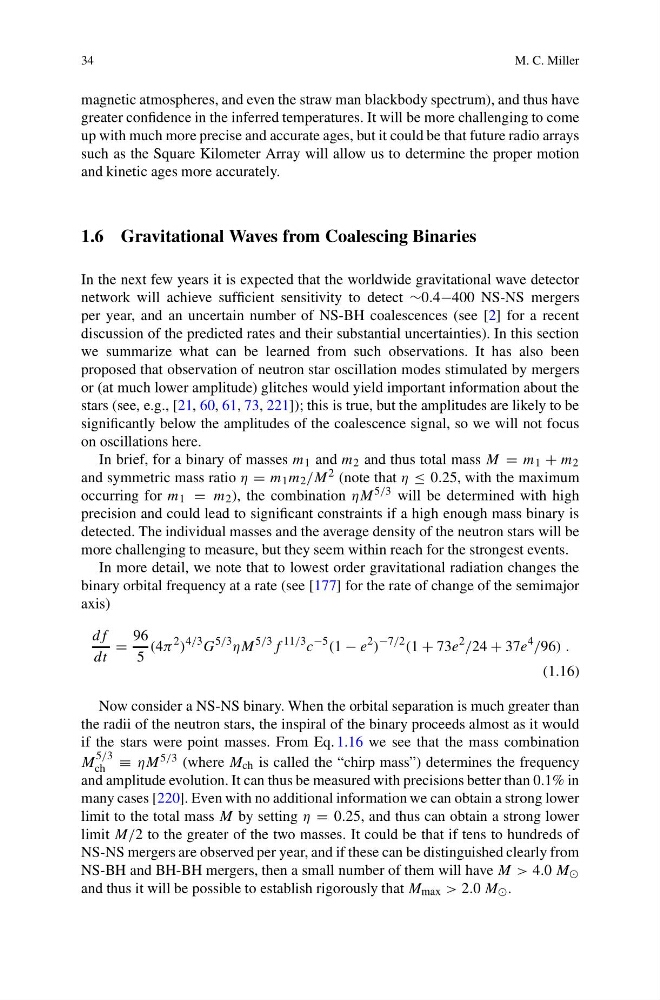
df
dt
=
96
5
(4π
2 )
4/3 G
5/3 ηM
5/3 f
11/3 c
−5 (1 − e
2 )
−7/2 (1 + 73e
2 /24 + 37e
4 /96) .
(1.16)
Now consider a NS-NS binary. When the orbital separation is much greater than
the radii of the neutron stars, the inspiral of the binary proceeds almost as it would
if the stars were point masses. From Eq. 1.16 we see that the mass combination
M
5/3
ch ≡ ηM 5/3 (where M ch is called the “chirp mass”) determines the frequency
and amplitude evolution. It can thus be measured with precisions better than 0.1% in
many cases [220]. Even with no additional information we can obtain a strong lower
limit to the total mass M by setting η = 0.25, and thus can obtain a strong lower
limit M/2 to the greater of the two masses. It could be that if tens to hundreds of
NS-NS mergers are observed per year, and if these can be distinguished clearly from
NS-BH and BH-BH mergers, then a small number of them will have M > 4.0 M
and thus it will be possible to establish rigorously that M max > 2.0 M .
M. C. Miller
magnetic atmospheres, and even the straw man blackbody spectrum), and thus have
greater confidence in the inferred temperatures. It will be more challenging to come
up with much more precise and accurate ages, but it could be that future radio arrays
such as the Square Kilometer Array will allow us to determine the proper motion
and kinetic ages more accurately.
1.6 Gravitational Waves from Coalescing Binaries
In the next few years it is expected that the worldwide gravitational wave detector
network will achieve sufficient sensitivity to detect ∼0.4−400 NS-NS mergers
per year, and an uncertain number of NS-BH coalescences (see [2] for a recent
discussion of the predicted rates and their substantial uncertainties). In this section
we summarize what can be learned from such observations. It has also been
proposed that observation of neutron star oscillation modes stimulated by mergers
or (at much lower amplitude) glitches would yield important information about the
stars (see, e.g., [21, 60, 61, 73, 221]); this is true, but the amplitudes are likely to be
significantly below the amplitudes of the coalescence signal, so we will not focus
on oscillations here.
In brief, for a binary of masses m 1 and m 2 and thus total mass M = m 1 + m 2
and symmetric mass ratio η = m 1 m 2 /M 2 (note that η ≤ 0.25, with the maximum
occurring for m 1 = m 2 ), the combination ηM 5/3 will be determined with high
precision and could lead to significant constraints if a high enough mass binary is
detected. The individual masses and the average density of the neutron stars will be
more challenging to measure, but they seem within reach for the strongest events.
In more detail, we note that to lowest order gravitational radiation changes the
binary orbital frequency at a rate (see [177] for the rate of change of the semimajor
axis)
df
dt
=
96
5
(4π
2 )
4/3 G
5/3 ηM
5/3 f
11/3 c
−5 (1 − e
2 )
−7/2 (1 + 73e
2 /24 + 37e
4 /96) .
(1.16)
Now consider a NS-NS binary. When the orbital separation is much greater than
the radii of the neutron stars, the inspiral of the binary proceeds almost as it would
if the stars were point masses. From Eq. 1.16 we see that the mass combination
M
5/3
ch ≡ ηM 5/3 (where M ch is called the “chirp mass”) determines the frequency
and amplitude evolution. It can thus be measured with precisions better than 0.1% in
many cases [220]. Even with no additional information we can obtain a strong lower
limit to the total mass M by setting η = 0.25, and thus can obtain a strong lower
limit M/2 to the greater of the two masses. It could be that if tens to hundreds of
NS-NS mergers are observed per year, and if these can be distinguished clearly from
NS-BH and BH-BH mergers, then a small number of them will have M > 4.0 M
and thus it will be possible to establish rigorously that M max > 2.0 M .