

6 High-Frequency Variability in Neutron-Star Low-Mass X-ray Binaries
319
Figure 6.37b shows the result of a similar analysis for the lower kHz QPO in
4U 1608−52 on the time scale of the millihertz QPO in this source [137]. In this
case, again, the frequency of the QPO changes over the cycle of the millihertz QPO
and is anti correlated with the source count rate in that cycle. This result, and the
previous one, could be explained if, for instance, the upper kHz QPO in Sco X-1 and
the lower kHz QPO in 4U 1608−52 are produced at the inner edge of the accretion
disc, and the value of the inner radius of the disc is modulated by radiation coming
from the neutron-star surface on the time scale of the NBO signal in the case of
Sco X-1, and the time scale of the millihertz QPO in 4U 1608−52.
6.9 Probing Neutron-Star Interiors and GR with kHz QPO
The Keplerian orbital frequency at a radial distance r from the centre of a slowly
rotating neutron star (to first order in the specific angular momentum, j =
cJ /GM 2 ) is:
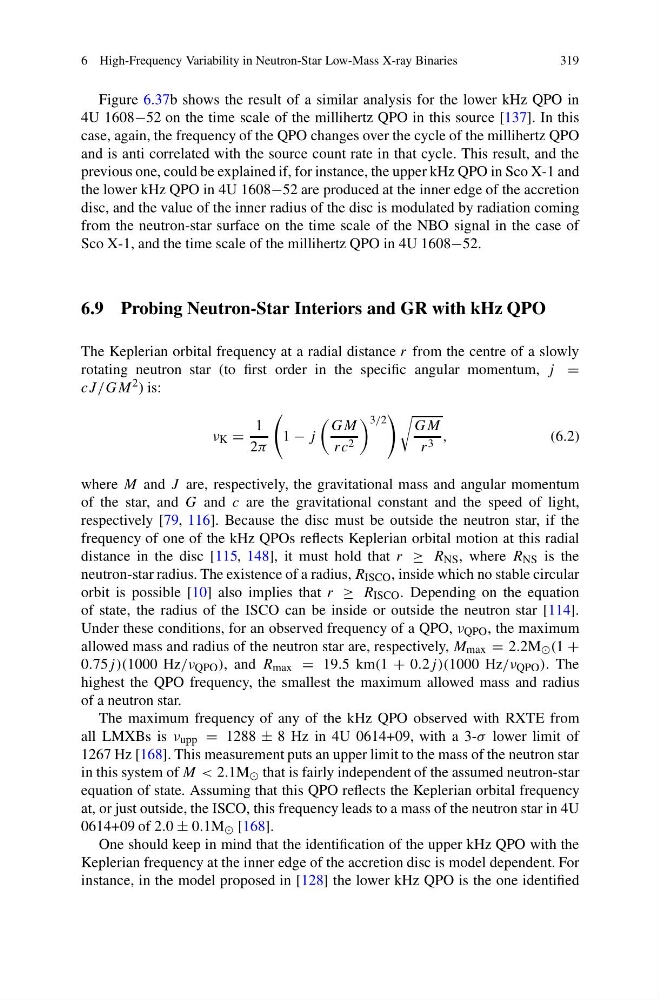
ν K =
1
2π
1 − j
GM
rc 2
3/2
GM
r 3 ,
(6.2)
where M and J are, respectively, the gravitational mass and angular momentum
of the star, and G and c are the gravitational constant and the speed of light,
respectively [79, 116]. Because the disc must be outside the neutron star, if the
frequency of one of the kHz QPOs reflects Keplerian orbital motion at this radial
distance in the disc [115, 148], it must hold that r ≥ R NS , where R NS is the
neutron-star radius. The existence of a radius, R ISCO , inside which no stable circular
orbit is possible [10] also implies that r ≥ R ISCO . Depending on the equation
of state, the radius of the ISCO can be inside or outside the neutron star [114].
Under these conditions, for an observed frequency of a QPO, ν QPO , the maximum
allowed mass and radius of the neutron star are, respectively, M max = 2.2M (1 +
0.75j )(1000 Hz/ν QPO ), and R max = 19.5 km(1 + 0.2j )(1000 Hz/ν QPO ). The
highest the QPO frequency, the smallest the maximum allowed mass and radius
of a neutron star.
The maximum frequency of any of the kHz QPO observed with RXTE from
all LMXBs is ν upp = 1288 ± 8 Hz in 4U 0614+09, with a 3-σ lower limit of
1267 Hz [168]. This measurement puts an upper limit to the mass of the neutron star
in this system of M < 2.1M that is fairly independent of the assumed neutron-star
equation of state. Assuming that this QPO reflects the Keplerian orbital frequency
at, or just outside, the ISCO, this frequency leads to a mass of the neutron star in 4U
0614+09 of 2.0 ± 0.1M [168].
One should keep in mind that the identification of the upper kHz QPO with the
Keplerian frequency at the inner edge of the accretion disc is model dependent. For
instance, in the model proposed in [128] the lower kHz QPO is the one identified
319
Figure 6.37b shows the result of a similar analysis for the lower kHz QPO in
4U 1608−52 on the time scale of the millihertz QPO in this source [137]. In this
case, again, the frequency of the QPO changes over the cycle of the millihertz QPO
and is anti correlated with the source count rate in that cycle. This result, and the
previous one, could be explained if, for instance, the upper kHz QPO in Sco X-1 and
the lower kHz QPO in 4U 1608−52 are produced at the inner edge of the accretion
disc, and the value of the inner radius of the disc is modulated by radiation coming
from the neutron-star surface on the time scale of the NBO signal in the case of
Sco X-1, and the time scale of the millihertz QPO in 4U 1608−52.
6.9 Probing Neutron-Star Interiors and GR with kHz QPO
The Keplerian orbital frequency at a radial distance r from the centre of a slowly
rotating neutron star (to first order in the specific angular momentum, j =
cJ /GM 2 ) is:
ν K =
1
2π
1 − j
GM
rc 2
3/2
GM
r 3 ,
(6.2)
where M and J are, respectively, the gravitational mass and angular momentum
of the star, and G and c are the gravitational constant and the speed of light,
respectively [79, 116]. Because the disc must be outside the neutron star, if the
frequency of one of the kHz QPOs reflects Keplerian orbital motion at this radial
distance in the disc [115, 148], it must hold that r ≥ R NS , where R NS is the
neutron-star radius. The existence of a radius, R ISCO , inside which no stable circular
orbit is possible [10] also implies that r ≥ R ISCO . Depending on the equation
of state, the radius of the ISCO can be inside or outside the neutron star [114].
Under these conditions, for an observed frequency of a QPO, ν QPO , the maximum
allowed mass and radius of the neutron star are, respectively, M max = 2.2M (1 +
0.75j )(1000 Hz/ν QPO ), and R max = 19.5 km(1 + 0.2j )(1000 Hz/ν QPO ). The
highest the QPO frequency, the smallest the maximum allowed mass and radius
of a neutron star.
The maximum frequency of any of the kHz QPO observed with RXTE from
all LMXBs is ν upp = 1288 ± 8 Hz in 4U 0614+09, with a 3-σ lower limit of
1267 Hz [168]. This measurement puts an upper limit to the mass of the neutron star
in this system of M < 2.1M that is fairly independent of the assumed neutron-star
equation of state. Assuming that this QPO reflects the Keplerian orbital frequency
at, or just outside, the ISCO, this frequency leads to a mass of the neutron star in 4U
0614+09 of 2.0 ± 0.1M [168].
One should keep in mind that the identification of the upper kHz QPO with the
Keplerian frequency at the inner edge of the accretion disc is model dependent. For
instance, in the model proposed in [128] the lower kHz QPO is the one identified