

6 High-Frequency Variability in Neutron-Star Low-Mass X-ray Binaries
307
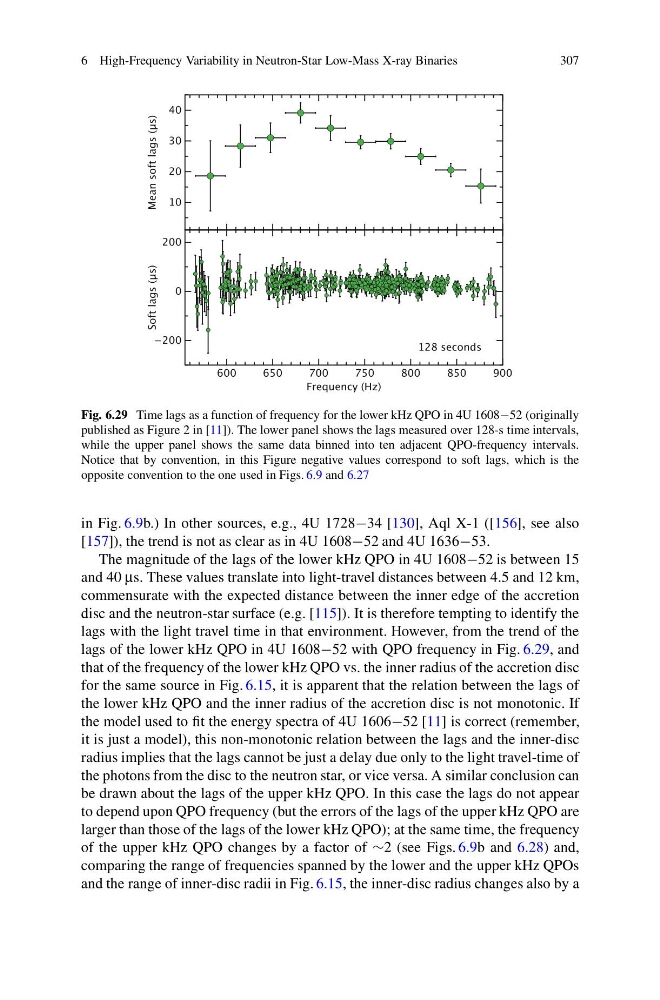
Fig. 6.29 Time lags as a function of frequency for the lower kHz QPO in 4U 1608−52 (originally
published as Figure 2 in [11]). The lower panel shows the lags measured over 128-s time intervals,
while the upper panel shows the same data binned into ten adjacent QPO-frequency intervals.
Notice that by convention, in this Figure negative values correspond to soft lags, which is the
opposite convention to the one used in Figs. 6.9 and 6.27
in Fig. 6.9b.) In other sources, e.g., 4U 1728−34 [130], Aql X-1 ([156], see also
[157]), the trend is not as clear as in 4U 1608−52 and 4U 1636−53.
The magnitude of the lags of the lower kHz QPO in 4U 1608−52 is between 15
and 40 μs. These values translate into light-travel distances between 4.5 and 12 km,
commensurate with the expected distance between the inner edge of the accretion
disc and the neutron-star surface (e.g. [115]). It is therefore tempting to identify the
lags with the light travel time in that environment. However, from the trend of the
lags of the lower kHz QPO in 4U 1608−52 with QPO frequency in Fig. 6.29, and
that of the frequency of the lower kHz QPO vs. the inner radius of the accretion disc
for the same source in Fig. 6.15, it is apparent that the relation between the lags of
the lower kHz QPO and the inner radius of the accretion disc is not monotonic. If
the model used to fit the energy spectra of 4U 1606−52 [11] is correct (remember,
it is just a model), this non-monotonic relation between the lags and the inner-disc
radius implies that the lags cannot be just a delay due only to the light travel-time of
the photons from the disc to the neutron star, or vice versa. A similar conclusion can
be drawn about the lags of the upper kHz QPO. In this case the lags do not appear
to depend upon QPO frequency (but the errors of the lags of the upper kHz QPO are
larger than those of the lags of the lower kHz QPO); at the same time, the frequency
of the upper kHz QPO changes by a factor of ∼2 (see Figs. 6.9b and 6.28) and,
comparing the range of frequencies spanned by the lower and the upper kHz QPOs
and the range of inner-disc radii in Fig. 6.15, the inner-disc radius changes also by a
307
Fig. 6.29 Time lags as a function of frequency for the lower kHz QPO in 4U 1608−52 (originally
published as Figure 2 in [11]). The lower panel shows the lags measured over 128-s time intervals,
while the upper panel shows the same data binned into ten adjacent QPO-frequency intervals.
Notice that by convention, in this Figure negative values correspond to soft lags, which is the
opposite convention to the one used in Figs. 6.9 and 6.27
in Fig. 6.9b.) In other sources, e.g., 4U 1728−34 [130], Aql X-1 ([156], see also
[157]), the trend is not as clear as in 4U 1608−52 and 4U 1636−53.
The magnitude of the lags of the lower kHz QPO in 4U 1608−52 is between 15
and 40 μs. These values translate into light-travel distances between 4.5 and 12 km,
commensurate with the expected distance between the inner edge of the accretion
disc and the neutron-star surface (e.g. [115]). It is therefore tempting to identify the
lags with the light travel time in that environment. However, from the trend of the
lags of the lower kHz QPO in 4U 1608−52 with QPO frequency in Fig. 6.29, and
that of the frequency of the lower kHz QPO vs. the inner radius of the accretion disc
for the same source in Fig. 6.15, it is apparent that the relation between the lags of
the lower kHz QPO and the inner radius of the accretion disc is not monotonic. If
the model used to fit the energy spectra of 4U 1606−52 [11] is correct (remember,
it is just a model), this non-monotonic relation between the lags and the inner-disc
radius implies that the lags cannot be just a delay due only to the light travel-time of
the photons from the disc to the neutron star, or vice versa. A similar conclusion can
be drawn about the lags of the upper kHz QPO. In this case the lags do not appear
to depend upon QPO frequency (but the errors of the lags of the upper kHz QPO are
larger than those of the lags of the lower kHz QPO); at the same time, the frequency
of the upper kHz QPO changes by a factor of ∼2 (see Figs. 6.9b and 6.28) and,
comparing the range of frequencies spanned by the lower and the upper kHz QPOs
and the range of inner-disc radii in Fig. 6.15, the inner-disc radius changes also by a