

6 High-Frequency Variability in Neutron-Star Low-Mass X-ray Binaries
297
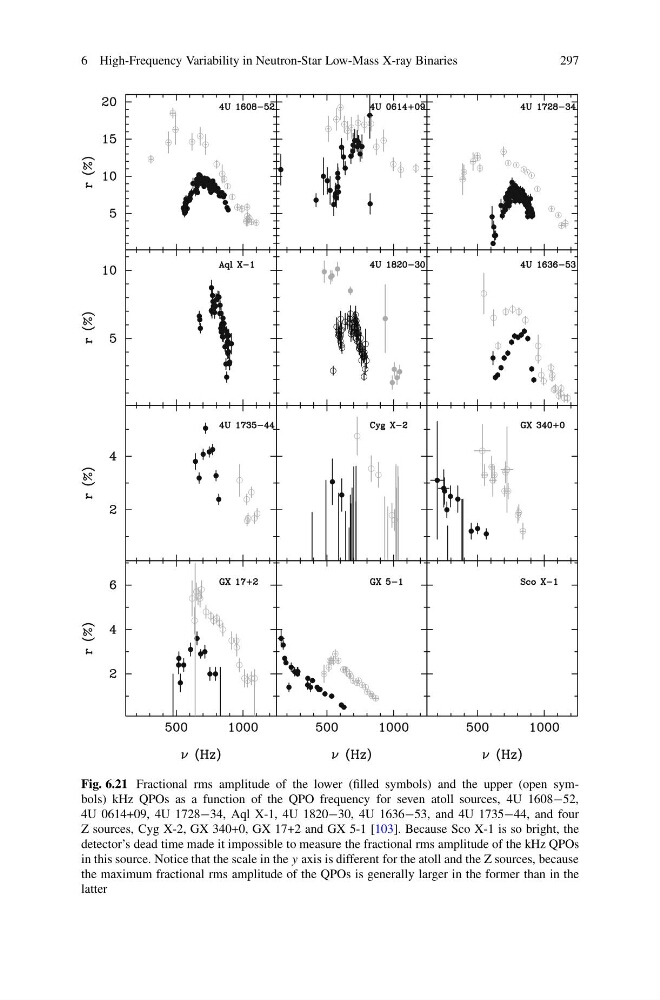
Fig. 6.21 Fractional rms amplitude of the lower (filled symbols) and the upper (open symbols) kHz QPOs as a function of the QPO frequency for seven atoll sources, 4U 1608−52,
4U 0614+09, 4U 1728−34, Aql X-1, 4U 1820−30, 4U 1636−53, and 4U 1735−44, and four
Z sources, Cyg X-2, GX 340+0, GX 17+2 and GX 5-1 [103]. Because Sco X-1 is so bright, the
detector’s dead time made it impossible to measure the fractional rms amplitude of the kHz QPOs
in this source. Notice that the scale in the y axis is different for the atoll and the Z sources, because
the maximum fractional rms amplitude of the QPOs is generally larger in the former than in the
latter
297
Fig. 6.21 Fractional rms amplitude of the lower (filled symbols) and the upper (open symbols) kHz QPOs as a function of the QPO frequency for seven atoll sources, 4U 1608−52,
4U 0614+09, 4U 1728−34, Aql X-1, 4U 1820−30, 4U 1636−53, and 4U 1735−44, and four
Z sources, Cyg X-2, GX 340+0, GX 17+2 and GX 5-1 [103]. Because Sco X-1 is so bright, the
detector’s dead time made it impossible to measure the fractional rms amplitude of the kHz QPOs
in this source. Notice that the scale in the y axis is different for the atoll and the Z sources, because
the maximum fractional rms amplitude of the QPOs is generally larger in the former than in the
latter