

16
M. C. Miller
The basic method of [224] involves several assumptions. These are:
1. The full surface radiates uniformly after the photosphere has retreated to the
radius of the star.
2. The stellar luminosity is the Eddington luminosity at the point of “touchdown”,
which is defined as the time after the peak inferred photospheric radius is
reached when the color temperature, derived from a Planck fit to the spectrum, is
maximal. The luminosity can then be determined via measurement of the flux at
Earth and the distance to the star, assuming that the flux is emitted isotropically.
3. The spectral model for the atmosphere is correct. Thus the model must have
been verified against data good enough to distinguish between models, and the
atmospheric composition must be known. It is typically assumed that the color
factor f c ≡ T col /T eff , which is the ratio between the fitted Planck temperature
and the effective temperature, is not only known but is constant throughout the
cooling phase.
4. All other sources of emission from the system are negligible.
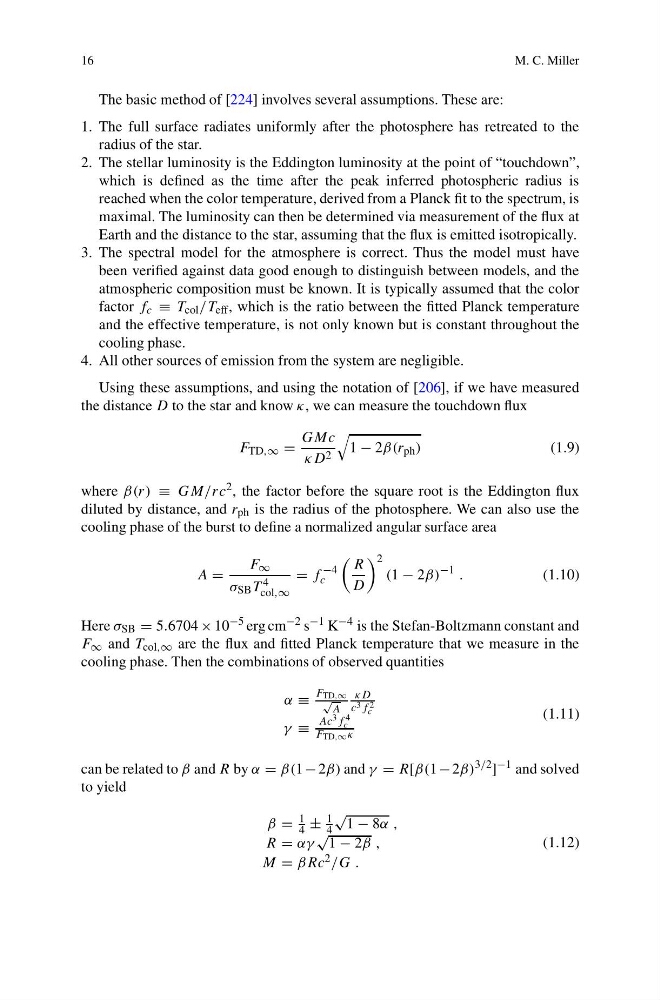
Using these assumptions, and using the notation of [206], if we have measured
the distance D to the star and know κ, we can measure the touchdown flux
F TD,∞ =
GMc
κD 2
1 − 2β(r ph )
(1.9)
where β(r) ≡ GM/rc 2 , the factor before the square root is the Eddington flux
diluted by distance, and r ph is the radius of the photosphere. We can also use the
cooling phase of the burst to define a normalized angular surface area
A =
F ∞
σ SB T 4
col,∞
= f
−4
c
R
D
2
(1 − 2β)
−1 .
(1.10)
Here σ SB = 5.6704 × 10 −5 erg cm −2 s −1 K −4 is the Stefan-Boltzmann constant and
F ∞ and T col,∞ are the flux and fitted Planck temperature that we measure in the
cooling phase. Then the combinations of observed quantities
α ≡
F TD,∞
√
A
κD
c 3 f 2
c
γ ≡
Ac 3 f 4
c
F TD,∞ κ
(1.11)
can be related to β and R by α = β(1 − 2β) and γ = R[β(1 − 2β) 3/2 ] −1 and solved
to yield
β =
1
4 ±
1
4
√
1 − 8α ,
R = αγ
√
1 − 2β ,
M = βRc 2 /G .
(1.12)
M. C. Miller
The basic method of [224] involves several assumptions. These are:
1. The full surface radiates uniformly after the photosphere has retreated to the
radius of the star.
2. The stellar luminosity is the Eddington luminosity at the point of “touchdown”,
which is defined as the time after the peak inferred photospheric radius is
reached when the color temperature, derived from a Planck fit to the spectrum, is
maximal. The luminosity can then be determined via measurement of the flux at
Earth and the distance to the star, assuming that the flux is emitted isotropically.
3. The spectral model for the atmosphere is correct. Thus the model must have
been verified against data good enough to distinguish between models, and the
atmospheric composition must be known. It is typically assumed that the color
factor f c ≡ T col /T eff , which is the ratio between the fitted Planck temperature
and the effective temperature, is not only known but is constant throughout the
cooling phase.
4. All other sources of emission from the system are negligible.
Using these assumptions, and using the notation of [206], if we have measured
the distance D to the star and know κ, we can measure the touchdown flux
F TD,∞ =
GMc
κD 2
1 − 2β(r ph )
(1.9)
where β(r) ≡ GM/rc 2 , the factor before the square root is the Eddington flux
diluted by distance, and r ph is the radius of the photosphere. We can also use the
cooling phase of the burst to define a normalized angular surface area
A =
F ∞
σ SB T 4
col,∞
= f
−4
c
R
D
2
(1 − 2β)
−1 .
(1.10)
Here σ SB = 5.6704 × 10 −5 erg cm −2 s −1 K −4 is the Stefan-Boltzmann constant and
F ∞ and T col,∞ are the flux and fitted Planck temperature that we measure in the
cooling phase. Then the combinations of observed quantities
α ≡
F TD,∞
√
A
κD
c 3 f 2
c
γ ≡
Ac 3 f 4
c
F TD,∞ κ
(1.11)
can be related to β and R by α = β(1 − 2β) and γ = R[β(1 − 2β) 3/2 ] −1 and solved
to yield
β =
1
4 ±
1
4
√
1 − 8α ,
R = αγ
√
1 − 2β ,
M = βRc 2 /G .
(1.12)