

1 Astrophysical Constraints on Dense Matter in Neutron Stars
15
many equations of state imply similar maximum masses but widely different radii.
We therefore turn to constraints on the radius.
1.4 Constraints on Radius, and Other Mass Constraints
As discussed in Sect. 1.2, accurate measurements of the radii of neutron stars would
strongly constrain the properties of neutron star core matter. Unfortunately, all
current inferences of neutron star radii are dominated by systematic errors, and
hence no radius estimates are reliable enough for such constraints. However, future
measurements using the approved missions NICER [90] and Athena+ [161] and
the proposed missions LOFT [78] and AXTAR [185], and hold great promise for
precise radius measurements if the effects of systematic errors can be shown to be
small. In this section we discuss various proposed methods for measuring radii and
the diverse results obtained by applying these methods. Some of the methods also
result in mass estimates, so we discuss those implications along the way.
1.4.1 Thermonuclear X-ray Bursts
More than 30 years ago it was proposed that the masses and radii of neutron stars
could be obtained via measurement of thermonuclear X-ray bursts [224]. These
bursts occur when enough hydrogen or helium (or carbon for the long-lasting
“superbursts”) accumulates on a neutron star in a binary. Nuclear fusion at the base
of the layer becomes unstable, leading to a burst that lasts for seconds to hours.
For a selection of observational and theoretical papers on thermonuclear bursts,
see [23, 64, 85, 86, 91, 112, 125, 137, 204, 212, 213, 236]. In some bursts, fits of
a Planck function to the spectra reveal a temperature that initially increases, then
decreases, then increases again before finally decreasing [107, 136, 203]. These are
called photospheric radius expansion (PRE) bursts [168]. The usual assumption is
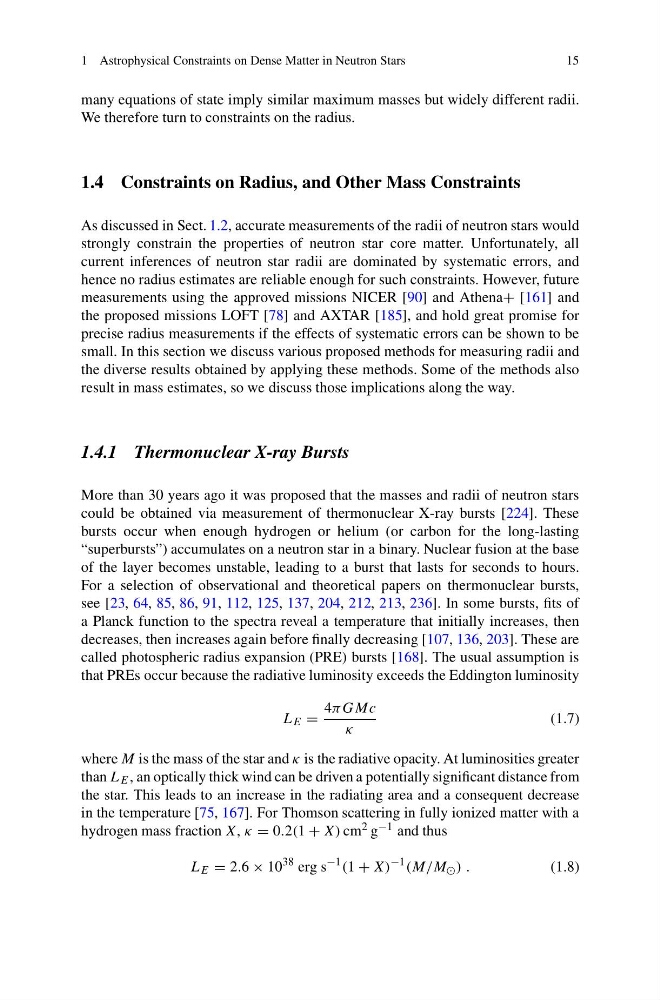
that PREs occur because the radiative luminosity exceeds the Eddington luminosity
L E =
4πGMc
κ
(1.7)
where M is the mass of the star and κ is the radiative opacity. At luminosities greater
than L E , an optically thick wind can be driven a potentially significant distance from
the star. This leads to an increase in the radiating area and a consequent decrease
in the temperature [75, 167]. For Thomson scattering in fully ionized matter with a
hydrogen mass fraction X, κ = 0.2(1 + X) cm 2 g −1 and thus
L E = 2.6 × 10
38 erg s
−1 (1 + X)
−1 (M/M ) .
(1.8)
15
many equations of state imply similar maximum masses but widely different radii.
We therefore turn to constraints on the radius.
1.4 Constraints on Radius, and Other Mass Constraints
As discussed in Sect. 1.2, accurate measurements of the radii of neutron stars would
strongly constrain the properties of neutron star core matter. Unfortunately, all
current inferences of neutron star radii are dominated by systematic errors, and
hence no radius estimates are reliable enough for such constraints. However, future
measurements using the approved missions NICER [90] and Athena+ [161] and
the proposed missions LOFT [78] and AXTAR [185], and hold great promise for
precise radius measurements if the effects of systematic errors can be shown to be
small. In this section we discuss various proposed methods for measuring radii and
the diverse results obtained by applying these methods. Some of the methods also
result in mass estimates, so we discuss those implications along the way.
1.4.1 Thermonuclear X-ray Bursts
More than 30 years ago it was proposed that the masses and radii of neutron stars
could be obtained via measurement of thermonuclear X-ray bursts [224]. These
bursts occur when enough hydrogen or helium (or carbon for the long-lasting
“superbursts”) accumulates on a neutron star in a binary. Nuclear fusion at the base
of the layer becomes unstable, leading to a burst that lasts for seconds to hours.
For a selection of observational and theoretical papers on thermonuclear bursts,
see [23, 64, 85, 86, 91, 112, 125, 137, 204, 212, 213, 236]. In some bursts, fits of
a Planck function to the spectra reveal a temperature that initially increases, then
decreases, then increases again before finally decreasing [107, 136, 203]. These are
called photospheric radius expansion (PRE) bursts [168]. The usual assumption is
that PREs occur because the radiative luminosity exceeds the Eddington luminosity
L E =
4πGMc
κ
(1.7)
where M is the mass of the star and κ is the radiative opacity. At luminosities greater
than L E , an optically thick wind can be driven a potentially significant distance from
the star. This leads to an increase in the radiating area and a consequent decrease
in the temperature [75, 167]. For Thomson scattering in fully ionized matter with a
hydrogen mass fraction X, κ = 0.2(1 + X) cm 2 g −1 and thus
L E = 2.6 × 10
38 erg s
−1 (1 + X)
−1 (M/M ) .
(1.8)