

5 Thermonuclear X-ray Bursts
233
5.4.1 Reflection by the Accretion Disk
A substantial fraction of the X-rays emitted by the bursting neutron star fall on
the accretion disk [47, 113]. For a thin disk this fraction is about 25% of the total
burst emission, and most flux falls on the inner few tens of kilometers closest to the
star. The radiation undergoes diffusive scattering off the disk’s photosphere, which
is referred to as X-ray “reflection.” Depending on the inclination angle of the disk
with respect to the line of sight, a substantial part of the observed burst flux may
have arisen from photons reflected by the disk. The reflection fraction is defined as
the ratio of the reflected and the directly observed burst flux components. For a thin
disk, reflection fractions of up to approximately 0.5 are expected.
If the disk has a different shape, such as a steeply increasing height, the reflection
fraction can potentially exceed unity: most of the burst signal is observed in
reflection [70]. A simple analogy is a candle in a teacup: when viewed under certain
angles, the flame of the candle is not directly visible, but one still sees its light scatter
off the inner sides of the cup.
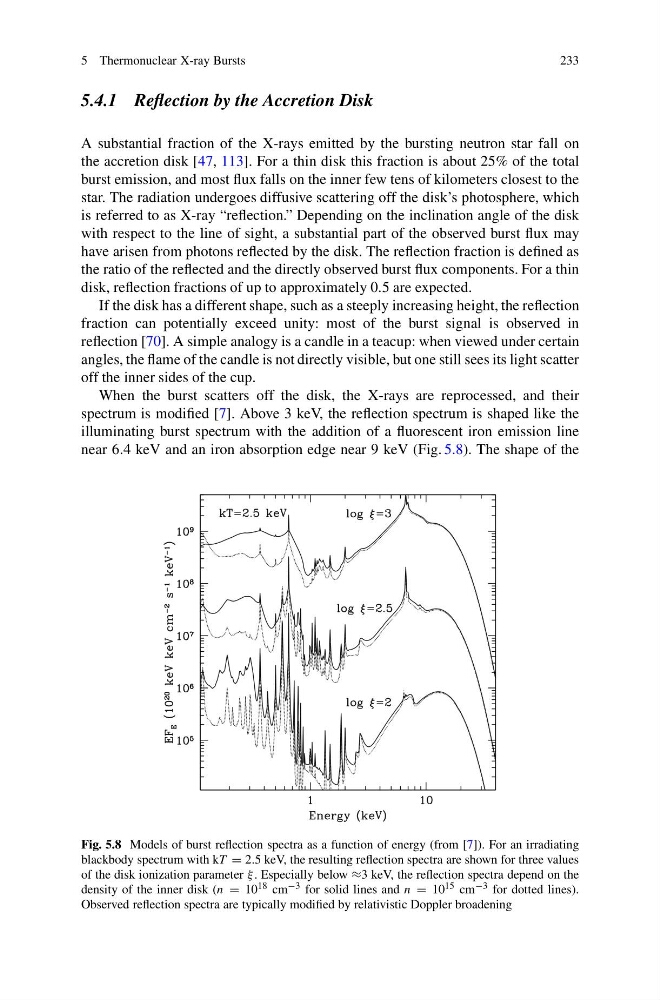
When the burst scatters off the disk, the X-rays are reprocessed, and their
spectrum is modified [7]. Above 3 keV, the reflection spectrum is shaped like the
illuminating burst spectrum with the addition of a fluorescent iron emission line
near 6.4 keV and an iron absorption edge near 9 keV (Fig. 5.8). The shape of the
Fig. 5.8 Models of burst reflection spectra as a function of energy (from [7]). For an irradiating
blackbody spectrum with kT = 2.5 keV, the resulting reflection spectra are shown for three values
of the disk ionization parameter ξ . Especially below ≈3 keV, the reflection spectra depend on the
density of the inner disk (n = 10 18 cm −3 for solid lines and n = 10 15 cm −3 for dotted lines).
Observed reflection spectra are typically modified by relativistic Doppler broadening
233
5.4.1 Reflection by the Accretion Disk
A substantial fraction of the X-rays emitted by the bursting neutron star fall on
the accretion disk [47, 113]. For a thin disk this fraction is about 25% of the total
burst emission, and most flux falls on the inner few tens of kilometers closest to the
star. The radiation undergoes diffusive scattering off the disk’s photosphere, which
is referred to as X-ray “reflection.” Depending on the inclination angle of the disk
with respect to the line of sight, a substantial part of the observed burst flux may
have arisen from photons reflected by the disk. The reflection fraction is defined as
the ratio of the reflected and the directly observed burst flux components. For a thin
disk, reflection fractions of up to approximately 0.5 are expected.
If the disk has a different shape, such as a steeply increasing height, the reflection
fraction can potentially exceed unity: most of the burst signal is observed in
reflection [70]. A simple analogy is a candle in a teacup: when viewed under certain
angles, the flame of the candle is not directly visible, but one still sees its light scatter
off the inner sides of the cup.
When the burst scatters off the disk, the X-rays are reprocessed, and their
spectrum is modified [7]. Above 3 keV, the reflection spectrum is shaped like the
illuminating burst spectrum with the addition of a fluorescent iron emission line
near 6.4 keV and an iron absorption edge near 9 keV (Fig. 5.8). The shape of the
Fig. 5.8 Models of burst reflection spectra as a function of energy (from [7]). For an irradiating
blackbody spectrum with kT = 2.5 keV, the resulting reflection spectra are shown for three values
of the disk ionization parameter ξ . Especially below ≈3 keV, the reflection spectra depend on the
density of the inner disk (n = 10 18 cm −3 for solid lines and n = 10 15 cm −3 for dotted lines).
Observed reflection spectra are typically modified by relativistic Doppler broadening