

4 Accreting Millisecond X-ray Pulsars
187
0
1
2
3
4
5
6
7
8
9
Spin Frequency [Hz]
0
1
2
3
4
5
6
7
8
9
1 0 0 - 2 0 0
2 0 0 - 3 0 0
3 0 0 - 4 0 0
4 0 0 - 5 0 0
5 0 0 - 6 0 0
6 0 0 - 7 0 0
1 0 0 - 2 0 0
2 0 0 - 3 0 0
3 0 0 - 4 0 0
4 0 0 - 5 0 0
5 0 0 - 6 0 0
6 0 0 - 7 0 0
Nr. Accreting Pulsars
Acc. Powered (Persistent)
Acc. Powered (Intermittent)
Nuclear Powered
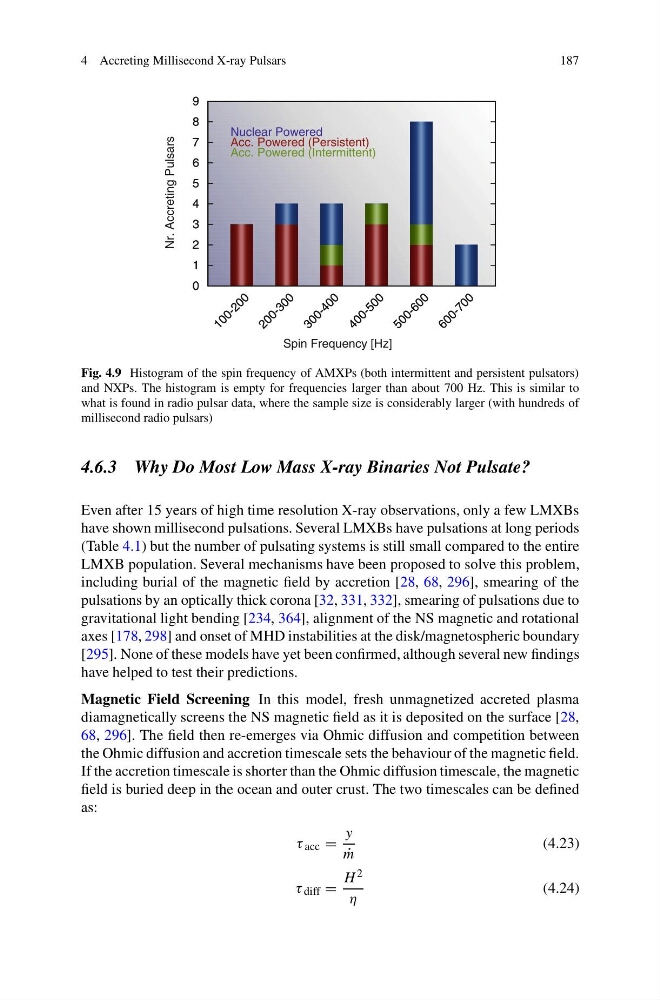
Fig. 4.9 Histogram of the spin frequency of AMXPs (both intermittent and persistent pulsators)
and NXPs. The histogram is empty for frequencies larger than about 700 Hz. This is similar to
what is found in radio pulsar data, where the sample size is considerably larger (with hundreds of
millisecond radio pulsars)
4.6.3 Why Do Most Low Mass X-ray Binaries Not Pulsate?
Even after 15 years of high time resolution X-ray observations, only a few LMXBs
have shown millisecond pulsations. Several LMXBs have pulsations at long periods
(Table 4.1) but the number of pulsating systems is still small compared to the entire
LMXB population. Several mechanisms have been proposed to solve this problem,
including burial of the magnetic field by accretion [28, 68, 296], smearing of the
pulsations by an optically thick corona [32, 331, 332], smearing of pulsations due to
gravitational light bending [234, 364], alignment of the NS magnetic and rotational
axes [178, 298] and onset of MHD instabilities at the disk/magnetospheric boundary
[295]. None of these models have yet been confirmed, although several new findings
have helped to test their predictions.
Magnetic Field Screening In this model, fresh unmagnetized accreted plasma
diamagnetically screens the NS magnetic field as it is deposited on the surface [28,
68, 296]. The field then re-emerges via Ohmic diffusion and competition between
the Ohmic diffusion and accretion timescale sets the behaviour of the magnetic field.
If the accretion timescale is shorter than the Ohmic diffusion timescale, the magnetic
field is buried deep in the ocean and outer crust. The two timescales can be defined
as:
τ acc =
y
˙
m
(4.23)
τ diff =
H 2
η
(4.24)
187
0
1
2
3
4
5
6
7
8
9
Spin Frequency [Hz]
0
1
2
3
4
5
6
7
8
9
1 0 0 - 2 0 0
2 0 0 - 3 0 0
3 0 0 - 4 0 0
4 0 0 - 5 0 0
5 0 0 - 6 0 0
6 0 0 - 7 0 0
1 0 0 - 2 0 0
2 0 0 - 3 0 0
3 0 0 - 4 0 0
4 0 0 - 5 0 0
5 0 0 - 6 0 0
6 0 0 - 7 0 0
Nr. Accreting Pulsars
Acc. Powered (Persistent)
Acc. Powered (Intermittent)
Nuclear Powered
Fig. 4.9 Histogram of the spin frequency of AMXPs (both intermittent and persistent pulsators)
and NXPs. The histogram is empty for frequencies larger than about 700 Hz. This is similar to
what is found in radio pulsar data, where the sample size is considerably larger (with hundreds of
millisecond radio pulsars)
4.6.3 Why Do Most Low Mass X-ray Binaries Not Pulsate?
Even after 15 years of high time resolution X-ray observations, only a few LMXBs
have shown millisecond pulsations. Several LMXBs have pulsations at long periods
(Table 4.1) but the number of pulsating systems is still small compared to the entire
LMXB population. Several mechanisms have been proposed to solve this problem,
including burial of the magnetic field by accretion [28, 68, 296], smearing of the
pulsations by an optically thick corona [32, 331, 332], smearing of pulsations due to
gravitational light bending [234, 364], alignment of the NS magnetic and rotational
axes [178, 298] and onset of MHD instabilities at the disk/magnetospheric boundary
[295]. None of these models have yet been confirmed, although several new findings
have helped to test their predictions.
Magnetic Field Screening In this model, fresh unmagnetized accreted plasma
diamagnetically screens the NS magnetic field as it is deposited on the surface [28,
68, 296]. The field then re-emerges via Ohmic diffusion and competition between
the Ohmic diffusion and accretion timescale sets the behaviour of the magnetic field.
If the accretion timescale is shorter than the Ohmic diffusion timescale, the magnetic
field is buried deep in the ocean and outer crust. The two timescales can be defined
as:
τ acc =
y
˙
m
(4.23)
τ diff =
H 2
η
(4.24)