

186
A. Patruno and A. L. Watts
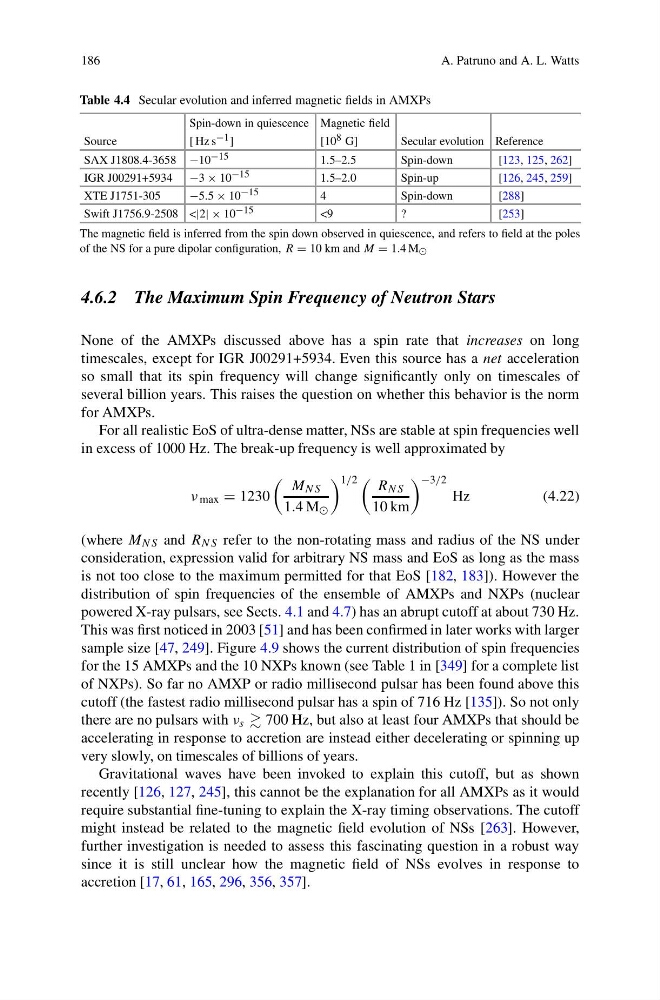
Table 4.4 Secular evolution and inferred magnetic fields in AMXPs
Spin-down in quiescence Magnetic field
Source
[ Hz s −1 ]
[10 8 G]
Secular evolution Reference
SAX J1808.4-3658 −10 −15
1.5–2.5
Spin-down
[123, 125, 262]
IGR J00291+5934 −3 × 10 −15
1.5–2.0
Spin-up
[126, 245, 259]
XTE J1751-305
−5.5 × 10 −15
4
Spin-down
[288]
Swift J1756.9-2508 <|2| × 10 −15
<9
?
[253]
The magnetic field is inferred from the spin down observed in quiescence, and refers to field at the poles
of the NS for a pure dipolar configuration, R = 10 km and M = 1.4 M
4.6.2 The Maximum Spin Frequency of Neutron Stars
None of the AMXPs discussed above has a spin rate that increases on long
timescales, except for IGR J00291+5934. Even this source has a net acceleration
so small that its spin frequency will change significantly only on timescales of
several billion years. This raises the question on whether this behavior is the norm
for AMXPs.
For all realistic EoS of ultra-dense matter, NSs are stable at spin frequencies well
in excess of 1000 Hz. The break-up frequency is well approximated by
ν max = 1230
M NS
1.4 M
1/2
R NS
10 km
−3/2
Hz
(4.22)
(where M NS and R NS refer to the non-rotating mass and radius of the NS under
consideration, expression valid for arbitrary NS mass and EoS as long as the mass
is not too close to the maximum permitted for that EoS [182, 183]). However the
distribution of spin frequencies of the ensemble of AMXPs and NXPs (nuclear
powered X-ray pulsars, see Sects. 4.1 and 4.7) has an abrupt cutoff at about 730 Hz.
This was first noticed in 2003 [51] and has been confirmed in later works with larger
sample size [47, 249]. Figure 4.9 shows the current distribution of spin frequencies
for the 15 AMXPs and the 10 NXPs known (see Table 1 in [349] for a complete list
of NXPs). So far no AMXP or radio millisecond pulsar has been found above this
cutoff (the fastest radio millisecond pulsar has a spin of 716 Hz [135]). So not only
there are no pulsars with ν s 700 Hz, but also at least four AMXPs that should be
accelerating in response to accretion are instead either decelerating or spinning up
very slowly, on timescales of billions of years.
Gravitational waves have been invoked to explain this cutoff, but as shown
recently [126, 127, 245], this cannot be the explanation for all AMXPs as it would
require substantial fine-tuning to explain the X-ray timing observations. The cutoff
might instead be related to the magnetic field evolution of NSs [263]. However,
further investigation is needed to assess this fascinating question in a robust way
since it is still unclear how the magnetic field of NSs evolves in response to
accretion [17, 61, 165, 296, 356, 357].
A. Patruno and A. L. Watts
Table 4.4 Secular evolution and inferred magnetic fields in AMXPs
Spin-down in quiescence Magnetic field
Source
[ Hz s −1 ]
[10 8 G]
Secular evolution Reference
SAX J1808.4-3658 −10 −15
1.5–2.5
Spin-down
[123, 125, 262]
IGR J00291+5934 −3 × 10 −15
1.5–2.0
Spin-up
[126, 245, 259]
XTE J1751-305
−5.5 × 10 −15
4
Spin-down
[288]
Swift J1756.9-2508 <|2| × 10 −15
<9
?
[253]
The magnetic field is inferred from the spin down observed in quiescence, and refers to field at the poles
of the NS for a pure dipolar configuration, R = 10 km and M = 1.4 M
4.6.2 The Maximum Spin Frequency of Neutron Stars
None of the AMXPs discussed above has a spin rate that increases on long
timescales, except for IGR J00291+5934. Even this source has a net acceleration
so small that its spin frequency will change significantly only on timescales of
several billion years. This raises the question on whether this behavior is the norm
for AMXPs.
For all realistic EoS of ultra-dense matter, NSs are stable at spin frequencies well
in excess of 1000 Hz. The break-up frequency is well approximated by
ν max = 1230
M NS
1.4 M
1/2
R NS
10 km
−3/2
Hz
(4.22)
(where M NS and R NS refer to the non-rotating mass and radius of the NS under
consideration, expression valid for arbitrary NS mass and EoS as long as the mass
is not too close to the maximum permitted for that EoS [182, 183]). However the
distribution of spin frequencies of the ensemble of AMXPs and NXPs (nuclear
powered X-ray pulsars, see Sects. 4.1 and 4.7) has an abrupt cutoff at about 730 Hz.
This was first noticed in 2003 [51] and has been confirmed in later works with larger
sample size [47, 249]. Figure 4.9 shows the current distribution of spin frequencies
for the 15 AMXPs and the 10 NXPs known (see Table 1 in [349] for a complete list
of NXPs). So far no AMXP or radio millisecond pulsar has been found above this
cutoff (the fastest radio millisecond pulsar has a spin of 716 Hz [135]). So not only
there are no pulsars with ν s 700 Hz, but also at least four AMXPs that should be
accelerating in response to accretion are instead either decelerating or spinning up
very slowly, on timescales of billions of years.
Gravitational waves have been invoked to explain this cutoff, but as shown
recently [126, 127, 245], this cannot be the explanation for all AMXPs as it would
require substantial fine-tuning to explain the X-ray timing observations. The cutoff
might instead be related to the magnetic field evolution of NSs [263]. However,
further investigation is needed to assess this fascinating question in a robust way
since it is still unclear how the magnetic field of NSs evolves in response to
accretion [17, 61, 165, 296, 356, 357].