

122
P. Esposito et al.
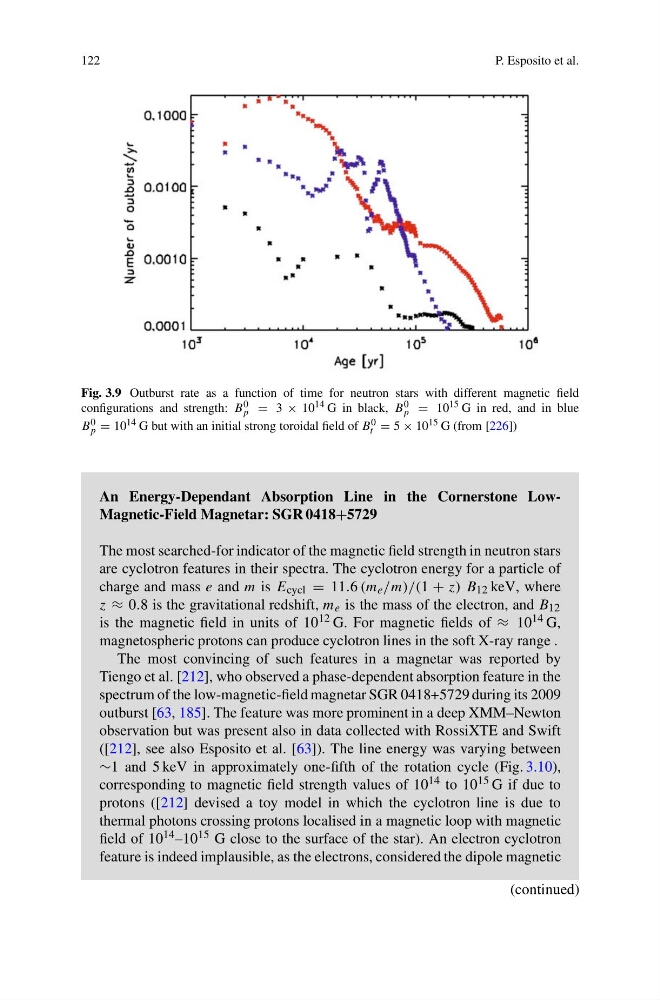
Fig. 3.9 Outburst rate as a function of time for neutron stars with different magnetic field
configurations and strength: B 0
p = 3 × 10 14 G in black, B 0
p = 10 15 G in red, and in blue
B 0
p = 10 14 G but with an initial strong toroidal field of B 0
t = 5 × 10 15 G (from [226])
An Energy-Dependant Absorption Line in the Cornerstone LowMagnetic-Field Magnetar: SGR 0418+5729
The most searched-for indicator of the magnetic field strength in neutron stars
are cyclotron features in their spectra. The cyclotron energy for a particle of
charge and mass e and m is E cycl = 11.6 (m e /m)/(1 + z) B 12 keV, where
z ≈ 0.8 is the gravitational redshift, m e is the mass of the electron, and B 12
is the magnetic field in units of 10 12 G. For magnetic fields of ≈ 10 14 G,
magnetospheric protons can produce cyclotron lines in the soft X-ray range .
The most convincing of such features in a magnetar was reported by
Tiengo et al. [212], who observed a phase-dependent absorption feature in the
spectrum of the low-magnetic-field magnetar SGR 0418+5729 during its 2009
outburst [63, 185]. The feature was more prominent in a deep XMM–Newton
observation but was present also in data collected with RossiXTE and Swift
([212], see also Esposito et al. [63]). The line energy was varying between
∼1 and 5 keV in approximately one-fifth of the rotation cycle (Fig. 3.10),
corresponding to magnetic field strength values of 10 14 to 10 15 G if due to
protons ([212] devised a toy model in which the cyclotron line is due to
thermal photons crossing protons localised in a magnetic loop with magnetic
field of 10 14 –10 15 G close to the surface of the star). An electron cyclotron
feature is indeed implausible, as the electrons, considered the dipole magnetic
(continued)
P. Esposito et al.
Fig. 3.9 Outburst rate as a function of time for neutron stars with different magnetic field
configurations and strength: B 0
p = 3 × 10 14 G in black, B 0
p = 10 15 G in red, and in blue
B 0
p = 10 14 G but with an initial strong toroidal field of B 0
t = 5 × 10 15 G (from [226])
An Energy-Dependant Absorption Line in the Cornerstone LowMagnetic-Field Magnetar: SGR 0418+5729
The most searched-for indicator of the magnetic field strength in neutron stars
are cyclotron features in their spectra. The cyclotron energy for a particle of
charge and mass e and m is E cycl = 11.6 (m e /m)/(1 + z) B 12 keV, where
z ≈ 0.8 is the gravitational redshift, m e is the mass of the electron, and B 12
is the magnetic field in units of 10 12 G. For magnetic fields of ≈ 10 14 G,
magnetospheric protons can produce cyclotron lines in the soft X-ray range .
The most convincing of such features in a magnetar was reported by
Tiengo et al. [212], who observed a phase-dependent absorption feature in the
spectrum of the low-magnetic-field magnetar SGR 0418+5729 during its 2009
outburst [63, 185]. The feature was more prominent in a deep XMM–Newton
observation but was present also in data collected with RossiXTE and Swift
([212], see also Esposito et al. [63]). The line energy was varying between
∼1 and 5 keV in approximately one-fifth of the rotation cycle (Fig. 3.10),
corresponding to magnetic field strength values of 10 14 to 10 15 G if due to
protons ([212] devised a toy model in which the cyclotron line is due to
thermal photons crossing protons localised in a magnetic loop with magnetic
field of 10 14 –10 15 G close to the surface of the star). An electron cyclotron
feature is indeed implausible, as the electrons, considered the dipole magnetic
(continued)