

118
P. Esposito et al.
coupled magneto-thermal evolution in Pons et al. [178], but including only the
Ohmic dissipation. More recently, Viganò and Pons [225] presented the first twodimensional magneto-thermal code able to manage arbitrarily large magnetic field
intensities while self-consistently including the Hall term throughout the entire
evolution.
The magneto-thermal evolution in the lifetime of the neutron star is governed by
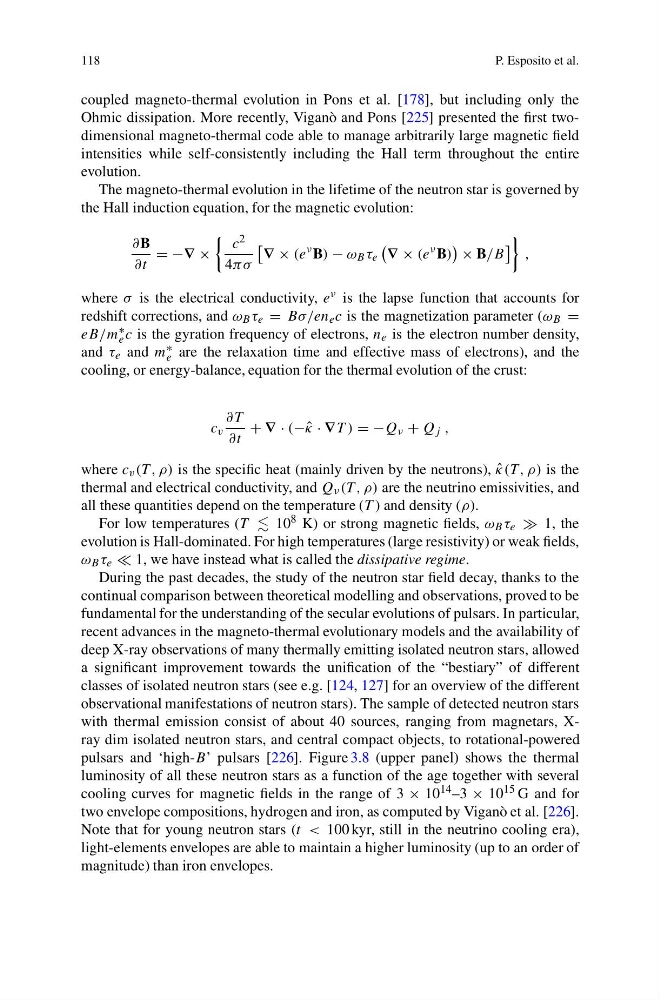
the Hall induction equation, for the magnetic evolution:
∂B
∂t
= −∇ ×
c 2
4πσ
∇ × (e
ν B) − ω B τ e
∇ × (e
ν B)
× B/B
,
where σ is the electrical conductivity, e ν is the lapse function that accounts for
redshift corrections, and ω B τ e = Bσ/en e c is the magnetization parameter (ω B =
eB/m ∗
e c is the gyration frequency of electrons, n e is the electron number density,
and τ e and m ∗
e are the relaxation time and effective mass of electrons), and the
cooling, or energy-balance, equation for the thermal evolution of the crust:
c v
∂T
∂t
+ ∇ · (− ˆ
κ · ∇T ) = −Q ν + Q j ,
where c v (T , ρ) is the specific heat (mainly driven by the neutrons), ˆ
κ(T , ρ) is the
thermal and electrical conductivity, and Q ν (T , ρ) are the neutrino emissivities, and
all these quantities depend on the temperature (T ) and density (ρ).
For low temperatures (T 10 8 K) or strong magnetic fields, ω B τ e 1, the
evolution is Hall-dominated. For high temperatures (large resistivity) or weak fields,
ω B τ e 1, we have instead what is called the dissipative regime.
During the past decades, the study of the neutron star field decay, thanks to the
continual comparison between theoretical modelling and observations, proved to be
fundamental for the understanding of the secular evolutions of pulsars. In particular,
recent advances in the magneto-thermal evolutionary models and the availability of
deep X-ray observations of many thermally emitting isolated neutron stars, allowed
a significant improvement towards the unification of the “bestiary” of different
classes of isolated neutron stars (see e.g. [124, 127] for an overview of the different
observational manifestations of neutron stars). The sample of detected neutron stars
with thermal emission consist of about 40 sources, ranging from magnetars, Xray dim isolated neutron stars, and central compact objects, to rotational-powered
pulsars and ‘high-B’ pulsars [226]. Figure 3.8 (upper panel) shows the thermal
luminosity of all these neutron stars as a function of the age together with several
cooling curves for magnetic fields in the range of 3 × 10 14 –3 × 10 15 G and for
two envelope compositions, hydrogen and iron, as computed by Viganò et al. [226].
Note that for young neutron stars (t < 100 kyr, still in the neutrino cooling era),
light-elements envelopes are able to maintain a higher luminosity (up to an order of
magnitude) than iron envelopes.
P. Esposito et al.
coupled magneto-thermal evolution in Pons et al. [178], but including only the
Ohmic dissipation. More recently, Viganò and Pons [225] presented the first twodimensional magneto-thermal code able to manage arbitrarily large magnetic field
intensities while self-consistently including the Hall term throughout the entire
evolution.
The magneto-thermal evolution in the lifetime of the neutron star is governed by
the Hall induction equation, for the magnetic evolution:
∂B
∂t
= −∇ ×
c 2
4πσ
∇ × (e
ν B) − ω B τ e
∇ × (e
ν B)
× B/B
,
where σ is the electrical conductivity, e ν is the lapse function that accounts for
redshift corrections, and ω B τ e = Bσ/en e c is the magnetization parameter (ω B =
eB/m ∗
e c is the gyration frequency of electrons, n e is the electron number density,
and τ e and m ∗
e are the relaxation time and effective mass of electrons), and the
cooling, or energy-balance, equation for the thermal evolution of the crust:
c v
∂T
∂t
+ ∇ · (− ˆ
κ · ∇T ) = −Q ν + Q j ,
where c v (T , ρ) is the specific heat (mainly driven by the neutrons), ˆ
κ(T , ρ) is the
thermal and electrical conductivity, and Q ν (T , ρ) are the neutrino emissivities, and
all these quantities depend on the temperature (T ) and density (ρ).
For low temperatures (T 10 8 K) or strong magnetic fields, ω B τ e 1, the
evolution is Hall-dominated. For high temperatures (large resistivity) or weak fields,
ω B τ e 1, we have instead what is called the dissipative regime.
During the past decades, the study of the neutron star field decay, thanks to the
continual comparison between theoretical modelling and observations, proved to be
fundamental for the understanding of the secular evolutions of pulsars. In particular,
recent advances in the magneto-thermal evolutionary models and the availability of
deep X-ray observations of many thermally emitting isolated neutron stars, allowed
a significant improvement towards the unification of the “bestiary” of different
classes of isolated neutron stars (see e.g. [124, 127] for an overview of the different
observational manifestations of neutron stars). The sample of detected neutron stars
with thermal emission consist of about 40 sources, ranging from magnetars, Xray dim isolated neutron stars, and central compact objects, to rotational-powered
pulsars and ‘high-B’ pulsars [226]. Figure 3.8 (upper panel) shows the thermal
luminosity of all these neutron stars as a function of the age together with several
cooling curves for magnetic fields in the range of 3 × 10 14 –3 × 10 15 G and for
two envelope compositions, hydrogen and iron, as computed by Viganò et al. [226].
Note that for young neutron stars (t < 100 kyr, still in the neutrino cooling era),
light-elements envelopes are able to maintain a higher luminosity (up to an order of
magnitude) than iron envelopes.