

3 Magnetars: A Short Review and Some Sparse Considerations
101
double-blackbody model provides a much better fit to the data than a blackbodyplus-power-law model [210]. On the other hand, a non-thermal component is
certainly present at least in the magnetars detected in the hard-X-ray range.
Given the many complications and uncertainties, it is evident that prudence is
necessary when drawing physical inferences from the spectral parameters. It is
however worth noticing that physical models based on resonant cyclotron scattering
(likely, repeated scatterings) of seed thermal photons on mildly relativistic electrons
are quite successful in reproducing the general thermal-plus-power-law shape of the
continuum and fit the spectra of most magnetars. We refer to Turolla et al. [219] for
an overview of the state of the art of these models, their application, and the main
open problems.
3.2.1.2 Hard-X-Ray Emission
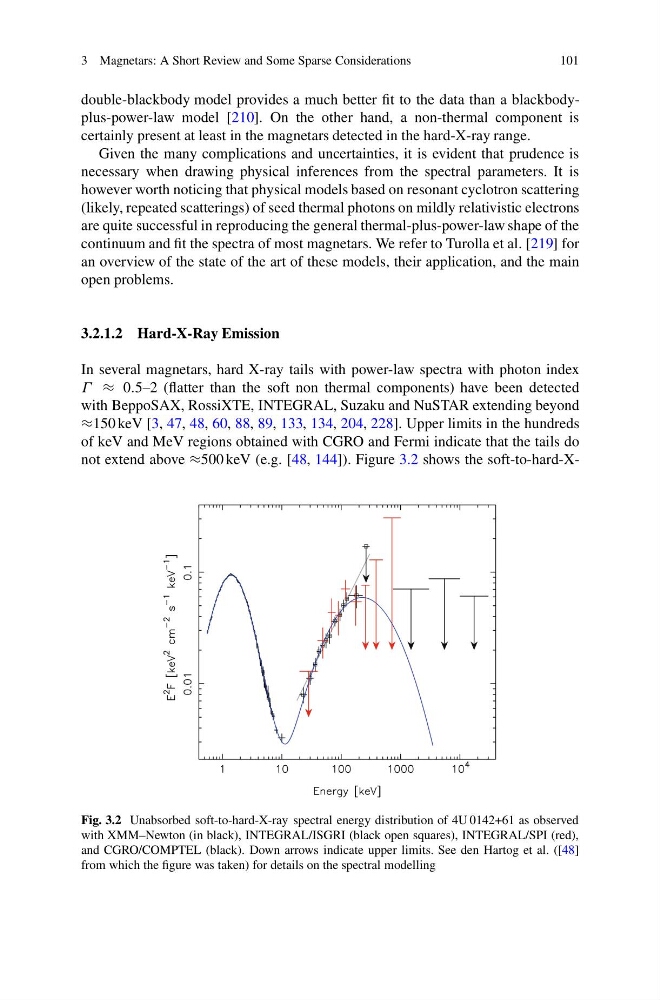
In several magnetars, hard X-ray tails with power-law spectra with photon index
Γ ≈ 0.5–2 (flatter than the soft non thermal components) have been detected
with BeppoSAX, RossiXTE, INTEGRAL, Suzaku and NuSTAR extending beyond
≈150 keV [3, 47, 48, 60, 88, 89, 133, 134, 204, 228]. Upper limits in the hundreds
of keV and MeV regions obtained with CGRO and Fermi indicate that the tails do
not extend above ≈500 keV (e.g. [48, 144]). Figure 3.2 shows the soft-to-hard-XFig. 3.2 Unabsorbed soft-to-hard-X-ray spectral energy distribution of 4U 0142+61 as observed
with XMM–Newton (in black), INTEGRAL/ISGRI (black open squares), INTEGRAL/SPI (red),
and CGRO/COMPTEL (black). Down arrows indicate upper limits. See den Hartog et al. ([48]
from which the figure was taken) for details on the spectral modelling
101
double-blackbody model provides a much better fit to the data than a blackbodyplus-power-law model [210]. On the other hand, a non-thermal component is
certainly present at least in the magnetars detected in the hard-X-ray range.
Given the many complications and uncertainties, it is evident that prudence is
necessary when drawing physical inferences from the spectral parameters. It is
however worth noticing that physical models based on resonant cyclotron scattering
(likely, repeated scatterings) of seed thermal photons on mildly relativistic electrons
are quite successful in reproducing the general thermal-plus-power-law shape of the
continuum and fit the spectra of most magnetars. We refer to Turolla et al. [219] for
an overview of the state of the art of these models, their application, and the main
open problems.
3.2.1.2 Hard-X-Ray Emission
In several magnetars, hard X-ray tails with power-law spectra with photon index
Γ ≈ 0.5–2 (flatter than the soft non thermal components) have been detected
with BeppoSAX, RossiXTE, INTEGRAL, Suzaku and NuSTAR extending beyond
≈150 keV [3, 47, 48, 60, 88, 89, 133, 134, 204, 228]. Upper limits in the hundreds
of keV and MeV regions obtained with CGRO and Fermi indicate that the tails do
not extend above ≈500 keV (e.g. [48, 144]). Figure 3.2 shows the soft-to-hard-XFig. 3.2 Unabsorbed soft-to-hard-X-ray spectral energy distribution of 4U 0142+61 as observed
with XMM–Newton (in black), INTEGRAL/ISGRI (black open squares), INTEGRAL/SPI (red),
and CGRO/COMPTEL (black). Down arrows indicate upper limits. See den Hartog et al. ([48]
from which the figure was taken) for details on the spectral modelling