

100
P. Esposito et al.
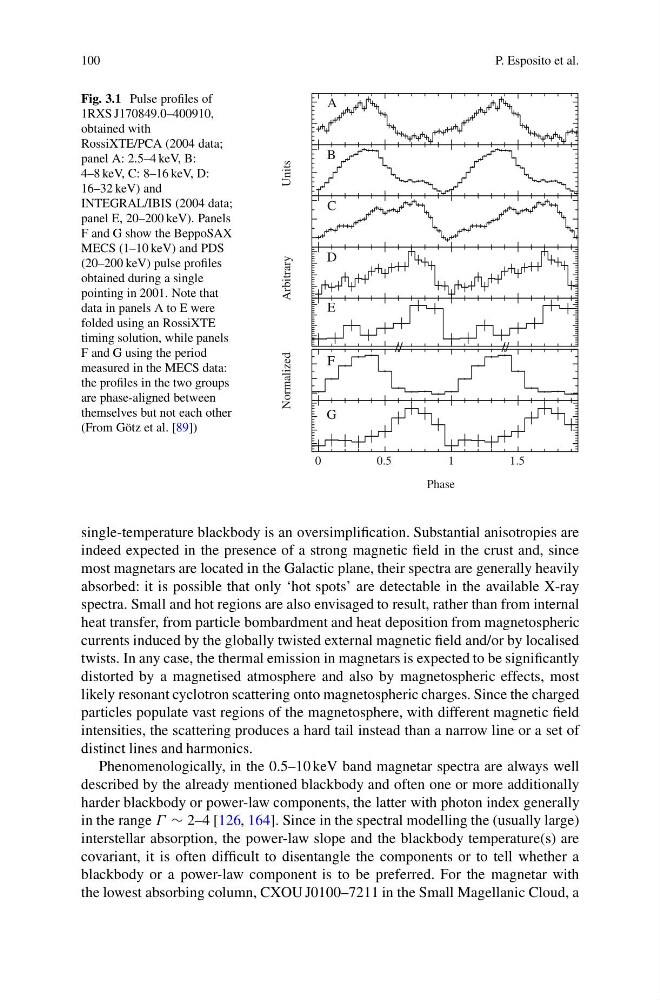
Fig. 3.1 Pulse profiles of
1RXS J170849.0–400910,
obtained with
RossiXTE/PCA (2004 data;
panel A: 2.5–4 keV, B:
4–8 keV, C: 8–16 keV, D:
16–32 keV) and
INTEGRAL/IBIS (2004 data;
panel E, 20–200 keV). Panels
F and G show the BeppoSAX
MECS (1–10 keV) and PDS
(20–200 keV) pulse profiles
obtained during a single
pointing in 2001. Note that
data in panels A to E were
folded using an RossiXTE
timing solution, while panels
F and G using the period
measured in the MECS data:
the profiles in the two groups
are phase-aligned between
themselves but not each other
(From Götz et al. [89])
A
Units
B
C
Arbitrary
D
E
//
//
Normalized
F
0
0.5
1
1.5
Phase
G
single-temperature blackbody is an oversimplification. Substantial anisotropies are
indeed expected in the presence of a strong magnetic field in the crust and, since
most magnetars are located in the Galactic plane, their spectra are generally heavily
absorbed: it is possible that only ‘hot spots’ are detectable in the available X-ray
spectra. Small and hot regions are also envisaged to result, rather than from internal
heat transfer, from particle bombardment and heat deposition from magnetospheric
currents induced by the globally twisted external magnetic field and/or by localised
twists. In any case, the thermal emission in magnetars is expected to be significantly
distorted by a magnetised atmosphere and also by magnetospheric effects, most
likely resonant cyclotron scattering onto magnetospheric charges. Since the charged
particles populate vast regions of the magnetosphere, with different magnetic field
intensities, the scattering produces a hard tail instead than a narrow line or a set of
distinct lines and harmonics.
Phenomenologically, in the 0.5–10 keV band magnetar spectra are always well
described by the already mentioned blackbody and often one or more additionally
harder blackbody or power-law components, the latter with photon index generally
in the range Γ ∼ 2–4 [126, 164]. Since in the spectral modelling the (usually large)
interstellar absorption, the power-law slope and the blackbody temperature(s) are
covariant, it is often difficult to disentangle the components or to tell whether a
blackbody or a power-law component is to be preferred. For the magnetar with
the lowest absorbing column, CXOU J0100–7211 in the Small Magellanic Cloud, a
P. Esposito et al.
Fig. 3.1 Pulse profiles of
1RXS J170849.0–400910,
obtained with
RossiXTE/PCA (2004 data;
panel A: 2.5–4 keV, B:
4–8 keV, C: 8–16 keV, D:
16–32 keV) and
INTEGRAL/IBIS (2004 data;
panel E, 20–200 keV). Panels
F and G show the BeppoSAX
MECS (1–10 keV) and PDS
(20–200 keV) pulse profiles
obtained during a single
pointing in 2001. Note that
data in panels A to E were
folded using an RossiXTE
timing solution, while panels
F and G using the period
measured in the MECS data:
the profiles in the two groups
are phase-aligned between
themselves but not each other
(From Götz et al. [89])
A
Units
B
C
Arbitrary
D
E
//
//
Normalized
F
0
0.5
1
1.5
Phase
G
single-temperature blackbody is an oversimplification. Substantial anisotropies are
indeed expected in the presence of a strong magnetic field in the crust and, since
most magnetars are located in the Galactic plane, their spectra are generally heavily
absorbed: it is possible that only ‘hot spots’ are detectable in the available X-ray
spectra. Small and hot regions are also envisaged to result, rather than from internal
heat transfer, from particle bombardment and heat deposition from magnetospheric
currents induced by the globally twisted external magnetic field and/or by localised
twists. In any case, the thermal emission in magnetars is expected to be significantly
distorted by a magnetised atmosphere and also by magnetospheric effects, most
likely resonant cyclotron scattering onto magnetospheric charges. Since the charged
particles populate vast regions of the magnetosphere, with different magnetic field
intensities, the scattering produces a hard tail instead than a narrow line or a set of
distinct lines and harmonics.
Phenomenologically, in the 0.5–10 keV band magnetar spectra are always well
described by the already mentioned blackbody and often one or more additionally
harder blackbody or power-law components, the latter with photon index generally
in the range Γ ∼ 2–4 [126, 164]. Since in the spectral modelling the (usually large)
interstellar absorption, the power-law slope and the blackbody temperature(s) are
covariant, it is often difficult to disentangle the components or to tell whether a
blackbody or a power-law component is to be preferred. For the magnetar with
the lowest absorbing column, CXOU J0100–7211 in the Small Magellanic Cloud, a