

968
Appendix: All Solutions to the Problems
n ·
∂ F
∂∇ a · a∇
· ∇a
S
= 0
( 1 0 )
Obviously there are
[∇ · (B · ∇a)]
T
= (B · ∇a)
T
· ∇ = (a∇ · B
T
) · ∇
(11)
[(a∇ · B) · ∇]
T
= ∇ · (a∇ · B)
T
= ∇ · (B
T
· ∇a)
(12)
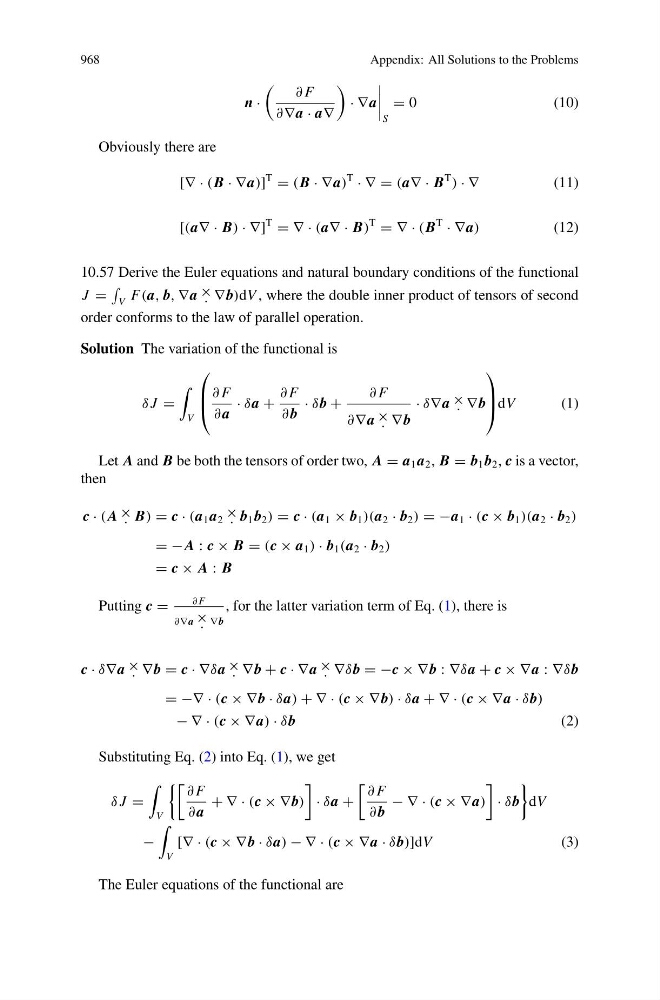
10.57 Derive the Euler equations and natural boundary conditions of the functional
J =
V F(a, b, ∇ a ×
· ∇ b)dV , where the double inner product of tensors of second
order conforms to the law of parallel operation.
Solution The variation of the functional is
δ J =
V
⎛
⎜
⎝
∂ F
∂ a
· δa +
∂ F
∂ b
· δb +
∂ F
∂∇ a ×
· ∇ b
· δ∇ a ×
· ∇ b
⎞
⎟
⎠dV
(1)
Let A and B be both the tensors of order two, A = a 1 a 2 , B = b 1 b 2 , c is a vector,
then
c · ( A ×
· B) = c · (a 1 a 2 ×
· b 1 b 2 ) = c · (a 1 × b 1 )(a 2 · b 2 ) = −a 1 · (c × b 1 )(a 2 · b 2 )
= −A : c × B = (c × a 1 ) · b 1 (a 2 · b 2 )
= c × A : B
Putting c =
∂ F
∂∇ a ×
·
∇ b
, for the latter variation term of Eq. (1), there is
c · δ∇ a ×
· ∇ b = c · ∇δa ×
· ∇ b + c · ∇a ×
· ∇δb = −c × ∇b : ∇δa + c × ∇a : ∇δb
= −∇ · (c × ∇b · δa) + ∇ · (c × ∇b) · δa + ∇ · (c × ∇a · δb)
− ∇ · (c × ∇a) · δb
(2)
Substituting Eq. (2) into Eq. (1), we get
δ J =
V
∂ F
∂ a
+ ∇ · (c × ∇b)
· δa +
∂ F
∂ b
− ∇ · (c × ∇a)
· δb
dV
−
V
[∇ · (c × ∇b · δa) − ∇ · (c × ∇a · δb)]dV
(3)
The Euler equations of the functional are