

Appendix: All Solutions to the Problems
965
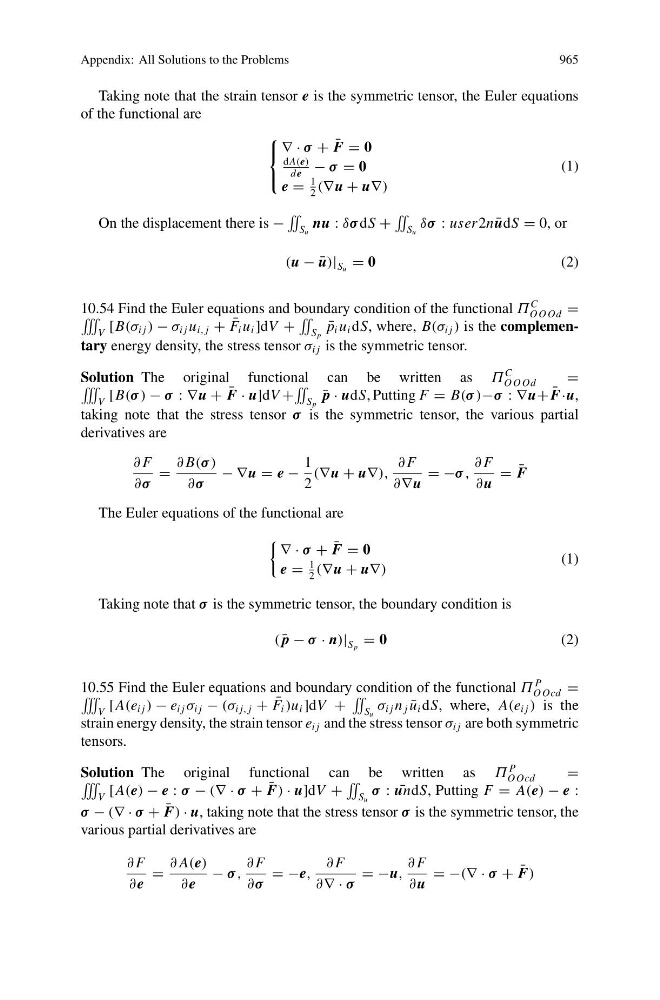
Taking note that the strain tensor e is the symmetric tensor, the Euler equations
of the functional are
⎧
⎨
⎩
∇ · σ + ¯
F = 0
dA(e)
d e
− σ = 0
e =
1
2
(∇u + u∇)
(1)
On the displacement there is −
˜
S u
nu : δσ dS +
˜
S u
δσ : user2n ¯
udS = 0, or
(u − ¯
u)| S u = 0
(2)
10.54 Find the Euler equations and boundary condition of the functional Π
C
O O Od =
˝
V [B(σ i j ) − σ i j u i, j + ¯
F i u i ]dV +
˜
S p
¯
p i u i dS, where, B(σ i j ) is the complementary energy density, the stress tensor σ i j is the symmetric tensor.
Solution The original functional can be written as Π
C
O O Od
=
˝
V [B(σ ) − σ : ∇u + ¯
F · u]dV +
˜
S p
¯
p · udS, Putting F = B(σ )−σ : ∇u+ ¯
F·u,
taking note that the stress tensor σ is the symmetric tensor, the various partial
derivatives are
∂ F
∂σ
=
∂ B(σ )
∂σ
− ∇u = e −
1
2
(∇u + u∇),
∂ F
∂∇u
= −σ ,
∂ F
∂ u
= ¯
F
The Euler equations of the functional are
∇ · σ + ¯
F = 0
e =
1
2
(∇u + u∇)
(1)
Taking note that σ is the symmetric tensor, the boundary condition is
( ¯
p − σ · n)| S p = 0
(2)
10.55 Find the Euler equations and boundary condition of the functional Π
P
O Ocd =
˝
V [A(e i j ) − e i j σ i j − (σ i j, j + ¯
F i )u i ]dV +
˜
S u
σ i j n j ¯
u i dS, where, A(e i j ) is the
strain energy density, the strain tensor e i j and the stress tensor σ i j are both symmetric
tensors.
Solution The original functional can be written as Π
P
O Ocd
=
˝
V [A(e) − e : σ − (∇ · σ + ¯
F) · u]dV +
˜
S u
σ : ¯
undS, Putting F = A(e) − e :
σ − (∇ · σ + ¯
F) · u, taking note that the stress tensor σ is the symmetric tensor, the
various partial derivatives are
∂ F
∂ e
=
∂ A(e)
∂ e
− σ ,
∂ F
∂σ
= −e,
∂ F
∂∇ · σ
= −u,
∂ F
∂ u
= −(∇ · σ + ¯
F)