

964
Appendix: All Solutions to the Problems
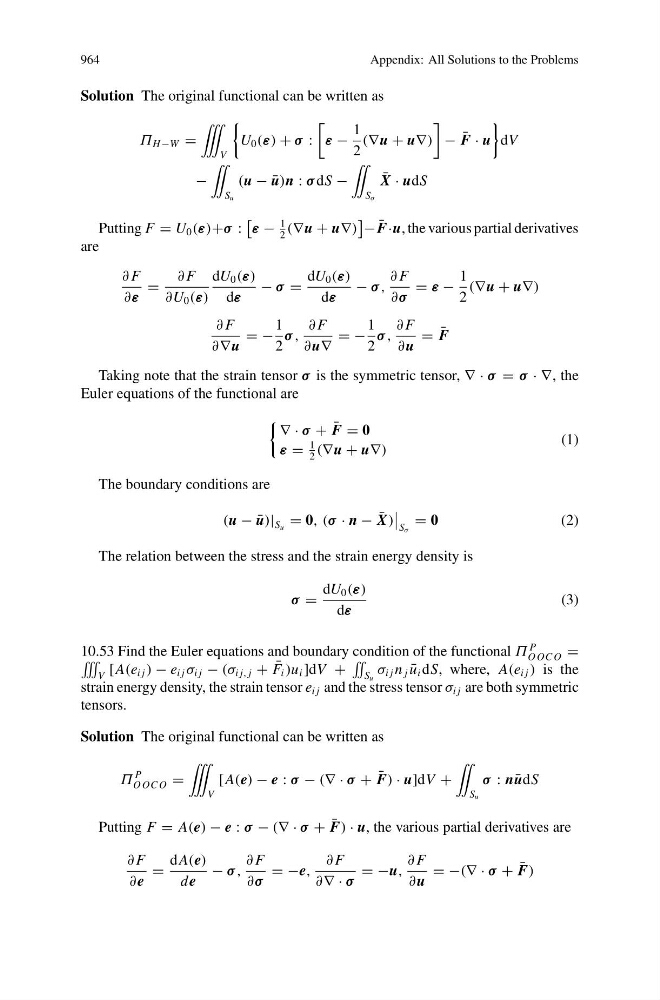
Solution The original functional can be written as
Π H −W =
˚
V
U 0 (ε) + σ :
ε −
1
2
(∇u + u∇)
− ¯
F · u
dV
−
¨
S u
(u − ¯
u)n : σ dS −
¨
S σ
¯
X · udS
Putting F = U 0 (ε)+σ :
ε −
1
2
(∇u + u∇)
− ¯
F·u, the various partial derivatives
are
∂ F
∂ε
=
∂ F
∂U 0 (ε)
dU 0 (ε)
dε
− σ =
dU 0 (ε)
dε
− σ ,
∂ F
∂σ
= ε −
1
2
(∇u + u∇)
∂ F
∂∇u
= −
1
2
σ ,
∂ F
∂ u∇
= −
1
2
σ ,
∂ F
∂ u
= ¯
F
Taking note that the strain tensor σ is the symmetric tensor, ∇ · σ = σ · ∇, the
Euler equations of the functional are
∇ · σ + ¯
F = 0
ε =
1
2
(∇u + u∇)
(1)
The boundary conditions are
(u − ¯
u)| S u = 0, (σ · n − ¯
X)
S σ
= 0
(2)
The relation between the stress and the strain energy density is
σ =
dU 0 (ε)
dε
(3)
10.53 Find the Euler equations and boundary condition of the functional Π
P
O OC O =
˝
V [A(e i j ) − e i j σ i j − (σ i j, j + ¯
F i )u i ]dV +
˜
S u
σ i j n j ¯
u i dS, where, A(e i j ) is the
strain energy density, the strain tensor e i j and the stress tensor σ i j are both symmetric
tensors.
Solution The original functional can be written as
Π
P
O OC O =
˚
V
[A(e) − e : σ − (∇ · σ + ¯
F) · u]dV +
¨
S u
σ : n ¯
udS
Putting F = A(e) − e : σ − (∇ · σ + ¯
F) · u, the various partial derivatives are
∂ F
∂ e
=
dA(e)
d e
− σ ,
∂ F
∂σ
= −e,
∂ F
∂∇ · σ
= −u,
∂ F
∂ u
= −(∇ · σ + ¯
F)