

Appendix: All Solutions to the Problems
957
J =
t1
t0
˚
V
LdV dt =
t1
t0
˚
V
1
8π
1
c
∂ A
∂t
+ ∇ϕ
2
−
1
8π
(∇ × A)
2 +
A · j
c
− ρϕ
dV dt
(1)
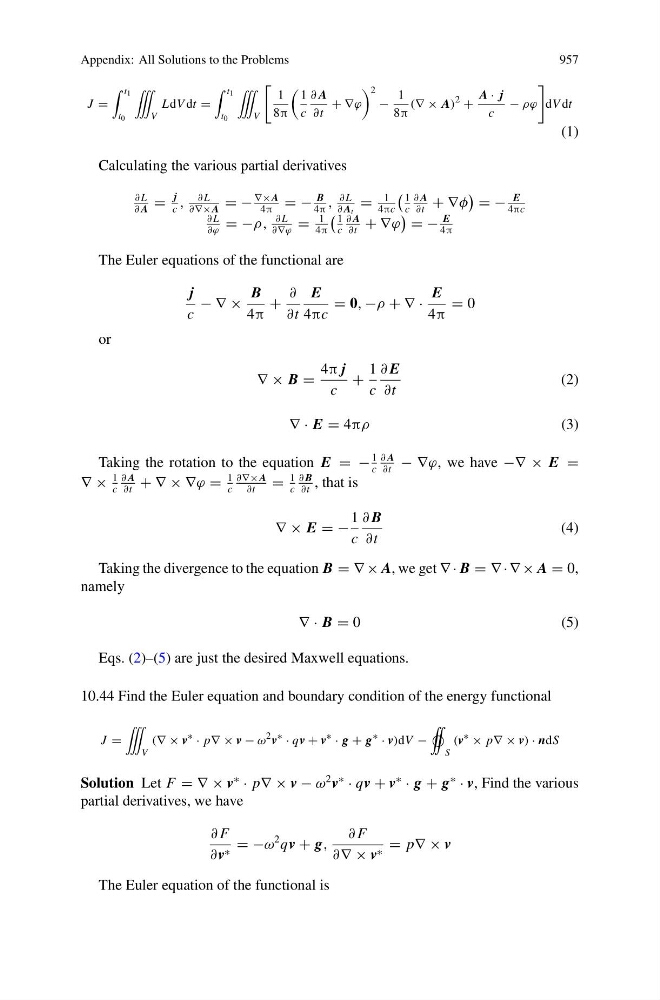
Calculating the various partial derivatives
∂ L
∂ A
=
j
c
,
∂ L
∂∇× A
= −
∇× A
4π
= −
B
4π
,
∂ L
∂ A t
=
1
4πc
1
c
∂ A
∂t
+ ∇φ
= −
E
4πc
∂ L
∂ϕ
= −ρ,
∂ L
∂∇ϕ
=
1
4π
1
c
∂ A
∂t
+ ∇ϕ
= −
E
4π
The Euler equations of the functional are
j
c
− ∇ ×
B
4π
+
∂
∂t
E
4πc
= 0, −ρ + ∇ ·
E
4π
= 0
or
∇ × B =
4π j
c
+
1
c
∂ E
∂t
(2)
∇ · E = 4πρ
(3)
Taking the rotation to the equation E = −
1
c
∂ A
∂t
− ∇ϕ, we have −∇ × E =
∇ ×
1
c
∂ A
∂t
+ ∇ × ∇ϕ =
1
c
∂∇× A
∂t
=
1
c
∂ B
∂t
, that is
∇ × E = −
1
c
∂ B
∂t
(4)
Taking the divergence to the equation B = ∇ × A, we get ∇ · B = ∇ ·∇ × A = 0,
namely
∇ · B = 0
( 5 )
Eqs. (2)–(5) are just the desired Maxwell equations.
10.44 Find the Euler equation and boundary condition of the energy functional
J =
˚
V
(∇ × v
∗ · p∇ × v − ω
2 v
∗ · qv + v
∗ · g + g
∗ · v)dV −
S
(v
∗ × p∇ × v) · ndS
Solution Let F = ∇ × v
∗
· p∇ × v − ω
2 v
∗
· qv + v
∗
· g + g
∗
· v, Find the various
partial derivatives, we have
∂ F
∂v ∗ = −ω
2 qv + g,
∂ F
∂∇ × v ∗ = p∇ × v
The Euler equation of the functional is