

Appendix: All Solutions to the Problems
935
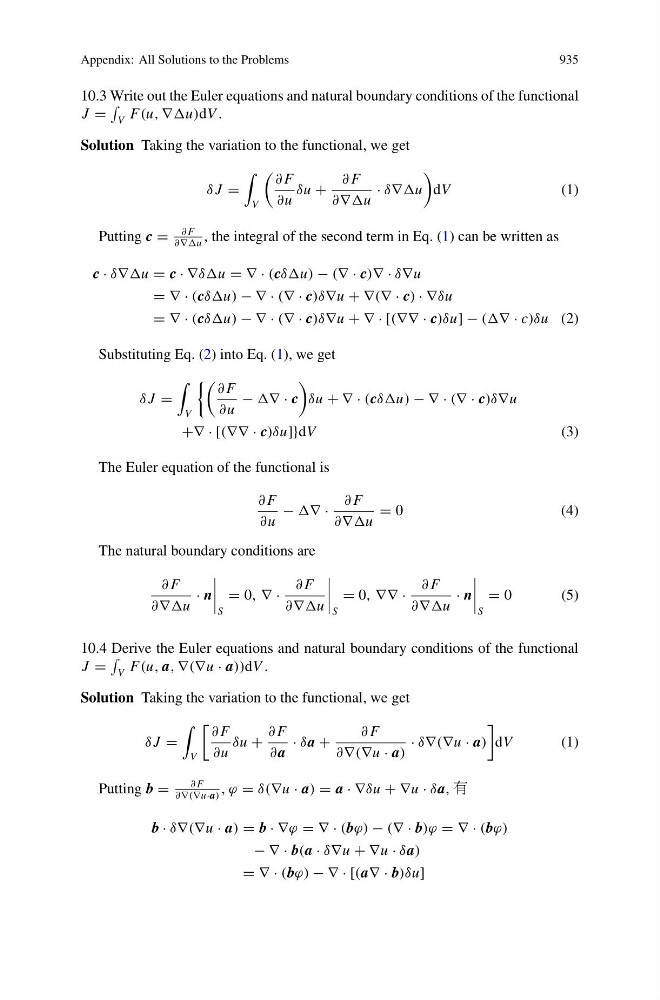
10.3 Write out the Euler equations and natural boundary conditions of the functional
J =
V F(u, ∇u)dV .
Solution Taking the variation to the functional, we get
δ J =
V
∂ F
∂u
δu +
∂ F
∂∇u
· δ∇u
dV
(1)
Putting c =
∂ F
∂∇u
, the integral of the second term in Eq. (1) can be written as
c · δ∇u = c · ∇δδu = ∇ · (cδδu) − (∇ · c)∇ · δ∇u
= ∇ · (cδδu) − ∇ · (∇ · c)δ∇u + ∇(∇ · c) · ∇δu
= ∇ · (cδδu) − ∇ · (∇ · c)δ∇u + ∇ · [(∇∇ · c)δu] − ((∇ · c)δu (2)
Substituting Eq. (2) into Eq. (1), we get
δ J =
V
∂ F
∂u
− ∇ · c
δu + ∇ · (cδδu) − ∇ · (∇ · c)δ∇u
+∇ · [(∇∇ · c)δu]}dV
(3)
The Euler equation of the functional is
∂ F
∂u
− ∇ ·
∂ F
∂∇u
= 0
( 4 )
The natural boundary conditions are
∂ F
∂∇u
· n
S
= 0, ∇ ·
∂ F
∂∇u
S
= 0, ∇∇ ·
∂ F
∂∇u
· n
S
= 0
( 5 )
10.4 Derive the Euler equations and natural boundary conditions of the functional
J =
V F(u, a, ∇(∇u · a))dV .
Solution Taking the variation to the functional, we get
δ J =
V
∂ F
∂u
δu +
∂ F
∂ a
· δa +
∂ F
∂∇(∇u · a)
· δ∇(∇u · a)
dV
(1)
Putting b =
∂ F
∂∇(∇u·a)
, ϕ = δ(∇u · a) = a · ∇δu + ∇u · δa, 有
b · δ∇(∇u · a) = b · ∇ϕ = ∇ · (bϕ) − (∇ · b)ϕ = ∇ · (bϕ)
− ∇ · b(a · δ∇u + ∇u · δa)
= ∇ · (bϕ) − ∇ · [(a∇ · b)δu]