

Appendix: All Solutions to the Problems
901
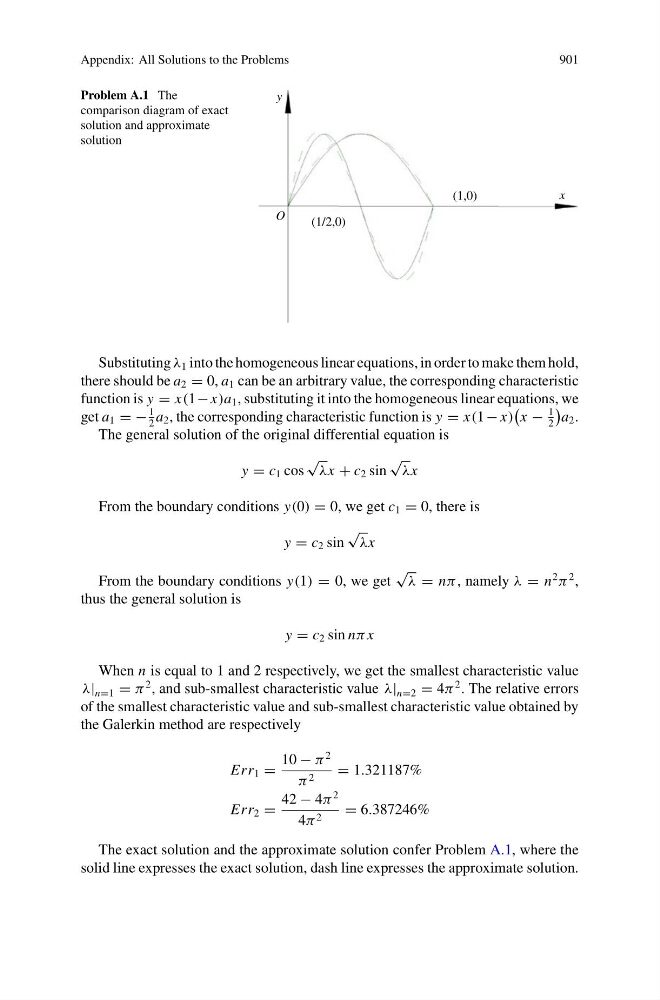
Problem A.1 The
comparison diagram of exact
solution and approximate
solution
O
x
y
(1/2,0)
(1,0)
Substituting λ 1 into the homogeneous linear equations, in order to make them hold,
there should be a 2 = 0, a 1 can be an arbitrary value, the corresponding characteristic
function is y = x(1− x)a 1 , substituting it into the homogeneous linear equations, we
get a 1 = −
1
2
a 2 , the corresponding characteristic function is y = x(1 − x)
x −
1
2
a 2 .
The general solution of the original differential equation is
y = c 1 cos
√ λx + c 2 sin
√
λx
From the boundary conditions y(0) = 0, we get c 1 = 0, there is
y = c 2 sin
√
λx
From the boundary conditions y(1) = 0, we get
√ λ = nπ , namely λ = n
2
π
2 ,
thus the general solution is
y = c 2 sin nπ x
When n is equal to 1 and 2 respectively, we get the smallest characteristic value
λ| n=1 = π
2 , and sub-smallest characteristic value λ| n=2 = 4π
2 . The relative errors
of the smallest characteristic value and sub-smallest characteristic value obtained by
the Galerkin method are respectively
Err 1 =
10 − π
2
π 2
= 1.321187%
Err 2 =
42 − 4π
2
4π 2
= 6.387246%
The exact solution and the approximate solution confer Problem A.1, where the
solid line expresses the exact solution, dash line expresses the approximate solution.