

Appendix: All Solutions to the Problems
879
J [u(x, y)] =
¨
D
(u
2
x + u
2
y − 2u)dxdy
Its approximate solution is searched in the form of u 1 = c 1 (x
2
− a
2
)(y
2
− b
2
).
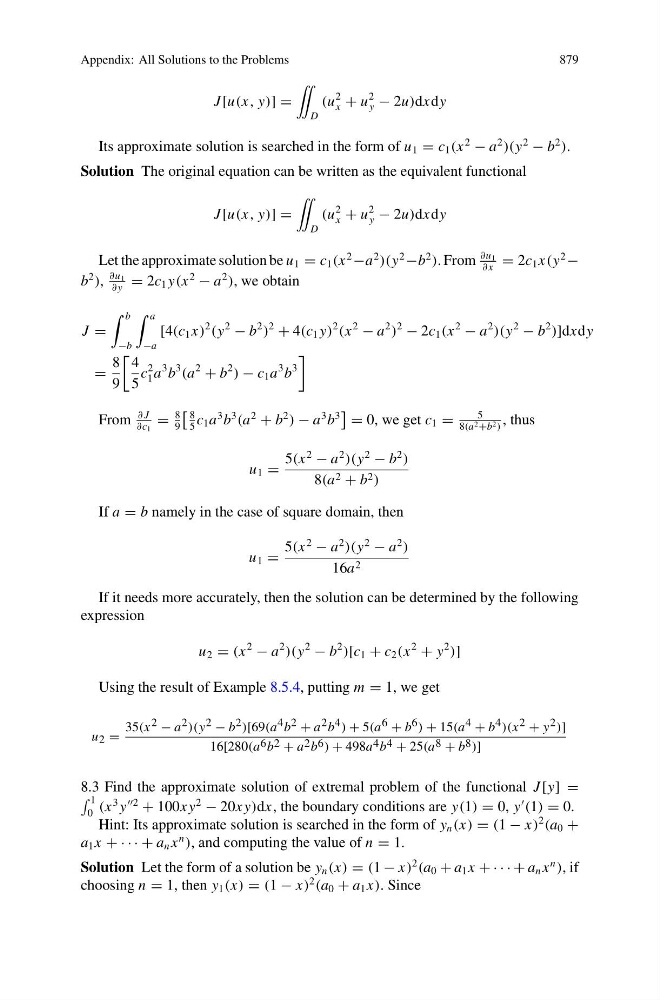
Solution The original equation can be written as the equivalent functional
J [u(x, y)] =
¨
D
(u
2
x + u
2
y − 2u)dxdy
Let the approximate solution be u 1 = c 1 (x
2
−a
2
)(y
2
−b
2
). From
∂u 1
∂ x
= 2c 1 x(y
2
−
b
2
),
∂u 1
∂ y
= 2c 1 y(x
2
− a
2
), we obtain
J =
b
−b
a
−a
[4(c 1 x)
2
(y
2
− b
2
)
2
+ 4(c 1 y)
2
(x
2
− a
2
)
2
− 2c 1 (x
2
− a
2
)(y
2
− b
2
)]dxdy
=
8
9
4
5
c
2
1 a
3 b
3
(a
2
+ b
2
) − c 1 a
3 b
3
From
∂ J
∂c 1
=
8
9
8
5
c 1 a
3 b
3
(a
2
+ b
2
) − a
3 b
3
= 0, we get c 1 =
5
8(a 2 +b 2 )
, thus
u 1 =
5(x
2
− a
2
)(y
2
− b
2
)
8(a 2 + b 2 )
If a = b namely in the case of square domain, then
u 1 =
5(x
2
− a
2
)(y
2
− a
2
)
16a 2
If it needs more accurately, then the solution can be determined by the following
expression
u 2 = (x
2
− a
2
)(y
2
− b
2
)[c 1 + c 2 (x
2
+ y
2
)]
Using the result of Example 8.5.4, putting m = 1, we get
u 2 =
35(x 2 − a 2 )(y 2 − b 2 )[69(a 4 b 2 + a 2 b 4 ) + 5(a 6 + b 6 ) + 15(a 4 + b 4 )(x 2 + y 2 )]
16[280(a 6 b 2 + a 2 b 6 ) + 498a 4 b 4 + 25(a 8 + b 8 )]
8.3 Find the approximate solution of extremal problem of the functional J [y] =
1
0 (x
3 y
2
+ 100x y
2
− 20x y)dx, the boundary conditions are y(1) = 0, y
(1) = 0.
Hint: Its approximate solution is searched in the form of y n (x) = (1 − x)
2
(a 0 +
a 1 x + · · · + a n x
n
), and computing the value of n = 1.
Solution Let the form of a solution be y n (x) = (1 − x)
2
(a 0 + a 1 x + · · · + a n x
n
), if
choosing n = 1, then y 1 (x) = (1 − x)
2
(a 0 + a 1 x). Since