

860
Appendix: All Solutions to the Problems
This function does not satisfy the condition of positively homogeneous function
of order one, thus the value of the functional has to do with the parameter form.
(3) For an arbitrary positive number k, there is
F(x, y, k ˙
x, k ˙
y) = x
2
(k ˙
x) + 3x y(k ˙
y)
2
= k(x
2
˙
x + 3kx y ˙
y
2
) = k F(x, y, ˙
x, ˙
y)
This function does not satisfy the condition of positively homogeneous function
of order one, thus the value of the functional has to do with the parameter form.
(4) For an arbitrary positive number k, there is
F(x, y, k ˙
x, k ˙
y) = x(k ˙
y) + y(k ˙
x)
2
= k(x ˙
y + yk ˙
x
2
) = k F(x, y, ˙
x, ˙
y)
This function does not satisfy the condition of positively homogeneous function
of order one, thus the value of the functional has to do with the parameter form.
(5) For an arbitrary positive number k, there is
F(x, y, k ˙
x, k ˙
y) = [x(k ˙
y) + y(k ˙
x)]
2
= k
2
(x ˙
y + y ˙
x)
2
= k
2 F(x, y, ˙
x, ˙
y)
This function is a positively homogeneous function of order two, it does not
satisfy the condition of positively homogeneous function of order one, thus the
value of the functional has to do with the parameter form.
(6) For an arbitrary positive number k, there is
F(x, y, k ˙
x, k ˙
y) =
x(k ˙
y 2 ) + y(k ˙
x 2 ) = k
x ˙
y 2 + y ˙
x 2 = k F(x, y, ˙
x, ˙
y)
This function satisfies the condition of positively homogeneous function of order
one, so the value of the functional has nothing to do with the parameter form.
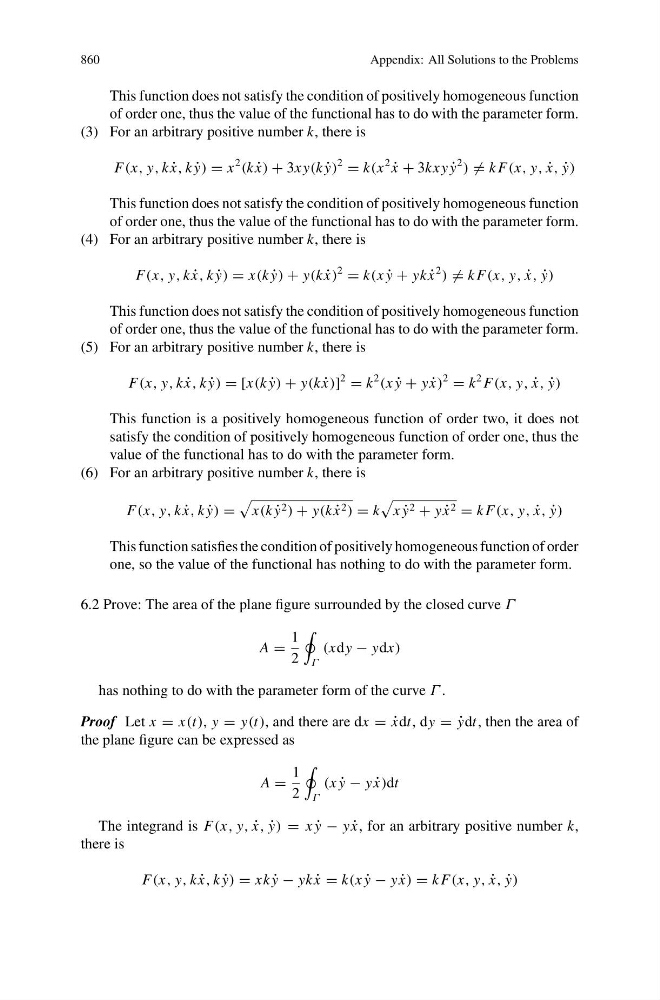
6.2 Prove: The area of the plane figure surrounded by the closed curve Γ
A =
1
2
Γ
(xdy − ydx)
has nothing to do with the parameter form of the curve Γ .
Proof Let x = x(t), y = y(t), and there are dx = ˙
xdt, dy = ˙
ydt, then the area of
the plane figure can be expressed as
A =
1
2
Γ
(x ˙
y − y ˙
x)dt
The integrand is F(x, y, ˙
x, ˙
y) = x ˙
y − y ˙
x, for an arbitrary positive number k,
there is
F(x, y, k ˙
x, k ˙
y) = xk ˙
y − yk ˙
x = k(x ˙
y − y ˙
x) = k F(x, y, ˙
x, ˙
y)