

70
1 Preliminaries
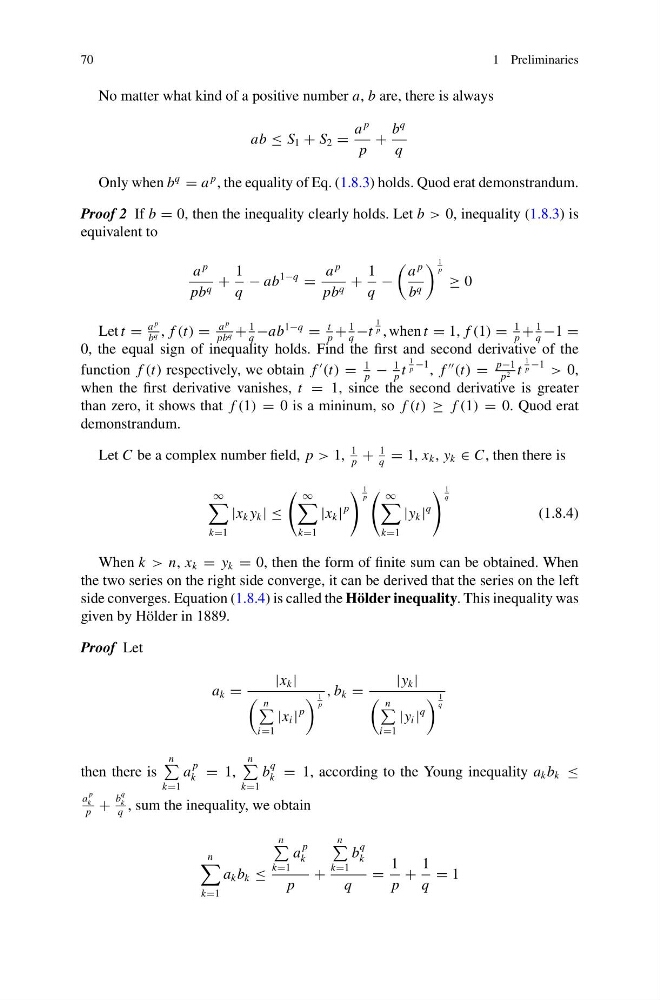
No matter what kind of a positive number a, b are, there is always
ab ≤ S 1 + S 2 =
a
p
p
+
b
q
q
Only when b
q
= a
p , the equality of Eq. (1.8.3) holds. Quod erat demonstrandum.
Proof 2 If b = 0, then the inequality clearly holds. Let b > 0, inequality (1.8.3) is
equivalent to
a
p
pb q +
1
q
− ab
1−q
=
a
p
pb q +
1
q
−
a
p
b q
1
p ≥ 0
Let t =
a
p
b q , f (t) =
a
p
pb q +
1
q
−ab
1−q
=
t
p
+
1
q
−t
1
p , when t = 1, f (1) =
1
p
+
1
q
−1 =
0, the equal sign of inequality holds. Find the first and second derivative of the
function f (t) respectively, we obtain f
(t) =
1
p
−
1
p
t
1
p −1 , f
(t) =
p−1
p 2 t
1
p −1 > 0,
when the first derivative vanishes, t = 1, since the second derivative is greater
than zero, it shows that f (1) = 0 is a mininum, so f (t) ≥ f (1) = 0. Quod erat
demonstrandum.
Let C be a complex number field, p > 1,
1
p
+
1
q
= 1, x k , y k ∈ C, then there is
∞
k=1
|x k y k | ≤
∞
k=1
|x k |
p
1
p
∞
k=1
|y k |
q
1
q
(1.8.4)
When k > n, x k = y k = 0, then the form of finite sum can be obtained. When
the two series on the right side converge, it can be derived that the series on the left
side converges. Equation (1.8.4) is called the Hölder inequality. This inequality was
given by Hölder in 1889.
Proof Let
a k =
|x k |
n
i=1
|x i |
p
1
p
, b k =
|y k |
n
i=1
|y i |
q
1
q
then there is
n
k=1
a
p
k = 1,
n
k=1
b
q
k = 1, according to the Young inequality a k b k ≤
a
p
k
p
+
b
q
k
q
, sum the inequality, we obtain
n
k=1
a k b k ≤
n
k=1
a
p
k
p
+
n
k=1
b
q
k
q
=
1
p
+
1
q
= 1
1 Preliminaries
No matter what kind of a positive number a, b are, there is always
ab ≤ S 1 + S 2 =
a
p
p
+
b
q
q
Only when b
q
= a
p , the equality of Eq. (1.8.3) holds. Quod erat demonstrandum.
Proof 2 If b = 0, then the inequality clearly holds. Let b > 0, inequality (1.8.3) is
equivalent to
a
p
pb q +
1
q
− ab
1−q
=
a
p
pb q +
1
q
−
a
p
b q
1
p ≥ 0
Let t =
a
p
b q , f (t) =
a
p
pb q +
1
q
−ab
1−q
=
t
p
+
1
q
−t
1
p , when t = 1, f (1) =
1
p
+
1
q
−1 =
0, the equal sign of inequality holds. Find the first and second derivative of the
function f (t) respectively, we obtain f
(t) =
1
p
−
1
p
t
1
p −1 , f
(t) =
p−1
p 2 t
1
p −1 > 0,
when the first derivative vanishes, t = 1, since the second derivative is greater
than zero, it shows that f (1) = 0 is a mininum, so f (t) ≥ f (1) = 0. Quod erat
demonstrandum.
Let C be a complex number field, p > 1,
1
p
+
1
q
= 1, x k , y k ∈ C, then there is
∞
k=1
|x k y k | ≤
∞
k=1
|x k |
p
1
p
∞
k=1
|y k |
q
1
q
(1.8.4)
When k > n, x k = y k = 0, then the form of finite sum can be obtained. When
the two series on the right side converge, it can be derived that the series on the left
side converges. Equation (1.8.4) is called the Hölder inequality. This inequality was
given by Hölder in 1889.
Proof Let
a k =
|x k |
n
i=1
|x i |
p
1
p
, b k =
|y k |
n
i=1
|y i |
q
1
q
then there is
n
k=1
a
p
k = 1,
n
k=1
b
q
k = 1, according to the Young inequality a k b k ≤
a
p
k
p
+
b
q
k
q
, sum the inequality, we obtain
n
k=1
a k b k ≤
n
k=1
a
p
k
p
+
n
k=1
b
q
k
q
=
1
p
+
1
q
= 1